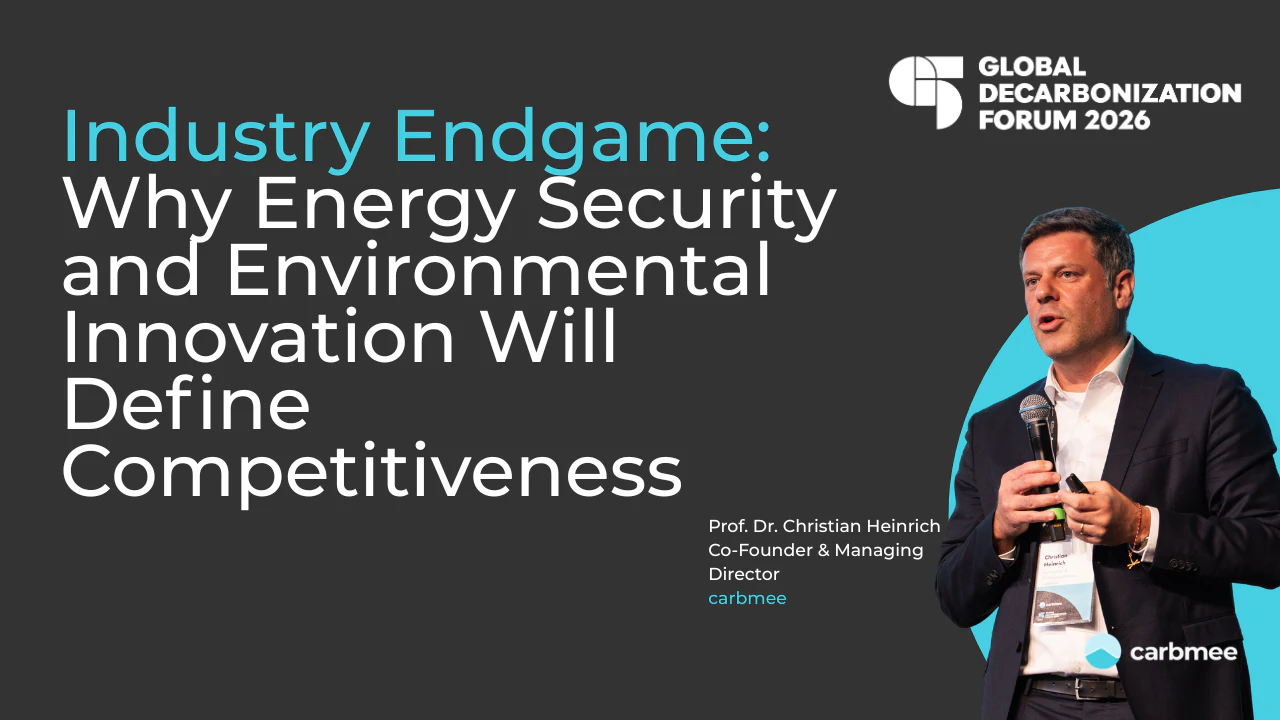
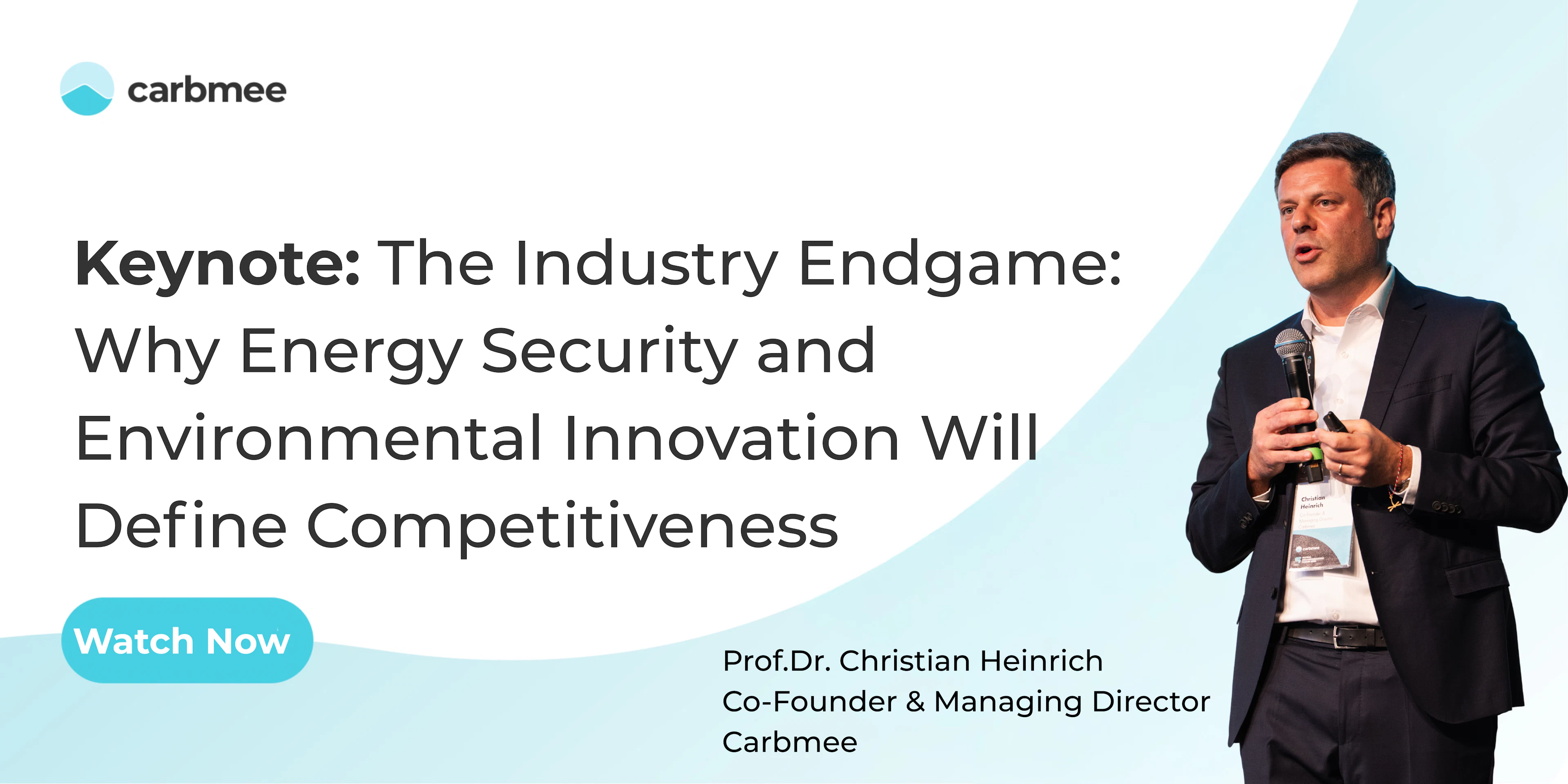
The Industry Endgame: Why Energy Security and Environmental Innovation Will Define Competitiveness
At the Global Decarbonization Forum 2026 in Berlin, Prof. Dr. Christian Heinrich, Co-Founder and Managing Director at carbmee, opened the day with a provocative keynote on what he calls the “industry endgame.” His central message challenged the way many organizations still approach sustainability: decarbonization is no longer an ESG side topic, it is a core business issue, deeply tied to energy costs, supply chains, and long-term competitiveness.
In his keynote, Christian connected global geopolitical developments with everyday business decisions, arguing that companies must shift from reactive compliance to proactive, data-driven action. He emphasized the importance of confronting reality, aligning incentives across organizations, and translating sustainability into clear P&L impact. Setting the tone for the day, his keynote made one thing clear: the real question is no longer if companies will transform, but how fast they are willing to act.

The Personal Endgame: Accountability Starts With You
Christian opened the forum with a question. One that had nothing to do with carbon regulations or supply chains. He asked the room to reflect honestly on their own habits − the cake, the glass of wine, the choices we all make and quietly justify. The point was not judgment. The point was that the hardest thing in any transformation is honesty. With yourself first, and then with the people around you.
The analogy extended directly into the business context. The same leader who quietly acknowledges that their company's decarbonization program is years behind where it should be, who waits for the state to set the rules before acting, who relies on someone else to take ownership, that leader is running the same logic as someone who ignores the consequences of their own choices until they become unavoidable.
The seat belt was his sharpest example. Without the rule, almost nobody changed their behavior. Once the rule arrived, the outcome improved by roughly 70 percent. CBAM, ETS, and the broader wave of carbon regulation are that rule for industry. The companies waiting to be forced will eventually comply. The ones that move before the mandate will have already captured the advantage.
The CEO Reality: Geopolitical Noise Is Distracting You From the End Goal
One of the most clarifying moments of the keynote came when Christian addressed the tendency to treat every short-term disruption − an oil price spike, a conflict in the Middle East, an election result − as a reason to pause long-term strategic thinking.
His framing was precise. These are distractions. Important ones, sometimes. But distractions nonetheless from a transformation that is larger, slower-moving, and far more consequential than any single news cycle. He pointed to the contrast between companies and political leaders locked into two or three year horizons and the family-owned businesses and long-planning economies that quietly double down while everyone else reacts.
The implication for sustainability leaders in the room was clear. Your job is not to wait for the C-suite to discover urgency on their own. Your job is to create it, to connect the dots between energy costs, carbon exposure, supplier risk, and revenue at risk in a language that P&L owners actually respond to.
Why This Transformation Is Bigger Than Digitization and Why That Matters
Christian drew an explicit comparison to the digitization wave of the last two decades, one that people in the room had lived through firsthand. In the early years of digital transformation, companies could claim to be digital without being penalized for the gap between the claim and the reality. Incubators, accelerators, and innovation labs substituted for genuine change. No one checked.
The decarbonization transformation is different, and the difference is structural. ETS systems. CBAM. Carbon taxes. These are not aspirational targets. They are hard financial penalties with percentages attached. The transformation carries a fiscal consequence that digitization never did, which means the impact on business valuation, cost base, and competitive position is, in Christian's words, double or triple the magnitude of the digital shift. That is not an argument for panic. It is an argument for urgency and for recognizing that the opportunity on the other side is proportionally large.
The Procurement Opportunity Nobody Is Talking About
Christian walked the audience through what he called the most obvious opportunity in the room, one that procurement leaders are consistently underselling to their own organizations. The logic is straightforward. A company with thousands of suppliers producing identical or comparable products is sitting on a significant energy cost differential across that supply base. Suppliers using renewable energy for production have lower and increasingly more stable energy costs. Motivating them to make that shift, and structuring a shared savings model, much like the lean procurement partnerships of the Volkswagen era, generates measurable cost reductions that can be split between buyer and supplier.
The barrier is not commercial. It is organizational. Procurement teams are still primarily incentivized on cost reduction alone. Without internal carbon pricing and without the right data tools, there is no mechanism for a category buyer to factor carbon into a sourcing decision, let alone to achieve green premium pricing. Equip the same team with automated product carbon footprint data and scenario planning capability, and a 10 to 20 percent carbon premium becomes a realistic outcome. Without it, it is not possible.
Transparency First. Everything Else Follows
Christian returned to a principle he attributed to Peter Drucker: you can only improve what you measure. Applied to scope 3, the implication is severe. Spend-based carbon methodologies carry an inaccuracy of around 30 percent. For a company with more than 80 percent of its emissions sitting in scope 3, that level of imprecision makes meaningful reduction essentially impossible to plan, let alone to prove.
The path forward is activity-based emissions transparency. Not because it is the idealistic choice, but because it is the only foundation on which procurement, sales, LCA teams, and finance can operate from the same dataset. Once that foundation exists, the outside-in analysis becomes possible, mapping revenue exposure, identifying which customer relationships and product lines carry the highest carbon risk, and presenting a CEO with a number they cannot ignore: 28 percent of revenue at risk by 2030 is a different conversation than a regulatory briefing on CBAM.
Christian did not close with a product slide or a technical deep dive. Instead, he brought the keynote back to where it started: responsibility and action. After connecting global shifts, business risks, and organizational barriers, he left the audience with a question meant to carry beyond the keynote, into every conversation, decision, and next step: are you ready to act? Or are you still waiting to react?
carbmee EIS™: The Infrastructure for the Industry Endgame
The capabilities Christian described sit at the core of carbmee EIS™, carbmee's environmental intelligence platform built for large industrial companies. From activity-based emissions transparency to supplier carbon footprint management and P&L-linked carbon risk analysis, carbmee EIS™ gives organizations the data foundation to move from PowerPoint to action, without waiting another five years.
Whether your priority is scope 3 accuracy, CBAM cost exposure, or building the business case that finally gets your CEO's attention, carbmee EIS™ provides the infrastructure to make it happen.