Carbon Cost Forecasting: Why Most Companies See the Problem Too Late
Most companies think their carbon challenge is reporting.
It’s not.
It’s timing.
By the time carbon cost shows up in reports, compliance systems, or financial statements, the decisions that created it are already locked in. Suppliers have been selected. Materials have been sourced. Products have been designed.
At that point, carbon cost is no longer something you can manage. It is something you have to absorb.
This is where most organizations are today.

Carbon Cost Is Not New. Visibility Is.
Carbon pricing is often framed as a new external pressure. CBAM, ETS, and expanding global regulation are seen as introducing new costs into the system.
That’s not entirely accurate.
The cost has always been there embedded in high-emission materials, energy-intensive production, and complex supply chains.
What is changing is visibility.
Regulation is making that cost measurable, traceable, and increasingly financial. What used to be hidden is now becoming explicit. And what becomes explicit eventually becomes material to the business.
The challenge is that most companies only see this cost when it is already too late to act.
In many organizations, carbon-related exposure still sits outside the core business logic. It is reviewed by sustainability teams, referenced in annual reporting cycles, or treated as an emerging compliance issue. But that framing misses the real issue. Carbon cost is not only a disclosure topic. It is becoming a direct operating cost, a sourcing variable, and in many sectors, a margin issue.
That is why timing matters more than awareness. Many companies already know carbon pricing is relevant. Far fewer can see where the cost is building inside their product portfolio, supplier base, or procurement decisions.
What Carbon Pricing Actually Means
To understand why carbon cost forecasting matters, it helps to clarify what carbon pricing actually is.
At a simple level, carbon pricing places a financial value on greenhouse gas emissions. The idea is straightforward: emissions create real economic and societal costs, even if those costs have historically not appeared on a company’s balance sheet. Carbon pricing starts to bring those costs back to the source.
In practice, this creates a price signal. The more carbon-intensive a material, process, supplier, or product is, the greater the financial exposure can become over time.
That is why carbon pricing matters far beyond sustainability reporting. It changes how companies need to think about sourcing, manufacturing, product strategy, and financial planning.
It also changes incentives. Once emissions are linked to cost, businesses have a stronger reason to reduce them. Lower emissions are no longer only an environmental target. In many cases, they become a financial advantage.
Why Carbon Pricing Is Gaining Importance
Carbon pricing is gaining momentum because governments and regulators increasingly see it as one of the most practical ways to drive emissions reduction. Rather than prescribing every technical change a company must make, carbon pricing creates an economic signal and allows businesses to respond in the way that fits their operations best.
That flexibility is one of the reasons it has become so important.
For companies, this means two things.
First, carbon cost exposure is becoming harder to ignore.
Second, the companies that can model and act on that exposure earlier will be in a much stronger position than those that only respond when the costs are already visible in reporting or compliance processes.
The Different Types of Carbon Pricing
Not all carbon pricing works in the same way. But all approaches have one thing in common: they turn emissions into a business variable.
Emissions Trading Systems (ETS)
An Emissions Trading System, often called cap-and-trade, sets an overall limit on emissions and requires covered companies to hold allowances for the emissions they generate.
In this system, the total amount of available allowances is limited. Companies that emit more need more allowances. Companies that reduce emissions may need fewer allowances or may benefit from more efficient operations. Because allowances can be traded, the carbon price can change over time based on supply and demand.
For companies, this means carbon cost is not static. It can rise, fall, and create financial uncertainty if it is not forecasted properly.
Carbon Taxes
A carbon tax applies a direct price to emissions or to the carbon content of fossil fuels. Unlike an ETS, where the market determines the price, a carbon tax creates more price certainty because the tax rate is set by policy.
From a business perspective, that changes the planning dynamic. The cost signal may be clearer, but the exposure is still real. If a company depends on carbon-intensive materials, transport, or production, that cost can flow through procurement and operations very quickly.
CBAM and Cross-Border Carbon Exposure
The Carbon Border Adjustment Mechanism adds another layer. It is designed to address emissions embedded in imported goods. That means companies are no longer only exposed to carbon cost in their own operations. They are increasingly exposed through the carbon profile of what they buy, where they buy it, and how those goods are produced.
This is one reason carbon cost forecasting is becoming strategically important for procurement and finance teams. Exposure is moving upstream into the supply base and across global trade flows.
Internal Carbon Pricing
Some organizations also use internal carbon pricing as a decision-making tool. This is not always a regulatory requirement. Instead, it is a way for businesses to apply a carbon cost internally when evaluating sourcing options, product design choices, capital allocation, or future risk.
Used well, internal carbon pricing helps organizations prepare for regulation before it fully hits the P&L. It allows them to test scenarios, compare alternatives, and make more resilient decisions earlier.
Where Carbon Cost Is Actually Decided
To understand the problem, you have to understand where carbon cost originates.
It is not created in reporting systems.
It is not created in sustainability dashboards.
It is created much earlier:
When procurement selects suppliers
When engineering specifies materials
When operations define production processes
These decisions determine the carbon intensity of a product long before any reporting takes place.
Yet most organizations lack visibility at exactly these points.
Instead, carbon data is typically:
- Disconnected from procurement systems
- Not linked to product structures (BOM)
- Aggregated too high to support decisions
- Available only after the fact
The result is a structural gap.
Decisions are made without carbon cost visibility. Costs are discovered after those decisions are irreversible.
This is what makes carbon cost so difficult to manage with traditional approaches. The real issue is not simply data availability. It is data timing and data relevance. If information only becomes visible after sourcing, design, or production decisions are made, then it cannot influence the outcome in a meaningful way.
Why Timing Changes Everything
This is what makes Carbon Cost Forecasting different from traditional carbon reporting.
Reporting tells you what has already happened. Forecasting helps you understand what decisions made today are likely to cost tomorrow.
That difference is fundamental.
A company that can see future carbon exposure at supplier, material, or product level can still act. It can revisit sourcing strategies, challenge specifications, compare suppliers, or prepare the business for regulatory and cost changes.
A company that sees carbon cost only at the end of the process can usually do none of those things. It can only explain what happened and account for the consequences.
The Real Risk: From Compliance to Margin Impact
This is why carbon is no longer just a sustainability topic.
It is a financial and operational variable.
For procurement teams, it affects:
- Supplier pricing and negotiation leverage
- Sourcing strategy across regions
- Exposure to high-carbon commodities
For finance teams, it affects:
- Cost forecasting accuracy
- Margin exposure across product lines
- Capital allocation and risk planning
For operations, it affects:
- Material selection
- Product design decisions
- Production footprint
Carbon cost is now directly linked to how competitive your products are. And yet, most companies are still managing it as a reporting exercise.
This is where the real risk starts to emerge. When carbon cost is treated only as a compliance question, organizations underestimate its commercial relevance. A carbon-intensive product may not only create reporting obligations. It may become more expensive to produce, harder to source competitively, or less attractive in markets where customers and regulators increasingly expect lower-emission alternatives.
In that sense, carbon cost is becoming part of industrial economics.
Why Current Approaches Break Down
The majority of organizations rely on a combination of spreadsheets, disconnected tools, and manual processes to manage carbon data.
This approach fails for three reasons.
1. Lack of Granularity
Most data is aggregated at company or site level, not at product or supplier level. This makes it impossible to identify where carbon cost actually sits.
If the goal is to understand future exposure, broad averages are not enough. Carbon cost does not affect every product equally. It does not affect every supplier equally. It sits in specific materials, components, production routes, and sourcing decisions.
2. Lack of Integration
Carbon data is not connected to procurement transactions or BOM structures. That means it cannot influence sourcing or design decisions.
This is a critical weakness. If carbon data lives outside the systems that teams use to make day-to-day decisions, it remains informational rather than operational.
3. Lack of Forward-Looking Insight
Even when emissions are calculated, they are rarely linked to carbon pricing scenarios. Teams cannot model future exposure under ETS or CBAM.
This creates a reactive organization.
One that reports accurately but decides too late.
In many cases, companies know their emissions totals but still cannot answer the questions that matter most to procurement or finance:
- Which suppliers create the highest future carbon cost exposure?
- Which product lines are most vulnerable?
- What happens if carbon prices rise further?
- Where can we reduce both emissions and cost at the same time?
Without that level of visibility, carbon remains something to disclose, not something to manage.
Carbon Cost Forecasting: A Different Approach
Carbon Cost Forecasting addresses this gap by shifting when and where carbon becomes visible.
Instead of looking backward, it enables teams to look forward.
Instead of working with aggregated data, it operates at transaction and product level.
Instead of reporting, it supports decision-making.
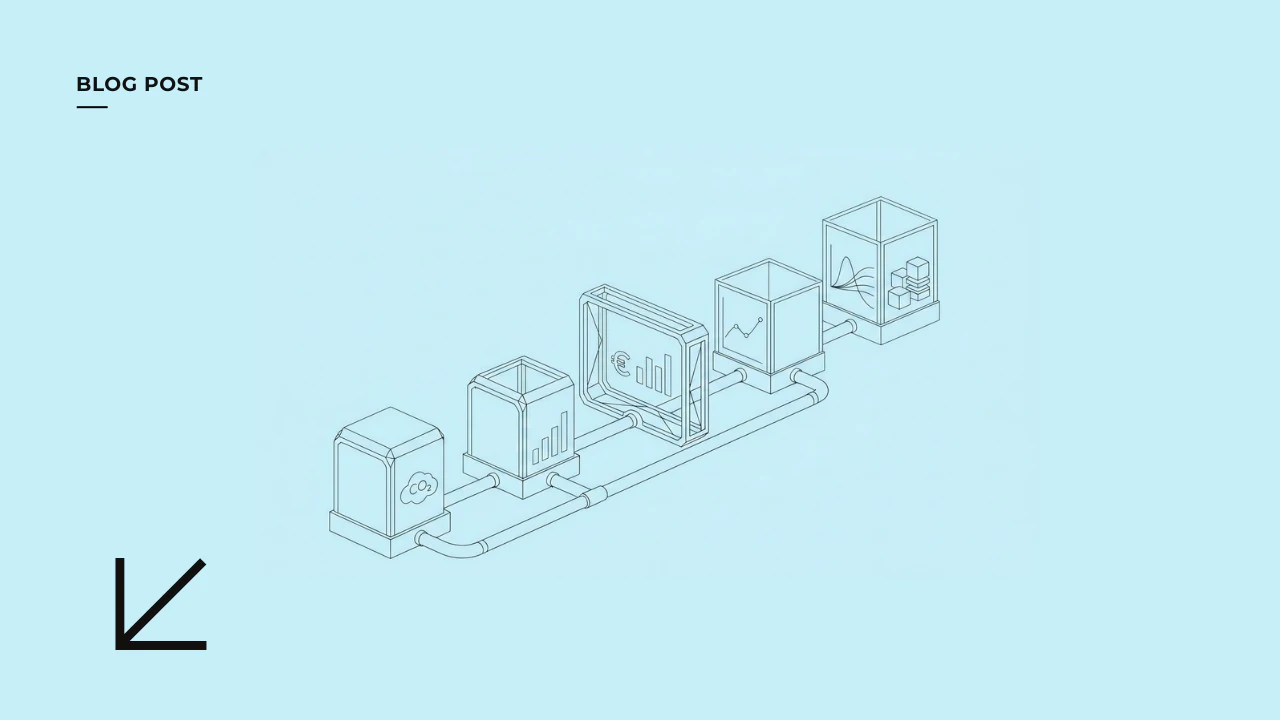
At its core, Carbon Cost Forecasting connects four elements:
- Procurement data (what you buy, from whom, and at what cost)
- Product structures (how materials and components build into products)
- Emissions data (what each material or supplier contributes)
- Carbon pricing scenarios (how cost evolves across regions and time)
When these elements are combined, something fundamentally changes. Carbon becomes a variable you can model.
That matters because once something can be modeled, it can be compared. And once it can be compared, it can influence action.
This is where carbon starts to move into the same decision framework as cost, risk, and margin.
From Data to Decision: How It Works
In practice, Carbon Cost Forecasting follows a clear logic.
1. Connect Data
Procurement transactions, BOMs, supplier data, and emissions factors are brought into one system.
2. Enrich with Carbon Intelligence
Each material and supplier is linked to emissions data and regional carbon pricing logic.
3. Model Scenarios
Different ETS and CBAM price scenarios are applied across time horizons and geographies.
4. Generate Insights
Teams can see which products, suppliers, and materials carry the highest carbon cost exposure and how that exposure changes over time.
The outcome is not another report.
It is a decision framework.
A strong data foundation is what makes this possible. Carbmee’s positioning is built around granular, transactional data linked to operational systems, so carbon insight can be tied back to actual procurement and product decisions rather than broad averages . Carbmee’s AI capabilities also support SKU- and transaction-level emissions matching, data quality management, and scenario simulation, which are directly relevant for carbon cost forecasting workflows .
What This Enables in Practice
Once carbon cost becomes visible at the right level, several things become possible.
Procurement Gains Leverage
Instead of negotiating based only on price, procurement teams can factor in carbon exposure. This changes supplier selection and contract strategy.
A lower purchase price may not stay lower once carbon cost is accounted for. That changes the sourcing conversation.
Finance Improves Forecasting
Carbon cost is no longer a surprise. It can be modeled alongside other cost drivers, improving accuracy and reducing volatility.
That makes planning more resilient and helps organizations understand future margin pressure earlier.
Sustainability Drives Action
Instead of reporting emissions, sustainability teams can prioritize reduction efforts based on both environmental and financial impact.
That creates a much stronger internal business case for action.
Organizations Align
Perhaps most importantly, procurement, finance, and sustainability start working from the same data foundation.
Carbon becomes a shared business variable.
This cross-functional alignment is one of the biggest value shifts. In many companies, sustainability teams already understand the emissions challenge, procurement teams understand supplier complexity, and finance understands cost pressure. Carbon Cost Forecasting helps bring those views together in one operational model.
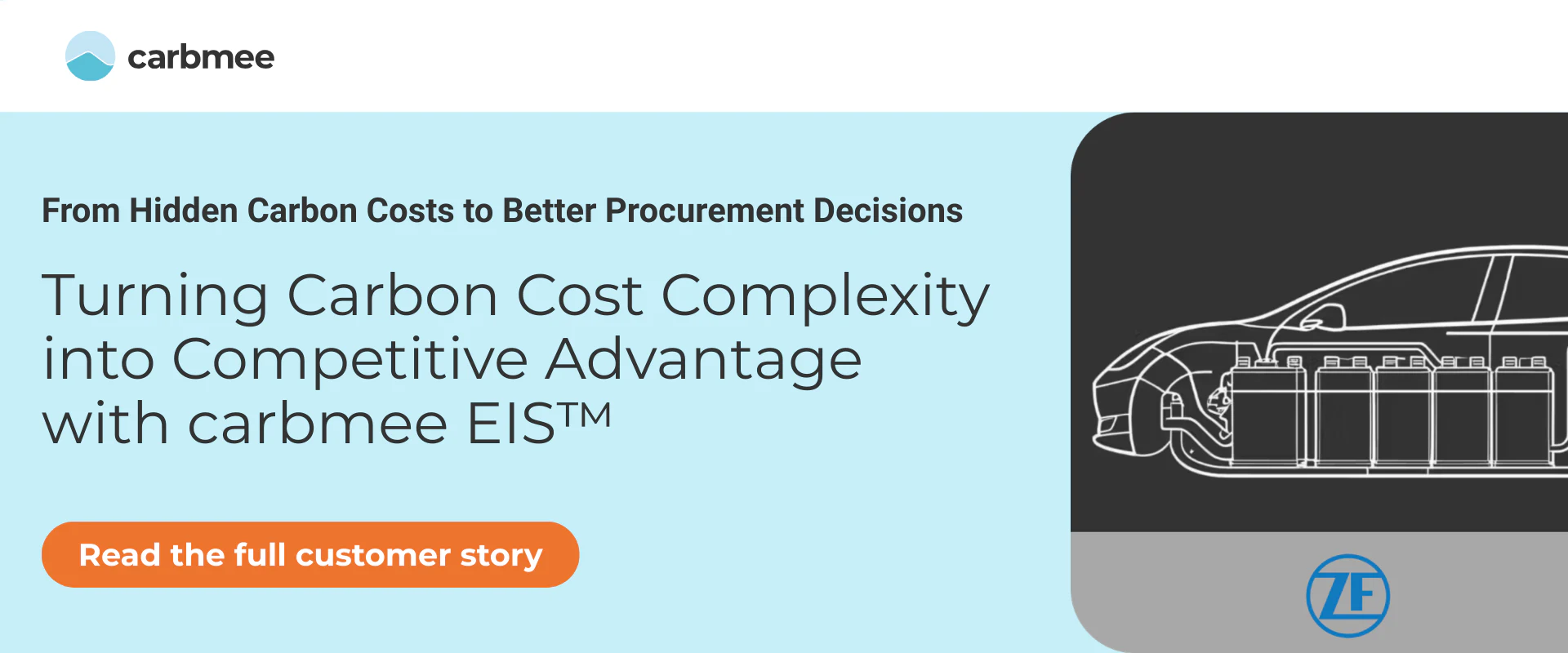
A Practical Example: ZF Group
ZF, a global manufacturer, faced a common challenge.
Carbon costs were present across their supply chain especially in steel, aluminum, and plastics but they were not visible at the level required for decision-making.
As Ralf Hässig, Senior Expert, Materials Management Sustainability described it: “Carbon costs felt like a hidden tax we couldn’t track.”
Using Carbmee, ZF built a framework to:
- Simulate carbon cost exposure across materials and suppliers
- Gain visibility at product level
- Improve sourcing and financial planning decisions
The shift was not just better reporting. It was earlier visibility.
And that changed how decisions were made.
ZF’s broader work with Carbmee also shows the scale of the issue. According to the customer story, ZF imports approximately 600,000 tons CO2e into the EU in aluminum and steel commodities alone, and under the current scope of CBAM could face close to €8 million in expected carbon costs by 2034 if exposure is not addressed .
Why This Matters Beyond Compliance
One of the biggest misconceptions in the market is that carbon cost forecasting is primarily about compliance readiness.
Compliance is part of it. But that is not the main strategic value.
The bigger opportunity is that earlier visibility creates better decisions:
- Better sourcing decisions
- Better product decisions
- Better supplier conversations
- Better investment decisions
It also creates a more credible path to reduction. When carbon is visible at a granular level, teams can identify which levers actually matter. They can move away from broad ambition and toward targeted action.
That is especially important in a business environment where many organizations are committed to sustainability in principle but still struggle to operationalize it. Carbmee’s Sustainability Intelligence Report shows that businesses continue to face major barriers including budget constraints, supply chain complexity, lack of clear data, and limited technology support.
That context is exactly why forecasting matters: it helps companies act with more precision instead of adding another disconnected reporting layer.
The Competitive Advantage of Seeing Earlier
This is the key takeaway.
Carbon cost is not something you can eliminate overnight.
But it is something you can understand earlier. And timing is what creates advantage.
Companies that see carbon cost early can:
- Adjust sourcing strategies before contracts are locked
- Choose lower-exposure materials during design
- Plan for regulatory changes before they impact margins
Companies that see it late can only react.
This is increasingly becoming a competitive divide. The difference will not simply be between companies that care about sustainability and those that do not. It will be between companies that can translate carbon into operational and financial insight, and those that still treat it as a separate reporting stream.
The Business Case for Acting Earlier
This is not only about avoiding downside risk. There is also a clear upside case for earlier visibility.
When companies can identify carbon hotspots at supplier, material, and product level, they are in a better position to reduce exposure where it matters most. That supports smarter sourcing, more targeted decarbonization, and better financial planning.
Carbmee’s value proof points point to a strong commercial case for this kind of approach, including average ROI of 356%, break-even in 4 months, up to 94% faster PCF creation compared with manual processes, and carbon cost savings potential of up to 4% of total turnover .
The important point is not the number alone. It is what the number represents. Better visibility does not just improve reporting quality. It improves business decisions.
The Question Every Company Needs to Answer
Most organizations are already exposed to carbon cost.
The real question is not whether it exists.
It is: When does it become visible to you?
If the answer is:
- in reporting
- in finance
- at compliance deadlines
Then you are already too late.
A more useful question may be this:
At what point in your decision-making process can carbon actually change the outcome?
If the answer is “after the decision,” then the business is still operating reactively.
From Carbon Risk to Financial Control
Carbon pricing is becoming a structural part of industrial economics. It is no longer a niche sustainability topic or a future consideration. It is a cost layer that is steadily integrating into procurement decisions, product economics, and financial planning.
The companies that win will not be the ones who report better.
They will be the ones who see earlier and act faster.
Carbon Cost Forecasting is what enables that shift.
By connecting procurement data, product structures, and emissions data with real-world carbon pricing scenarios, organizations can move from reactive reporting to proactive decision-making. Carbon becomes a variable that can be modeled, compared, and optimized—just like any other cost driver.
This is where Carbmee creates value.
With a granular, transactional data foundation and AI-supported scenario modeling, Carbmee enables companies to:
- Quantify carbon cost exposure at supplier, material, and product level
- Simulate future ETS and CBAM scenarios with financial impact
- Identify cost and emission reduction levers with clear ROI logic
- Align procurement, finance, and sustainability on a shared decision framework
The result is not just better visibility. It is better decisions—earlier in the process, where they still have financial impact.
In a market where carbon cost can reach millions or even billions across supply chains, the ability to forecast and act early becomes a competitive advantage.
The question is no longer whether carbon cost matters.
It is whether you can see it early enough to influence it.
If you want to understand your carbon cost exposure - and where to act - Carbmee provides the foundation to do it with precision.