The Innovation Frontier: Decarbonizing Industry at Speed and Scale
At the Global Decarbonization Forum 2026 in Berlin, Robin Spickers, Co-Founder and Product Lead at carbmee, took the stage to address one of the most persistent challenges in industrial sustainability: why is it still so hard for large companies to act on decarbonization, even when the business case is clear? His answer reframes the entire problem. It is not a strategy gap or a lack of ambition, it is a data visibility problem. In his keynote, Robin walked through how carbmee's environmental intelligence platform solves it, and announced the integrations and platform capabilities that mark the next chapter for industrial decarbonization.

The CEO Reality: What Decarbonization Programs Actually Need to Deliver
Every CEO today understands that sustainability has a business case. Consultants have delivered the slide decks. The strategy is agreed. But translating that understanding into measurable, operational outcomes is where most programs stall.
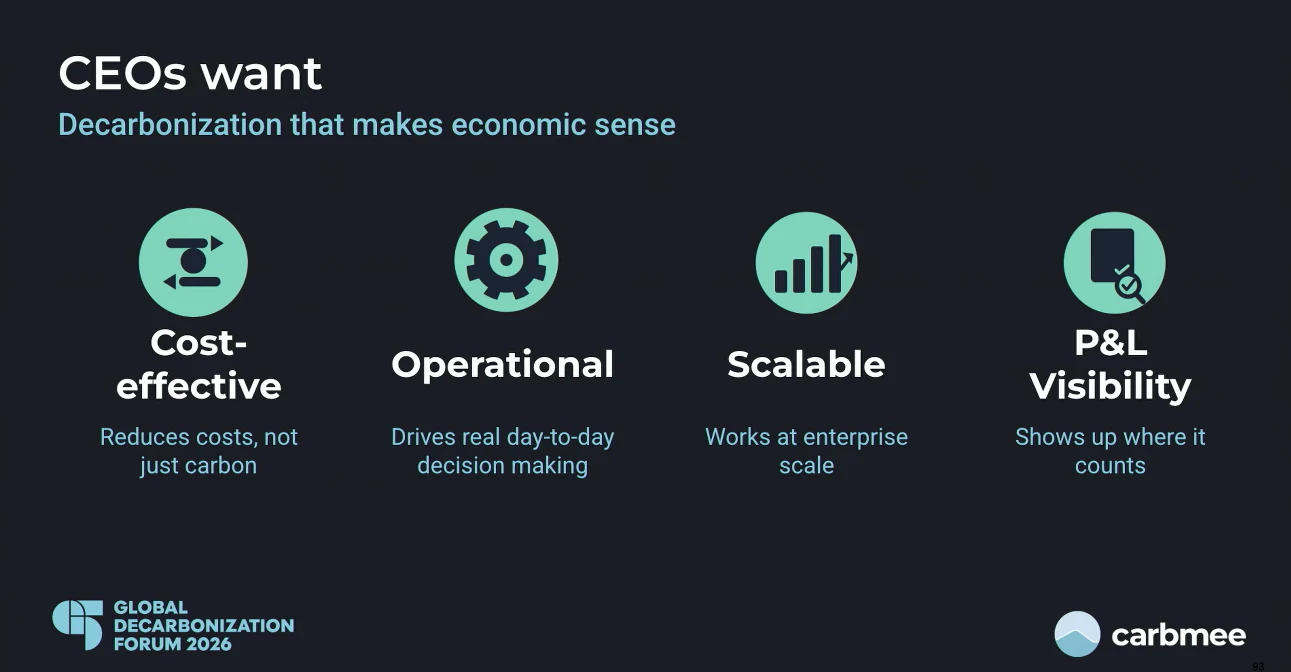
Robin outlined what a successful decarbonization program actually needs to deliver from a leadership perspective: it must be cost effective, integrated into day-to-day operational decision making, scalable across the entire enterprise, and clearly linked to cost savings.
The uncomfortable reality he put on the table: 50% of companies are still managing their carbon data in Excel. He drew a sharp analogy — no one would consider running their entire business operations from a spreadsheet instead of an ERP system. Yet that is precisely how most enterprises are handling one of the most consequential data challenges they face. In five to ten years, Robin argued, using a purpose-built platform for environmental data will seem just as obvious as an ERP system does today. The financial stakes are no longer abstract. With CBAM and ETS creating direct, calculable cost exposure at the product and supplier level, the price of poor data visibility is measurable.
Why Industrial Companies Were Never Designed for Net Zero
One of the keynote's most clarifying moments came when Robin explained why this problem is genuinely hard to solve and why generic ESG dashboards and spend-based estimation tools consistently fall short.
An industrial company was never architected with net zero in mind. Its data is fragmented across systems built for entirely different purposes. Building a serious, audit-proof carbon model requires purchasing transactions from ERP systems, detailed material composition data from PLM systems, manufacturing data from MES systems, and, critically, primary emissions data from suppliers that sits entirely outside the company's own infrastructure.
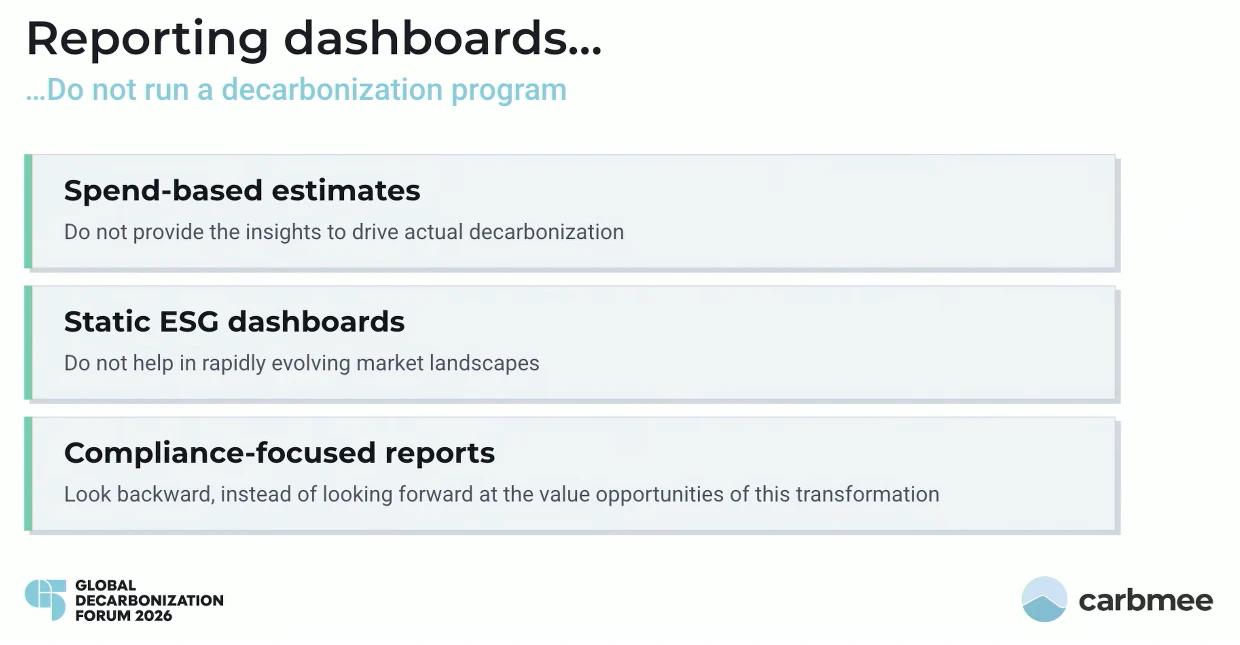
This is why spend-based estimations fail. They offer a rough approximation at best. Once primary data from a single supplier is added at the product level, the deviation from that estimate can be 200% in either direction. The only path to genuine accuracy and genuine reduction is continuous, structured collaboration across the supply chain.
Robin was direct about the conclusion: companies do not have a sustainability problem. They have a visibility problem. And that is a problem that can be solved.
How carbmee Solves It: One Platform, One Data Foundation
The carbmee platform is built around a three-layer data model. The first layer integrates master data, all SKUs, all products. The second layer connects that master data with purchasing transactions to map the supply chain. The third layer enables continuous supplier collaboration to keep the data current and precise.
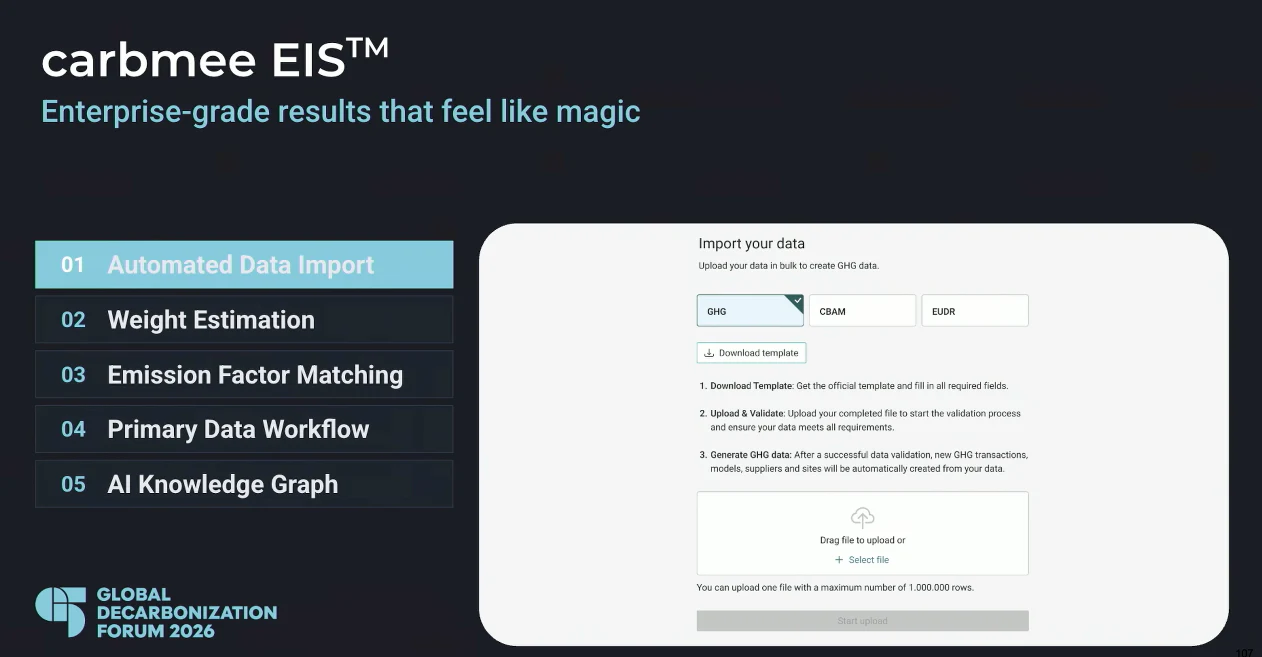
Together, these layers generate a full model of a company's operations, a single data foundation from which multiple regulatory and strategic outcomes can be derived simultaneously, whether that is GHG accounting, CBAM compliance, LCA calculations, or EUDR reporting. Once a company provides its data, carbmee can have the initial model live within a day.
From that baseline, the platform's five core components take over.
New Integrations: Connecting the Data That Already Exists
Integrations sit at the foundation of everything carbmee does. Spreadsheet exchanges slow everything down and introduce errors. The answer is live, native connections to the systems where industrial data already lives.
Robin announced three new integrations at the forum. The Snowflake integration connects carbmee directly to cloud data warehouses where many enterprises have already centralized their data. The SAP S/4HANA integration brings purchasing and operational data from one of the world's most widely used ERP systems directly into the carbmee platform. And the Jaggaer integration pushes product- and supplier-level carbon data directly into the procurement workflow, making it available to category buyers and strategic sourcing teams at the moment of decision.
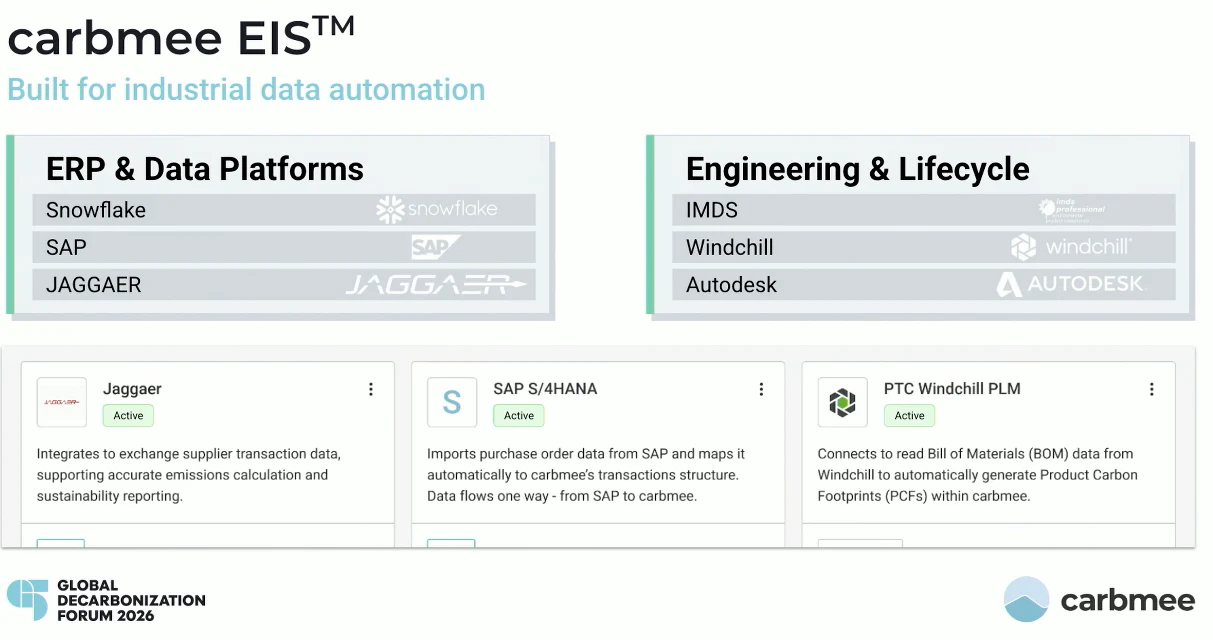
On the engineering and R&D side, carbmee also announced native integrations with IMDS, the automotive industry's standard material data system, as well as Windchill and Autodesk, two of the leading PLM systems. These integrations allow carbmee to pull precise material composition data directly into its product models with just a few clicks, eliminating one of the most time-consuming steps in scope 3 data collection.
AI-Powered Carbon Intelligence
Artificial intelligence has been aggressively integrated into the carbmee platform over recent quarters, and Robin highlighted two capabilities that are already delivering measurable efficiency gains for customers.
The first is carbmee's AI-based weight estimator. One of the most persistent gaps in industrial carbon accounting is the mismatch between financial transaction data and physical quantities. Many procurement systems record purchases in value terms - euros spent on steel, for example — without capturing weight or volume. Carbmee's AI generates activity-based weight estimations from natural language transaction data, which teams can then validate with suppliers and material experts. It does not replace the human — it brings the human into the loop at the right moment, progressively improving data quality over time.
The second is SKU-level emissions factor matching. Across two million transactions, 500,000 SKUs, and one thousand end products, carbmee maps a specific, database-backed emission factor to every single SKU. The initial baseline is ready in a single morning - not months, not years.
Five New Partnerships
Robin used the keynote to announce five strategic partnerships that significantly expand carbmee's reach and the outcomes it can deliver for customers.
ERM is a leading sustainability consulting firm. The partnership combines carbmee's software platform with specialist advisory services, addressing the reality that for many companies, technology alone is not enough to drive change at the pace required.
Quanzen opens the Indian market for carbmee at a moment of genuine opportunity. As the forum's earlier discussions made clear, India's acceptance of CBAM as part of its EU free trade agreement has fundamentally shifted that market's appetite for carbon accounting infrastructure — and demand is growing fast.
MAERSK brings deep CBAM expertise, enabling carbmee to access and verify supply chain primary data at scale. For companies with significant import exposure, knowing your CBAM liability at the supplier and product level before it becomes a line item on the CFO's desk is no longer optional.
EcoVadis unlocks significant data synergies. EcoVadis has already collected supplier sustainability assessments across thousands of companies globally. Integrating that dataset with carbmee's product-level carbon modeling creates a richer, more complete picture of supply chain risk and performance.
Finally, carbmee is now listed on the AWS Marketplace, making it significantly easier for enterprise customers to procure the platform within their existing cloud spend commitments and signaling a level of enterprise credibility that matters in a market where trust is everything.
Environmental Intelligence as the Next Industrial Transformation
Robin closed with a perspective that reframes the entire decarbonization challenge for businesses.
The companies that will win the next decade are not those that treat sustainability as a compliance checkbox. They are the ones that recognize it for what it increasingly is: a data and intelligence advantage. Knowing, at product and supplier level, where carbon costs sit and where they are heading is a procurement lever, a risk management tool, a competitive differentiator, and increasingly a prerequisite for accessing major markets.
Two options exist for every company right now. Treat regulation as a compliance obstacle and manage it reactively. Or treat it as a strategic initiative, build the data infrastructure now, and use it to drive decisions that reduce costs, reduce emissions, and reduce exposure to future risk at the same time.
The next industrial transformation, Robin argued, will be powered by environmental intelligence.
carbmee EIS™: ESRS and CBAM Reporting
The capabilities Robin described are all part of carbmee EIS™, carbmee's environmental intelligence platform purpose-built for large industrial companies. From data ingestion to audit-ready reporting, carbmee EIS™ helps organizations:
- Collect and centralize environmental data across operations and supply chains.
- Connect ERP, PLM, MES, and procurement systems in a single data model.
- Identify emission hotspots and reduction opportunities with AI-powered analytics.
- Streamline supplier collaboration and primary data collection at scale.
- Ensure compliance with CBAM, ESRS, LCA, and EUDR from one platform.
Whether your priority is CBAM cost visibility, Scope 3 accuracy, or audit-ready ESRS reporting, carbmee EIS™ provides the infrastructure to make it happen, without a five-year implementation.