CBAM: What It Is & How It Affects Your Industry
Key Takeaways
Definition: CBAM is a carbon border tax on specific goods imported into the EU, designed to prevent "carbon leakage," where companies move production to countries with less stringent climate policies.
Requirements: Businesses must report the greenhouse gas emissions embedded in their imported goods. Since January 1, 2026, importers have been in CBAM's definitive regime, working toward their first certificate surrender in 2027.
Exemptions: A 2025 simplification package introduced a 50-tonne annual de minimis threshold, so many smaller importers now fall outside CBAM entirely.
Importance: CBAM ensures that imported goods face the same carbon costs as those produced within the EU under the EU Emissions Trading System (ETS), encouraging cleaner industrial production globally and creating a level playing field for EU businesses.
Find out what the CBAM regulation means for your industry, its reporting requirements, and how to prepare for compliance.

What Is CBAM?
The Carbon Border Adjustment Mechanism (CBAM) is an environmental policy instrument introduced by the European Union (EU) under Regulation (EU) 2023/956 to support its climate neutrality objective by 2050. In simple terms, CBAM puts a price on carbon emissions embedded in certain imported goods, ensuring that non-EU producers face similar carbon costs to EU manufacturers covered by the EU Emissions Trading System (ETS).
CBAM's primary objective is to prevent carbon leakage, which occurs when production shifts to countries with weaker climate policies or when EU-made goods are replaced by more carbon-intensive imports. By pricing carbon at the border, CBAM incentivizes cleaner industrial production both inside and outside the EU.

How Is the CBAM Certificate Price Calculated?
The price of CBAM certificates is set and published by the European Commission, tied directly to the EU Emissions Trading System (ETS) so importers face the same carbon costs as EU-based manufacturers.
The Pricing Methodology
The Commission calculates CBAM certificate prices as the weighted average of EU ETS auction clearing prices, so the carbon cost embedded in your imports moves in line with the EU carbon market.
Publication Schedule
The frequency of price publication increases over time:
- 2026: Four quarterly prices, each calculated in the first calendar week after the relevant quarter ends. Each price applies to imports of CBAM-covered goods made during that quarter.
- From 2027 onwards: Weekly prices, providing more granular and timely cost signals for importers.
From February 2027, all CBAM certificate purchases will be made through a single common central platform, consolidating the process for importers across the EU.
CBAM Certificate Price
What the Free Allocation Phase-Out Means for Your Costs
Certificate price is only half of the cost equation. The other half is the CBAM factor: the share of embedded emissions for which a certificate must actually be surrendered, which rises as EU producers' free ETS allocation is phased out. In 2026, EU producers still keep 97.5% of their free allocation, so the CBAM factor is just 2.5% and importers surrender certificates for only that share.
The factor climbs every year through 2034, when free allocation ends completely. The European Commission published the first official walkthrough of this calculation, Guidance No. 4, on 14 August 2026, alongside sector-specific guides for cement, hydrogen, fertilisers, iron and steel, aluminium, and electricity.

The increase is not gradual throughout: the factor nearly doubles between 2029 and 2030, from 22.5% to 48.5%. For blast-furnace steel at a €75 certificate price, that single-year jump moves the net cost from roughly €34 to roughly €73 per tonne. Businesses that wait until the steep years to act on supplier decarbonization face a much larger bill than those who start planning now, since certificate prices and the CBAM factor compound together rather than separately.
How Does CBAM Work?
The Carbon Border Adjustment Mechanism requires EU importers to purchase special certificates to cover the carbon footprint of the goods they bring into the union. The process is designed to mirror the costs faced by local producers.

Step 1: Purchase CBAM Certificates. Sales open February 1, 2027, through the common central platform. From that point, authorized declarants must hold certificates covering at least 50% of cumulative embedded emissions at the end of each quarter, down from an original 80% requirement.
Step 2: Declare Annual Emissions. Each year, importers declare the total volume of goods imported and their embedded emissions for the preceding year. The first declaration, covering all of 2026, is due September 30, 2027.
Step 3: Surrender Certificates. Importers surrender certificates matching declared emissions. Surplus certificates can be sold back, up to 50% of that year's purchases, by October 31; anything left over is cancelled November 1.
Step 4: Deduct Foreign Carbon Prices. A carbon price already paid in the producer's home country can be deducted from the final CBAM cost. The Commission's May 2026 implementing rules set out how: a non-EU supplier's effective payment under a mandatory carbon tax or ETS (the UK ETS, China's national ETS, California's Cap-and-Invest) qualifies, minus any rebates or free allowances received, backed by a standardized English-language carbon price report certified by an accredited body.
Where a third country's scheme permits Article 6-compliant international credits, importers can claim a reduction too, capped at 10% of reported emissions. Without emission data, default values apply instead, at a mark-up of 10% in 2026, rising to 30% from 2028; importers using default emission values must also use the matching default carbon price.
Who Is Exempt From CBAM? The 50-Tonne De Minimis Threshold
Companies that import 50 tonnes or less of CBAM-covered goods per calendar year are exempt from CBAM entirely, under a threshold introduced by the EU's October 2025 Omnibus simplification package.
The exemption applies per importer, per year, aggregated across all CBAM goods combined. A company importing 25 tonnes of steel and 20 tonnes of cement in the same year stays under the 50-tonne threshold and has no CBAM obligations. The same company importing 60 tonnes of steel alone crosses the line and takes on full obligations for every tonne, not just the excess.
Two goods are excluded from this exemption regardless of volume: electricity and hydrogen. Any importer bringing in either faces full CBAM obligations from the first unit imported.
The threshold replaced an earlier rule that exempted shipments valued under €150 each, which some importers worked around by splitting large orders into smaller consignments. The switch to an annual mass test, measured across a company's total imports rather than shipment by shipment, closes that route.
How to get started: Add up your company's total imports, by mass, of iron and steel, aluminium, cement, and fertilizers combined, across the last twelve months. If the total is under 50 tonnes, confirm your import mix is genuinely stable before assuming the exemption will hold next year too.
What Happens If You Don't Comply? CBAM Penalties
Authorized declarants who surrender too few CBAM certificates face a fine of €100 per tonne of CO2e left uncovered, harmonized across all 27 EU member states since the 2025 Omnibus reform. Importing CBAM goods without authorization at all costs three to five times more: €300 to €500 per tonne of CO2e.
Before the Omnibus, individual member states set their own penalty levels, producing uneven enforcement. The harmonized €100 rate mirrors the penalty already used for excess emissions under the EU Emissions Trading System, so CBAM and ETS non-compliance are now priced consistently.
Paying the penalty does not remove the underlying obligation. A declarant who pays the fine still has to acquire and surrender the missing certificates on top of it, so the practical cost of falling short is the certificate price plus the penalty, not one or the other.
How to get started: Confirm your company holds authorized CBAM declarant status before importing any covered goods. If authorization is still pending, track your application status directly in the CBAM Registry rather than assuming provisional cover extends indefinitely.
Which Industries and Products Are Affected by CBAM?
The CBAM regulation is being implemented gradually, initially targeting sectors with a high risk of carbon leakage. Companies that source materials from non-EU suppliers without a comparable carbon price will be most affected.
Initially Impacted Goods
The first phase of the CBAM applies to the import of specific goods, including:
- Iron and steel
- Aluminium
- Cement
- Electricity
- Fertilisers
- Hydrogen
Key Industries Facing High Costs
Based on the initial list of goods, industries that rely heavily on these materials will face the most significant impact. These include:
- Automotive
- Construction
- Packaging
- Heavy machinery and industrial equipment manufacturing
The size of the impact varies sharply by material and production route, from steel made in an electric arc furnace at the low end to grey hydrogen at the high end, with green hydrogen carrying close to no exposure at all.

Because the CBAM factor is only 2.5% in 2026, net costs today are a fraction of these gross figures, rising as free allocation phases out through 2034. Businesses importing key components from regions without carbon pricing mechanisms should reassess sourcing strategies well before that phase-out accelerates.
The 2028 Downstream Expansion
From 2028, companies dealing in steel- and aluminium-intensive downstream products will also be affected and should begin preparing now. The European Commission's original December 2025 proposal covers roughly 180 such products, 94% of which are industrial supply-chain goods such as base metal mountings, cylinders, and industrial radiators, with a smaller share (6%) of household goods; it also folds pre-consumer aluminium and steel scrap into CBAM calculations and tightens reporting to curb misreporting.
On 6 July 2026, the European Parliament's ENVI committee adopted its position on the expansion by a vote of 56 in favor, 11 against, and 12 abstentions, broadly backing the Commission's plan while adding enforcement measures: anti-circumvention rules now reach slight processing done specifically to dodge CBAM, a weight-based threshold applies to a seller's total online shipments rather than each parcel, and the Commission could apply default emissions values tied to a good's true country of origin where circumvention is suspected. ENVI also removed the option to count Paris Agreement Article 6 carbon credits against CBAM obligations, leaving that question to the upcoming EU ETS revision, and set its own position on a Temporary Decarbonisation Fund running 2027 to 2029 that would extend to fertiliser producers.
This is not yet final law. The Council adopted its own, broader position in June 2026, and Parliament is expected to vote on its full negotiating mandate at its September 2026 plenary session before trilogue negotiations with the Council begin. The precise product list, currently centered on machinery, industrial equipment, vehicle components, construction equipment, fasteners, and selected household appliances, may still change during those negotiations.
What Timeline Applies to the CBAM Reporting Requirements?
The CBAM's transitional phase, which covered reporting only and carried no financial charges, ended on December 31, 2025.
From 1 January 2026, CBAM entered its definitive regime: full obligations now apply, and every import of covered goods is checked against authorization status in real time at EU customs. Two further dates complete the picture. Verifier registration opens on September 1, 2026, giving businesses roughly thirteen months to secure verified emissions data before certificate sales begin on February 1, 2027; the first CBAM verifiers are expected to receive accreditation around the same time, so no 2026 emissions data can be formally verified before then.
On 14 August 2026, the Commission published ten supporting guidance documents, covering core concepts, emissions-calculation methods, and the free allocation adjustment, translated into 11 languages beyond English (including Chinese, Turkish, and Vietnamese) to reach producers outside the EU. The first annual declaration and certificate surrender, covering all of 2026, is due September 30, 2027, aligned with the gradual phase-out of free EU ETS allowances that runs until 2034. From 2028, the scope is set to expand to include selected downstream products (see "Which Industries and Products Are Affected" above).
How Will CBAM Impact Global Trade and EU Manufacturers?
For EU-based manufacturers in carbon-intensive sectors, CBAM helps level the competitive landscape. These companies, already subject to the EU ETS, often compete with importers from regions without equivalent carbon costs. By applying a carbon price at the border, CBAM aims to make that competition fairer and to encourage higher environmental standards globally.
CBAM's legality is also being tested outside the EU. As of September 2026, a World Trade Organization dispute challenging CBAM remains active, alongside a separate case pending before the EU's Court of Justice. The EU defends the mechanism as an environmental measure permitted under WTO exceptions for protecting health and natural resources, not a trade tariff. Until these challenges are resolved, businesses should treat CBAM as a live compliance obligation rather than wait on a legal outcome that could still be years away.
CBAM in the UK
The UK's Carbon Border Adjustment Mechanism is progressing through the legislative process ahead of its planned start date of 1 January 2027. Primary legislation has been introduced through the Finance (No. 2) Bill 2025–26 and is currently under Parliamentary scrutiny, meaning it may still be amended.
Unlike the EU's certificate-based system, the UK CBAM is designed as a tax, administered by HMRC, with its own sector coverage and pricing method. Because the two systems work differently, whether a carbon price paid under the UK CBAM can be deducted from EU CBAM obligations, or vice versa, is not yet settled: a gap that matters most for businesses trading in both directions across the UK-EU border.
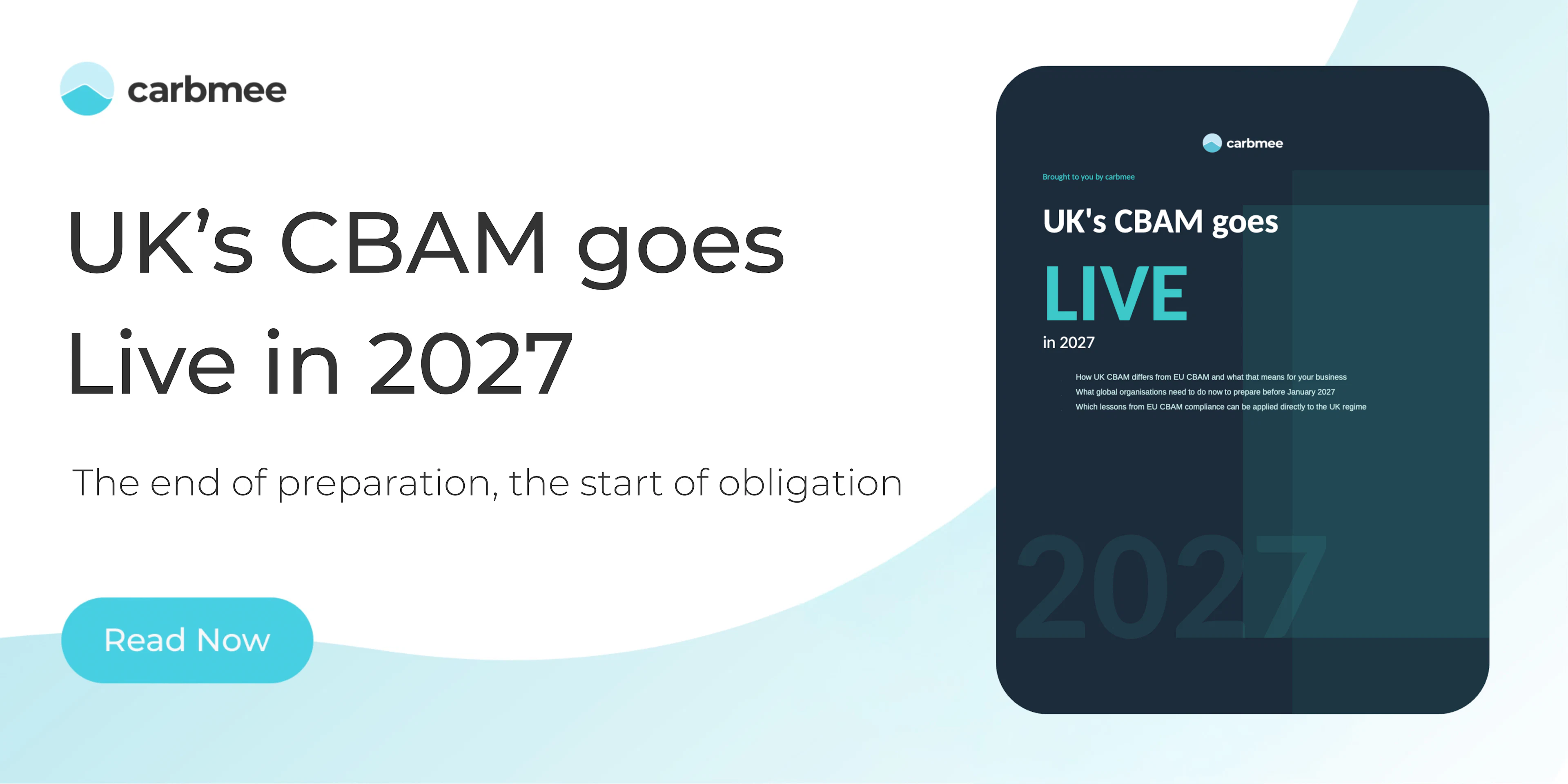
In parallel, the UK government has begun developing secondary legislation: the first package of draft regulations and draft notices, which will have legal force, was published on 10 February 2026 for a technical consultation that ran until 24 March 2026, with a second package expected in spring 2026. Final secondary legislation is expected to be laid later in 2026.
Master CBAM Compliance with Carbmee
The most crucial step for any affected business is to identify and quantify emissions across the supply chain. With most emissions hidden in Scope 3, gaining transparency is essential for meeting CBAM reporting requirements and avoiding unexpected financial risk as the CBAM factor climbs toward 100% by 2034.
carbmee's Environmental Intelligence System (EIS™), built on Carbontology™, connects ERP, supplier, and product data into one audit-grade foundation, streamlining data collection and giving you full visibility into emissions hotspots and future CBAM-related costs. With the Commission's August 2026 sector guidance now giving non-EU producers clear instructions for calculating their own emissions, supplying verified actual data instead of falling back on marked-up default values is more achievable than ever, and carbmee EIS™ helps you act on it.
ZF, a global automotive and technology supplier operating across 35+ EU legal entities, used carbmee to submit more than 40 CBAM reports and meet every deadline, while tracking a projected CBAM cost exposure of roughly €8 million by 2034.
Here's how you benefit from carbmee EIS™:
Turn Carbon Data Into Cost Control: Automatically quantify embedded emissions across your supply chain to identify where CBAM fees will hit hardest, and how to reduce them through supplier or material choices.
Move Beyond Reporting to Tracking and Budgeting: Generate audit-ready CBAM reports while monitoring emissions in real time, forecasting future carbon costs, and building carbon budgets directly into procurement and financial planning.
Turn Insights Into Financial Advantage: Use granular product- and supplier-level insights to support strategic sourcing, evaluate alternative materials, and prioritize decarbonization initiatives that deliver measurable financial impact.
Take the first step toward CBAM compliance, carbon reduction, and measurable financial impact. Talk to one of carbmee's industry experts today.