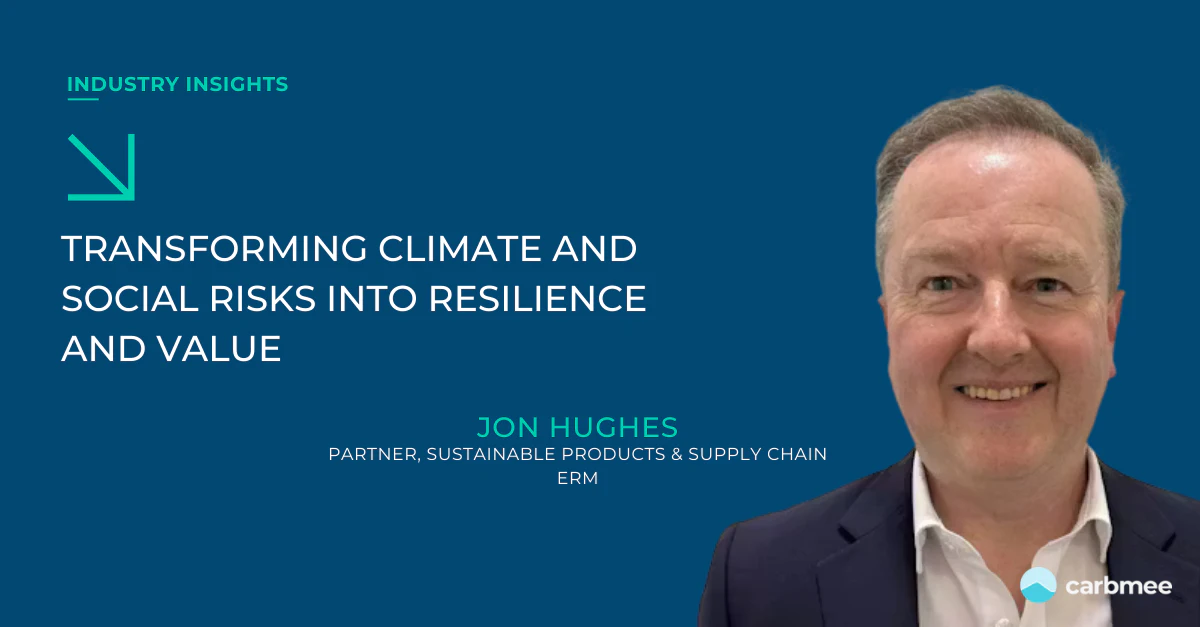
Transforming climate and social risks into resilience and value
The following post is an excerpt from Carbmee’s Industry Benchmark Report, 2026 Green Transformation in Practice, which analyzes year-over-year trends in energy, carbon, and sustainability execution across industrial sectors. Based on insights from over 100 senior decision makers, the report features expert perspectives from leaders at Jaggaer, PwC, and ERM. In this excerpt, we spotlight one of those expert interviews, offering a first-hand view into how leading organizations are navigating the challenges and opportunities of green transformation in 2026.

At the turn of the quarter century, we face a converging set of forces reshaping society: climate change, intensifying natural shocks, tightening resource constraints, shifting geopolitics, evolving demographics, rising social expectations, and the accelerating sweep of AI and digital technologies. For businesses, these dynamics bring more than increased risk - they will define which models remain investable, insurable, and licensed to operate.
While none of this is entirely new, the scale and speed of change have raised the stakes. For example, between 2020 and 2024, the European Union recorded average annual economic losses from climate and weather-related extremes of around EUR 45 billion - a 127% increase from the previous decade.
As these pressures intensify, the question is no longer whether to respond, but how. The most future ready organisations are reframing volatility as opportunity - transforming risk into resilience, and resilience into value.
Here are three strategic levers we see leading businesses using to make that shift.
Engineer value through sustainable design
Sustainable design, guided by the 4R principles: Reduce, Reuse, Replace, and Recycle - aligns business models and products with a resource-constrained, cost-competitive world. Circular approaches such as product-as-a-service, repair, and reuse can not only stabilise revenue but also reduce exposure to volatile input costs. Lower-impact product lines open pathways to expanding markets seeking cleaner, smarter solutions. Even simple design choices, such as minimal-waste packaging, can define brand identity - signalling quality, responsibility, and innovation while reducing operational and compliance costs.
As an example, Philips has embraced circular economy principles across several product lines. By designing medical devices for remanufacturing and reuse, they reduce dependency on virgin raw materials - some of which are subject to geopolitical or tariff-related risk. This not only cuts environmental impact but also strengthens supply security.
Build resilient supply chains
Resilient supply chains are a foundation of business continuity. Improving the visibility and monitoring of supply networks through a combination of digital tooling and supplier engagement programmes can limit exposure to labour, regulatory, climate and nature risks and bolster investor confidence. Integrating sustainability into procurement decisions, enforcing high supplier-standards, and forging long-term supplier partnerships strengthens reputation and can ensure preferential access to materials. Working across industries in coalitions on regenerative agriculture or green materials, for example, can drive systematic change, spread innovation costs and position participants to lead as markets and regulations evolve.
As an example, Apple, highly dependent on Chinese manufacturing, began shifting parts of its supply chain to other countries like India and Vietnam. For instance, iPhone production has increasingly moved to Foxconn and Pegatron facilities in India to reduce exposure to Chinese tariffs and geopolitical risks.
Deepen trust through social value creation
Trust, earned through measurable contributions to people and society, underpins business performance. Empowering employees by investing in skills, flexible work models, and purposeful career pathways builds credibility from the inside out, whilst also creating a motivated, adaptable workforce. Managing technological shifts responsibly - by developing digital capabilities, safeguarding data privacy, and preparing for AI adoption demonstrates integrity and safeguards stakeholder confidence. Investing in local and regional economies through partnerships, infrastructure, and enterprise development extends trust outwards, fostering economic development and reinforcing the license to operate.
Competitive advantage itself is being redefined by the forces reshaping the global economy.
These three levers –
1) Engineering value through sustainable design,
2) Building resilient supply chains, and
3) Deepening trust through social value creation -
help businesses translate that shift into tangible performance through protecting revenues and gaining access to preferential financing deals. The organisations that lead in the next quarter century will be those that see sustainability not as constraint, but as the engine of competitiveness.