
0 of 17
Designed for enterprise manufacturers with complex supply chains, the Carbmee's Environmental Intelligence Maturity Model helps organizations evaluate how effectively they are leveraging environmental intelligence across procurement, sustainability, finance, operations, and supplier management.
The model assesses maturity across four critical dimensions:
- People & Processes
- Technology
- Data Quality
- Strategy
In just a few minutes, you will receive a personalized assessment of your organization’s current maturity level, including key strengths, potential gaps, and opportunities for improvement. After completing the assessment, you will also have the option to sign up for a free, in-depth evaluation with carbmee experts to explore actionable next steps, benchmark your capabilities, and identify high-impact opportunities to strengthen your environmental intelligence strategy.
- 8 minutes
- 17 questions
- Instant results
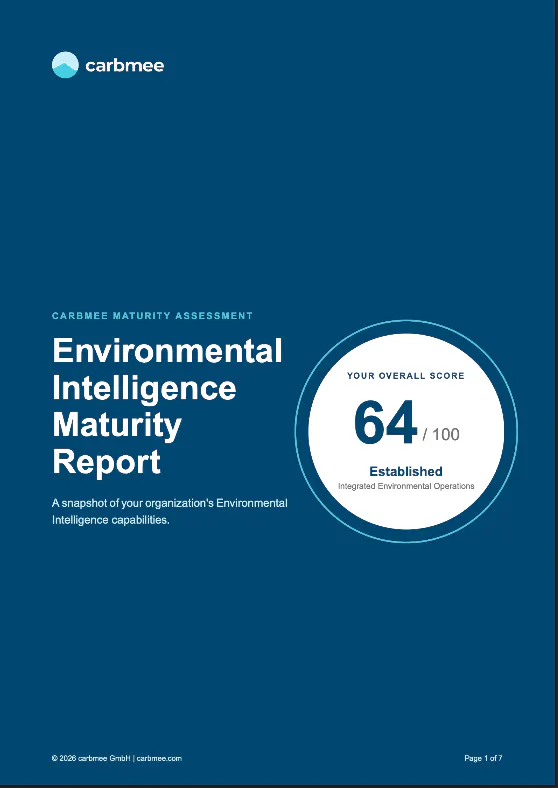
Inside your Environmental Intelligence report
When you complete the assessment, you'll receive a detailed PDF report mapped to the carbmee Environmental Intelligence Maturity Model. It places your organization on a four-stage maturity scale Beginner, Developing, Established, Advanced and breaks your score down across four critical dimensions: People & Processes, Technology, Data Quality, and Strategy. Each section comes with a clear interpretation of where you stand today and the specific next steps to advance toward the next stage.
Highlights
- Maturity score with stage placement
- Four-dimension breakdown : Process, Tech, Data, Strategy
- Strongest area & focus area highlighted
- Level-matched next steps per dimension
- 30-min expert walkthrough invite
1. Beginner
Initial Environmental Awareness
Organizations at this stage rely heavily on manual reporting processes and fragmented systems to manage environmental data and sustainability initiatives. Supplier visibility is limited, making it difficult to understand emissions performance or environmental risks across the supply chain. Sustainability efforts are primarily driven by compliance requirements rather than strategic value creation, and procurement teams have minimal involvement in environmental decision-making or sourcing strategies.
2. Developing
Developing Supply Chain Intelligence
At this stage, organizations begin building foundational supply chain transparency, particularly around Scope 3 emissions and supplier-related environmental impacts. Supplier engagement efforts start to emerge, supported by more standardized reporting processes and early-stage data collection practices. Procurement teams occasionally incorporate carbon-related considerations into sourcing decisions, creating the first steps toward carbon-informed procurement and supplier evaluation.
3. Established
Integrated Environmental Operations
Organizations operating at this maturity level have embedded environmental intelligence into core business and procurement operations. Supplier-level emissions visibility enables more informed sourcing and category management decisions, while procurement and sustainability teams collaborate through integrated workflows and governance structures. Compliance management and Product Carbon Footprint (PCF) processes become scalable and operationalized, allowing organizations to manage environmental performance more consistently across products and suppliers.
4. Advanced
Environmental Intelligence Leadership
At the highest maturity level, organizations leverage AI-enabled environmental governance to continuously optimize sourcing, supplier management, and carbon reduction initiatives. Carbon management is financially integrated into procurement, operational, and strategic planning processes, enabling organizations to evaluate environmental impact alongside business performance. With transactional-level supplier intelligence at scale, procurement teams lead decarbonization initiatives and carbon cost optimization efforts, transforming sustainability into a competitive advantage driven by operational environmental intelligence.