CSRD vs. SFDR: What’s the Difference and How They Work Together for ESG Reporting
Navigating the European Union’s growing set of ESG regulations can be overwhelming, especially for organizations newly stepping into the world of sustainability reporting. Two acronyms stand out as particularly confusing: CSRD and SFDR. They are central pillars of the EU’s sustainable finance framework, yet they serve different purposes and apply to different types of organizations. As more companies and financial institutions come under regulatory pressure, it becomes crucial to understand what each regulation means, how they differ, and why they are deeply interconnected.
In this article, we explain both regulations in detail and outline the key differences between CSRD and SFDR. We also look at how the two frameworks overlap, share data points, and influence each other. Whether you are a sustainability officer, an investor, or a compliance lead, this guide will help you confidently navigate the evolving ESG landscape. If you’re just getting started with EU regulations, we also recommend our EU Taxonomy Regulation Guide for additional context.

What is CSRD?
The Corporate Sustainability Reporting Directive, or CSRD, is the EU’s new regulatory framework that requires companies to disclose their environmental and social impacts in a standardized and transparent manner. It represents a major shift in corporate sustainability reporting and replaces the earlier Non-Financial Reporting Directive (NFRD), expanding both the scope and the depth of reporting obligations.
CSRD is designed to increase accountability among European companies by making sustainability information more comparable and reliable. It aims to ensure that investors and stakeholders can make better-informed decisions based on the environmental and social footprint of an organization. From emissions to diversity, CSRD covers a wide range of topics that fall under the ESG umbrella.
Corporate Sustainability Reporting Directive, in Simple Terms
CSRD applies to large companies and listed small and medium-sized enterprises (SMEs) operating in the European Union. Specifically, it affects companies that meet at least two of the following three criteria: more than 250 employees, over 25 million euros in assets, or more than 50 million euros in annual revenue. Listed SMEs will also be included in the scope in the coming years, although micro-enterprises are currently excluded.
At its core, the directive mandates that companies publicly disclose how their operations affect people and the planet. It introduces the concept of double materiality, which requires organizations to report both on how sustainability issues impact their financial performance and how their activities impact the environment and society. This holistic view is one of the most transformative aspects of the CSRD.
CSRD Reporting Requirements
Companies under CSRD must follow the European Sustainability Reporting Standards (ESRS), which define specific disclosures across a wide range of ESG topics. These include greenhouse gas emissions, water use, waste generation, biodiversity impact, social responsibility, and governance practices.
The directive is being rolled out in phases to give organizations time to adapt. Reporting requirements begin in 2025 for large companies already subject to NFRD, covering the 2024 financial year. Other large companies will start in 2026, and listed SMEs will be required to comply starting in 2027. The reports must be integrated into the management report and will be subject to external assurance, meaning companies need to ensure both the quality and auditability of their data.
What is SFDR?
One of the main purposes of the EU Taxonomy is to combat greenwashing, which can be defined as “a marketing tactic used to deceive people into believing an organization’s products, services or operations are more eco-friendly than reality” (IBM Sustainability). By providing measurable, science-based standards, the EU is tackling this problem and enabling companies, investors and banks to consistently assess sustainability performance. At the same time, the Taxonomy guides capital flows by directing investment and financing toward activities that are genuinely environmentally beneficial, ensuring that funding supports the transition to a sustainable, low-carbon economy.
Sustainable Finance Disclosure Regulation, Explained
SFDR applies specifically to financial market participants such as asset managers, investment firms, insurance companies, and pension funds that operate within the European Union. It does not apply directly to companies outside the financial sector, although those companies often provide the underlying data that financial institutions rely on.
Introduced in March 2021, SFDR represents a significant evolution in the EU’s approach to sustainable finance. It requires financial institutions to categorize their products based on their sustainability characteristics and to publish both entity-level and product-level disclosures on ESG matters.
SFDR Disclosure Categories
Under SFDR, financial products are classified into three categories: Article 6, Article 8, and Article 9.
- Article 6 products integrate ESG risks into investment decisions but do not actively promote ESG characteristics.
- Article 8 products promote environmental or social characteristics, provided that the companies in which investments are made follow good governance practices.
- Article 9 products have a clear sustainable investment objective, such as investing in clean energy or social housing.
In addition to these classifications, SFDR also introduces the concept of Principal Adverse Impacts (PAIs), which refer to the negative effects that investment decisions can have on sustainability factors. Financial institutions must disclose how they consider these impacts and provide relevant metrics across environmental and social dimensions.
CSRD vs. SFDR: A Side-by-Side Comparison
To clarify how these two frameworks differ, it is helpful to look at them side by side. While they are often discussed together, they apply to different audiences, use different reporting standards, and have distinct goals.
Comparison: CSRD vs. SFDR
1. Applies To
- CSRD: Large companies, listed SMEs, and public-interest entities.
- SFDR: Financial market participants and financial advisers.
2. Purpose
- CSRD: Enhance transparency regarding corporate sustainability and environmental impact.
- SFDR: Ensure transparency and comparability of financial products and investment funds.
3. Scope
- CSRD: Focuses on ESG impacts and risks at the company level.
- SFDR: Focuses on ESG performance and risks at the product and portfolio level.
4. Framework
- CSRD: Guided by the European Sustainability Reporting Standards (ESRS).
- SFDR: Guided by SFDR Level 1 and Level 2 disclosure requirements.
5. Key Concept
- CSRD: Double Materiality (how the world impacts the company AND how the company impacts the world).
- SFDR: Principal Adverse Impacts (PAIs) (identifying the negative effects of investment decisions on sustainability).
6. Reporting Format
- CSRD: Included as a dedicated section in the annual management reports.
- SFDR: Published on websites and included in formal fund documentation.
7. Effective Dates
- CSRD: Phased rollout starting in 2025 for most large companies.
- SFDR: Has been in force since March 2021.
This list illustrates that although both regulations aim to improve sustainability transparency, they do so from different perspectives. CSRD looks at the sustainability footprint of companies themselves, while SFDR focuses on how financial products contribute to or detract from sustainability objectives.

How CSRD and SFDR Are Connected
Although CSRD and SFDR target different stakeholders, they are deeply interlinked. One of the most important connections between them is the use of shared data. Financial market participants who must comply with SFDR often rely on sustainability data provided by the companies they invest in — data that is disclosed under CSRD.
This interdependence creates a strong incentive for companies and investors to align their ESG data management practices. When companies report accurately and comprehensively under CSRD, it becomes easier for financial institutions to meet their SFDR obligations. In this way, the two frameworks reinforce each other and contribute to a more transparent and reliable ESG ecosystem.
Shared Goals and Frameworks
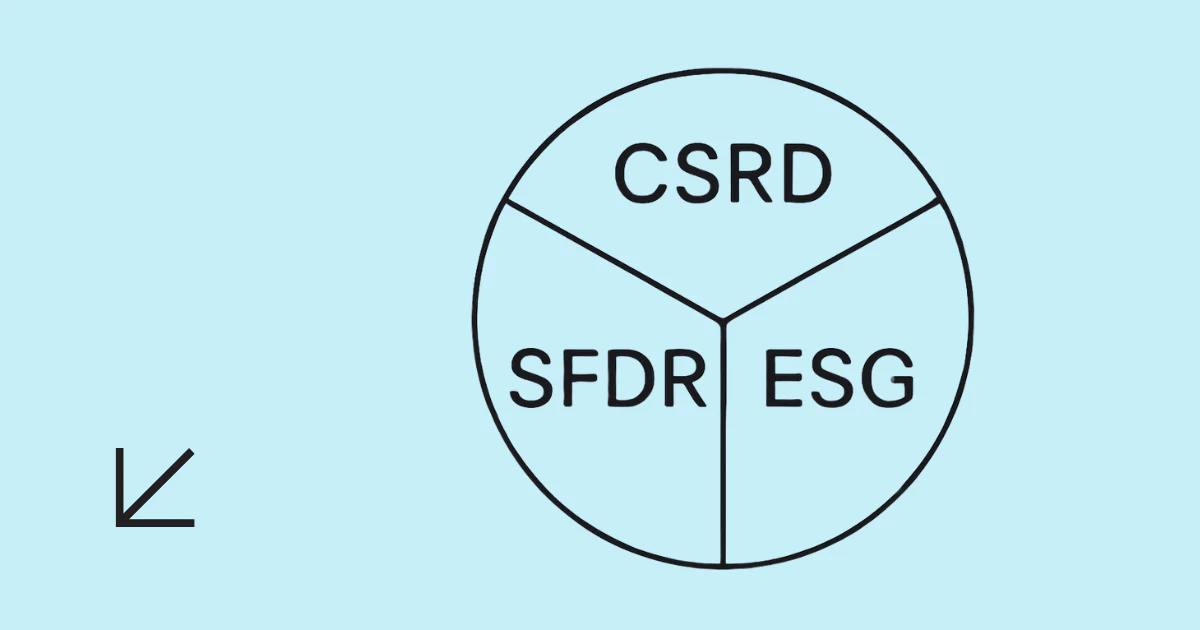
Both CSRD and SFDR are key components of the EU’s broader sustainable finance strategy. Along with the EU Taxonomy Regulation, they form a triad of policies aimed at directing capital toward sustainable economic activities.
Their shared objectives include promoting ESG transparency, standardizing sustainability data, and reducing the risk of greenwashing. They also aim to provide a clearer view of sustainability-related risks, both for businesses and investors.
Overlapping Data Points
Many sustainability indicators are relevant for both CSRD and SFDR. These include, but are not limited to:
- Greenhouse gas emissions (Scope 1, 2, and 3)
- Energy consumption from renewable and non-renewable sources
- Gender diversity in governance bodies
- Gender pay gap
- Exposure to fossil fuels
- Waste generation, including hazardous and radioactive waste
- Human rights violations and adherence to OECD and UN principles
This overlap means that data collected for CSRD reporting can often be reused for SFDR compliance, and vice versa. However, aligning these disclosures is not always straightforward.
Reporting Challenges: Why Aligning CSRD and SFDR Is Not So Simple
While the idea of reusing data between CSRD and SFDR is appealing, the reality is more complex. One major challenge is that the two regulations use different terminology and assessment criteria, even for similar indicators. This can lead to confusion and increased workloads for ESG teams trying to align disclosures.
Another issue is materiality. CSRD requires a double materiality assessment, which means companies only report on sustainability issues that are deemed materially relevant. On the other hand, SFDR requires disclosure of specific PAI indicators, regardless of materiality. This creates a potential data gap between what companies report and what financial institutions need.
Companies that are not directly subject to SFDR may still find themselves being asked by investors to provide SFDR-aligned data. Without proper tools, collecting and aligning this data manually can be extremely time-consuming and prone to error.
How Carbmee Helps Solve This Problem
At Carbmee, we recognize that ESG compliance is not just a reporting exercise but a data challenge. Our CSRD Solution helps organizations streamline their ESG data collection, align metrics across multiple frameworks, and reduce manual effort. By automating data processing and identifying overlaps between CSRD and SFDR requirements, Carbmee’s platform empowers companies to build audit-ready reports while supporting the needs of financial stakeholders.
Whether you are preparing your first CSRD report or looking to provide data to SFDR-compliant investors, Carbmee can help you create a unified, scalable sustainability reporting process.
What Role Does the EU Taxonomy Play in All This?
The EU Taxonomy is the foundation for understanding what qualifies as an environmentally sustainable activity. It provides clear definitions and technical screening criteria for determining whether an economic activity makes a substantial contribution to the EU’s climate and environmental goals.
Both CSRD and SFDR incorporate the EU Taxonomy. Under CSRD, companies must report how much of their revenue, capital expenditures, and operating expenditures are aligned with taxonomy-compliant activities. Under SFDR, financial products that promote environmental characteristics or have sustainability objectives must disclose the share of investments in taxonomy-aligned activities.
By offering a common language for sustainability, the EU Taxonomy enables consistent reporting across both regulatory frameworks. For a deeper dive, we recommend exploring our EU Taxonomy Regulation Guide.
Timeline: When Do You Need to Be Compliant?
Understanding the compliance timeline is critical for avoiding penalties and ensuring a smooth transition.
- SFDR came into force in March 2021. Level 2 disclosures became mandatory in January 2023.
- CSRD starts applying in 2025 for companies already subject to NFRD (reporting on 2024 data).
- Other large companies must start reporting in 2026 (for FY 2025).
- Listed SMEs are required to comply starting in 2027 (for FY 2026).
- EU Taxonomy disclosures are already mandatory for some companies and will expand further in parallel with CSRD adoption.
Building a Future-Proof ESG Reporting Strategy
CSRD and SFDR are not just isolated compliance obligations. Together, they form the backbone of the EU’s ambition to create a sustainable, transparent, and trustworthy financial system. While they have different scopes and apply to different entities, they are interconnected in purpose and practice.
Understanding their differences and overlaps will allow your organization to build a more coherent ESG reporting strategy. The key is to invest early in aligning your data systems, understanding double materiality, and leveraging tools that reduce complexity.
With platforms like Carbmee, companies can efficiently meet their CSRD obligations while supporting investor demands under SFDR. If you are looking to simplify compliance and turn ESG data into strategic value, our team is here to help.

Frequently Asked Questions
What is the main difference between CSRD and SFDR?
CSRD applies to companies and focuses on sustainability reporting within their own operations. SFDR applies to financial market participants and focuses on disclosing how their financial products impact sustainability.
Are CSRD and SFDR mandatory?
Yes. Both regulations are mandatory under EU law. CSRD affects companies based on size and public interest status. SFDR affects financial market participants operating in the EU.
How are CSRD and SFDR connected?
They are connected through shared ESG data. Companies report sustainability data under CSRD, which financial institutions then use to meet SFDR disclosure requirements.
What is double materiality in CSRD?
Double materiality means companies must report on how sustainability issues affect their business and how their operations impact people and the planet.
What are Articles 6, 8, and 9 in SFDR?
These refer to categories of financial products. Article 6 has no ESG focus, Article 8 promotes ESG characteristics, and Article 9 has a sustainable investment objective.
What if my company doesn’t fall under CSRD yet?
Even if you are not currently subject to CSRD, you may still be asked for sustainability data by investors or customers. Preparing early is highly recommended.