From CSRD to CBAM: Why Compliance Output Isn’t the Outcome
Most enterprise teams can produce an ESG report. That is no longer the bar.
With CSRD/ESRS, CBAM, and the EU Taxonomy raising expectations across Europe, alongside growing pressure from investors, customers, and supply chain partners, compliance is shifting from a periodic reporting exercise to a continuous, auditable operating requirement.
That shift matters.
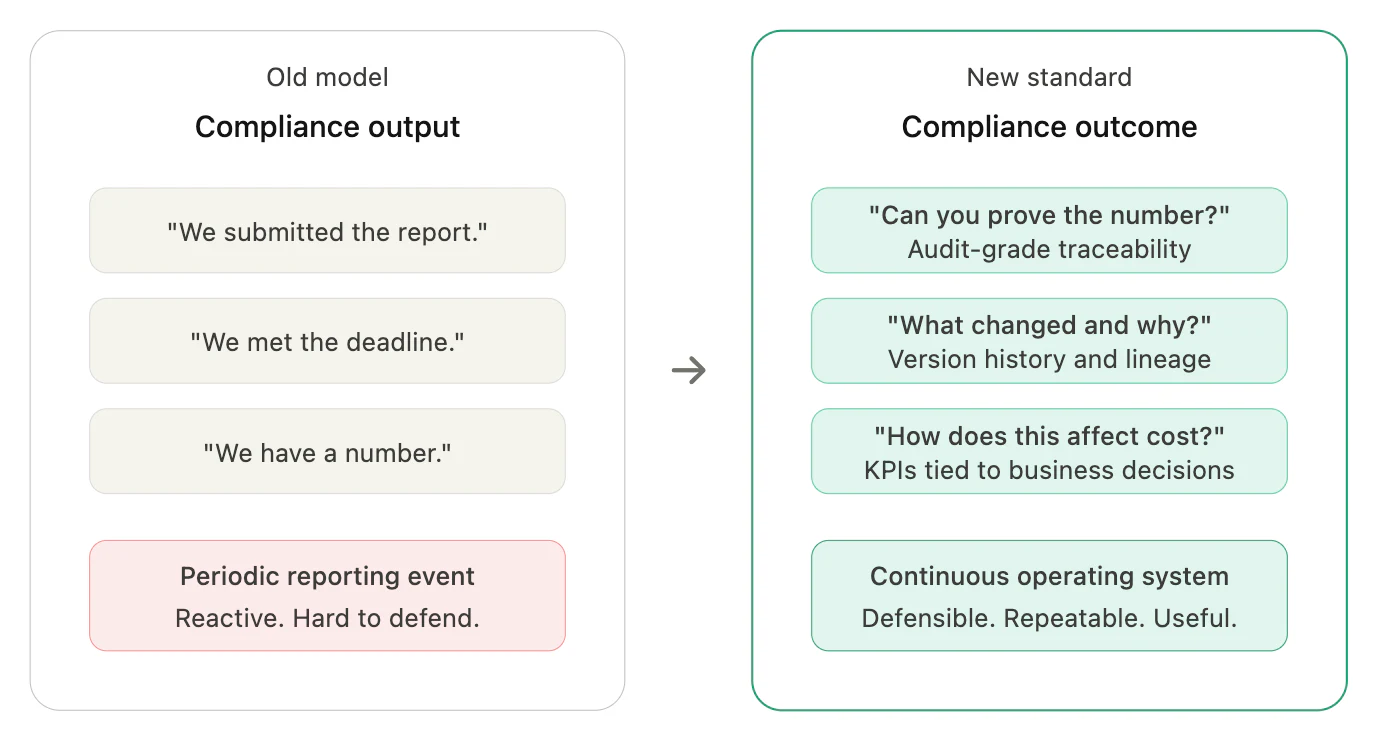
For many organisations, the old model was built around output:
We submitted the report. We met the deadline. We have a number.
But that is no longer enough. Today, stakeholders increasingly care about outcomes:
Can you prove the number? Can you trace it back to supplier- and activity-level evidence? Can you explain what changed and why? Can you show how compliance KPIs connect to risk, cost, and performance?
That is the real compliance gap: impressive reporting output, but weak business outcomes.
The companies pulling ahead are not simply producing disclosures faster. They are building systems that make those disclosures defensible, repeatable, and useful across the business.

The missing ingredient: audit-grade traceability
In a multi-framework world, compliance is not just about producing disclosures. It is about producing defensible disclosures.
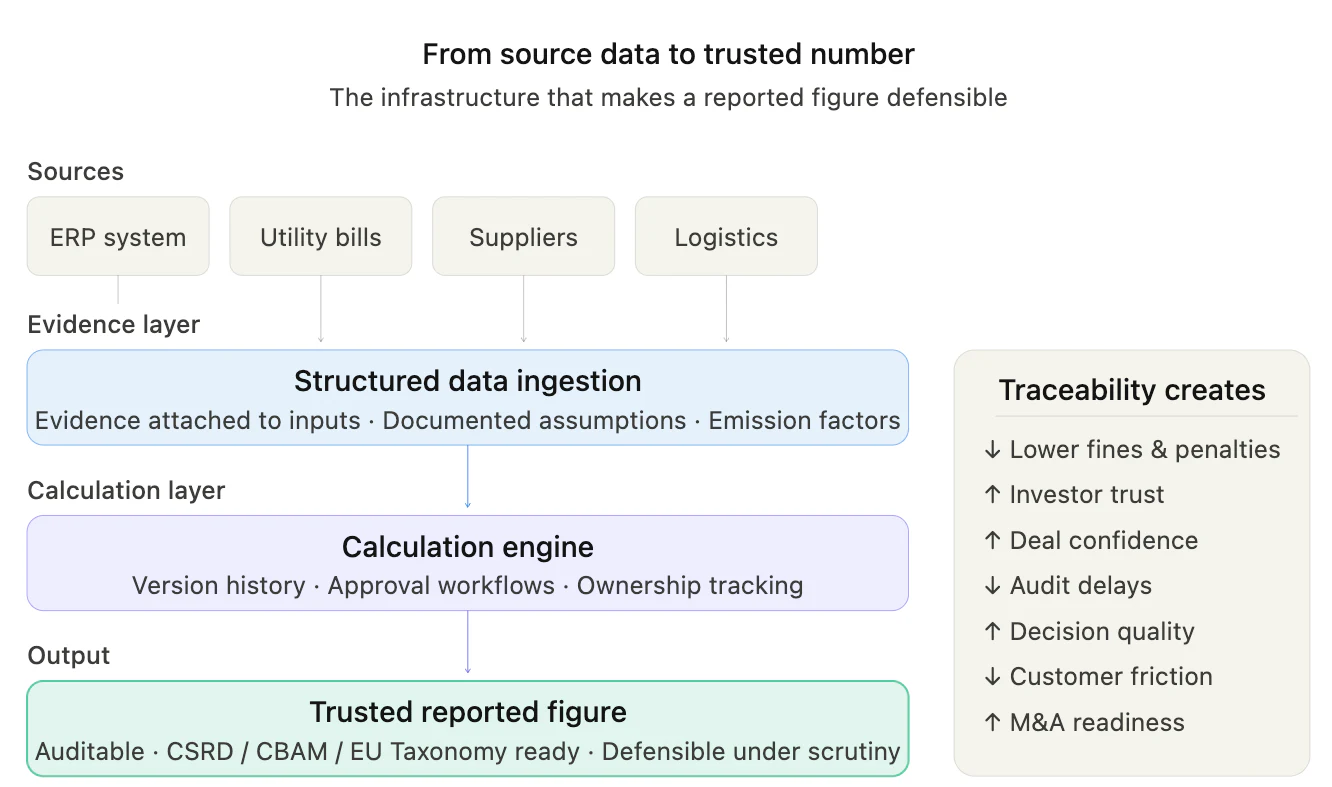
That requires audit-grade traceability, including:
- documented assumptions and emissions factors
- evidence attached directly to inputs, not buried in inboxes
- version history showing what changed, when, and why
- approval workflows with clear ownership
- lineage from source system to calculation to reported figure
This is the infrastructure that turns a reported number into a trusted number.
Traceability reduces downside risk, including fines, penalties, reputational damage, delayed audits, and customer friction. But it also creates upside. It builds trust with investors, strengthens due diligence readiness, improves deal confidence, and gives internal teams a stronger basis for decisions.
Without traceability, compliance stays reactive. With it, compliance becomes operational.
The problem: compliance data lives everywhere, and nowhere
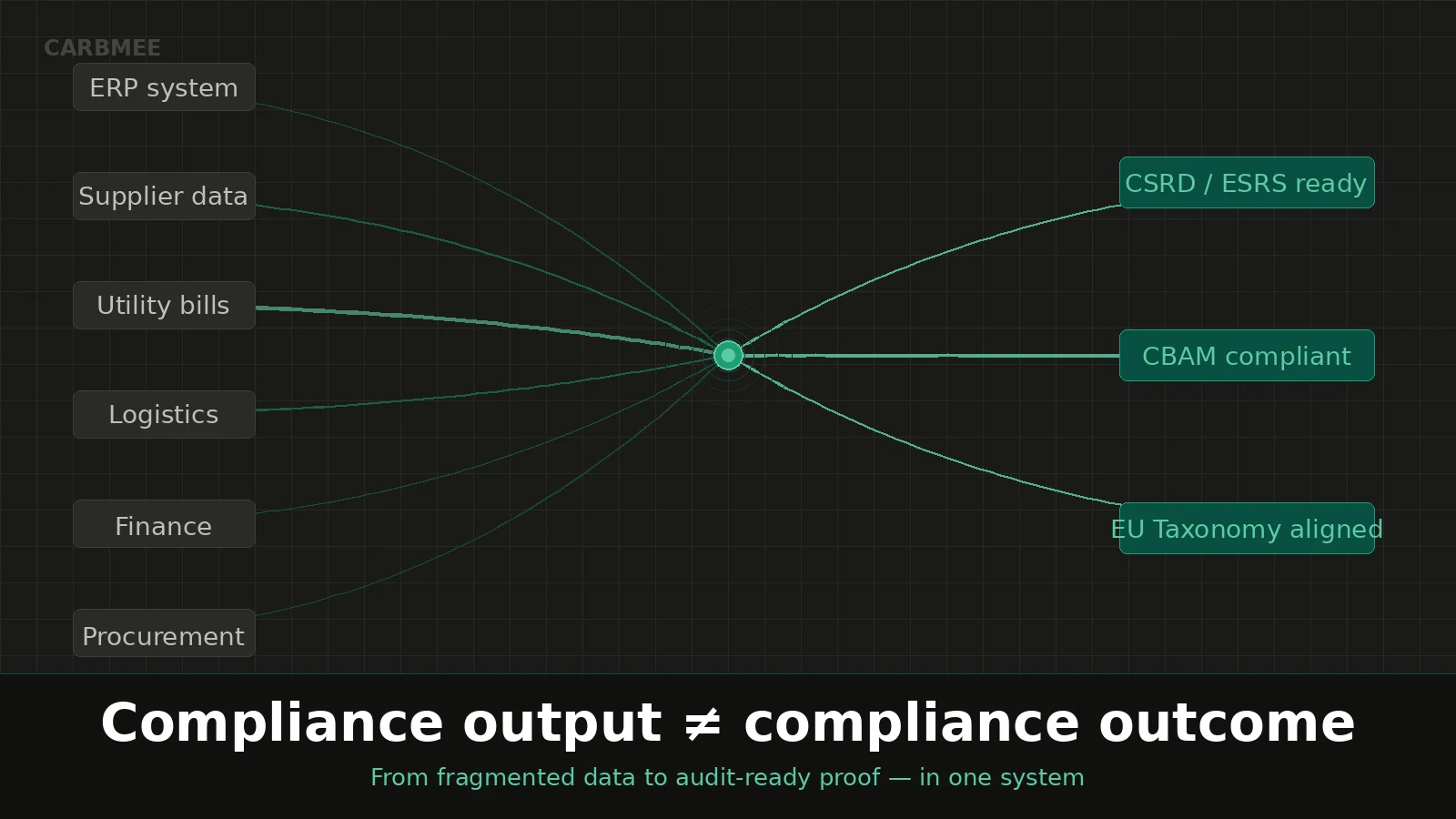
Most enterprises are trying to meet CSRD/ESRS, CBAM, and taxonomy requirements with systems that were never designed for continuous auditability.
The result is familiar:
- data fragmented across ERP systems, utility records, logistics partners, and suppliers
- emissions evidence scattered across spreadsheets, shared drives, and email threads
- manual reconciliation across sustainability, legal, finance, and procurement
- inconsistent definitions across functions, business units, and regions
- reporting cycles that turn into recurring scrambles
What looks manageable at first becomes increasingly brittle as requirements expand.
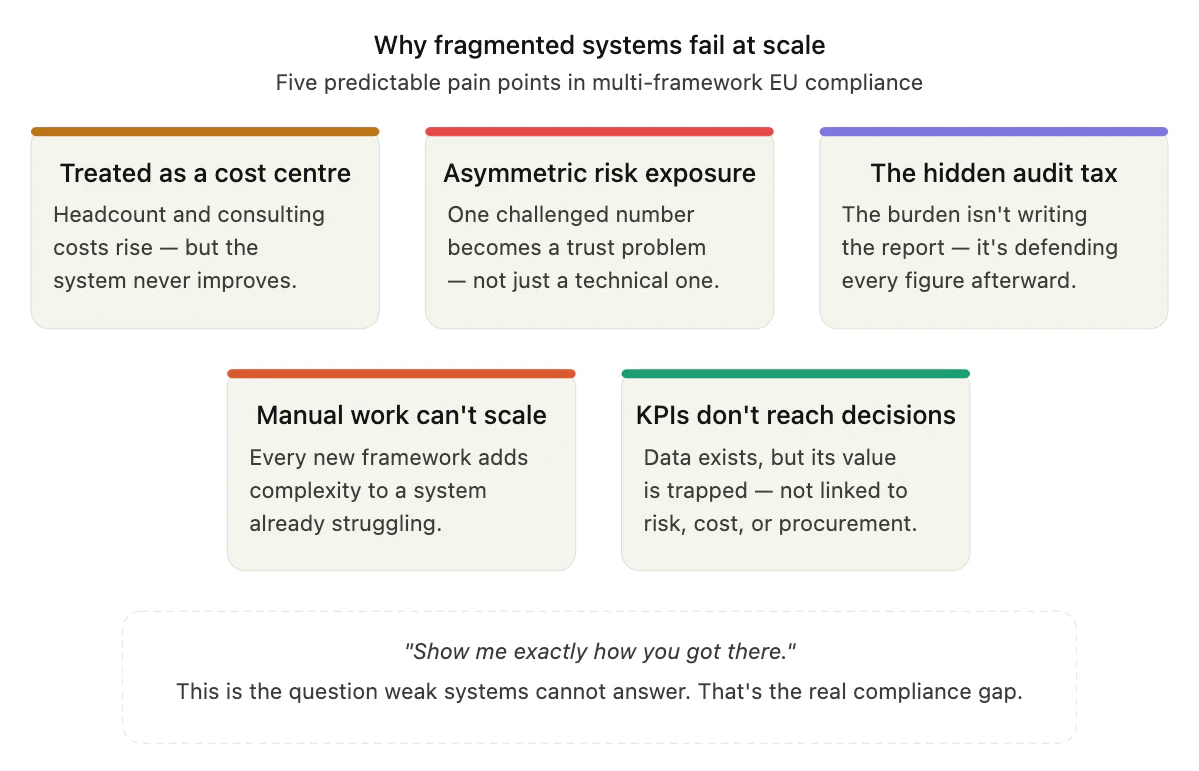
This creates several predictable pain points.
Compliance gets treated like a cost centre
Headcount rises. Consulting costs rise. Internal effort rises. But the underlying system does not improve, which means every future reporting cycle starts from the same weak foundation. Instead of compounding progress, teams repeat the same manual work.
Risk is real, and asymmetric
Non-compliance can trigger direct penalties, but often the bigger threat is commercial and reputational. If a customer, regulator, auditor, or investor challenges a number and the company cannot substantiate it, the issue is no longer just technical. It becomes a trust problem.
Audit readiness becomes the hidden tax
The real burden is rarely generating the report itself. The real burden is defending every reported figure when someone asks:
Show me exactly how you got there.
That is where weak systems create delay, stress, and exposure.
Manual reporting cannot scale to multi-framework change
As requirements evolve across the EU and internationally, manual processes do not just get slower. They become more fragile. Every new framework, every new data request, and every new assurance requirement adds complexity to systems that already struggle to hold together.
KPIs do not connect to business outcomes
Many teams can report supplier coverage, footprint changes, or emissions hotspots. Far fewer can reliably connect those indicators to financial and operational decisions such as:
- risk exposure
- margin impact
- procurement choices
- capex prioritisation
- supplier strategy
That disconnect is costly. It means compliance data exists, but its business value remains trapped.
The alternatives do not solve the real problem
Most companies fall into one of a few familiar patterns.
Spreadsheets plus point tools are fast to start, but hard to govern and almost impossible to audit at enterprise scale.
Consultancy-heavy reporting may produce polished reports, but often does little to build internal systems, repeatable workflows, or durable traceability.
Estimates and placeholders create a sense of coverage, but they break down quickly under CBAM or CSRD scrutiny.
Disconnected tools may contain useful data, but without a shared governance model or evidence chain, they still leave teams exposed.
These approaches can generate output. They do not create a durable outcome.
What enterprise teams actually need is a system that turns supplier-level reality into audit-ready compliance and measurable action.
The target state: compliance as a performance system
Imagine compliance working like an operating model, not an emergency. In that world:
- supplier-level primary data is collected in a structured, repeatable way
- evidence and assumptions live with the number
- every footprint has version control and an audit trail
- hotspots are visible by product, site, material, and supplier
- decarbonisation actions are linked to measurable outcomes
- compliance KPIs connect directly to enterprise risk and performance management
This is the shift from reporting as an event to compliance as a system.
In that system, compliance stops being overhead and starts becoming a value driver. It lowers regulatory and reputational risk. It shortens stakeholder response time from weeks to hours. It strengthens supplier programmes and improves data quality. It supports better investment decisions in decarbonisation by showing payback, ROI, and modelled-versus-actual impact. It improves readiness for M&A, IPO activity, financing, and due diligence.
That is the real opportunity: not just better disclosure, but better performance.
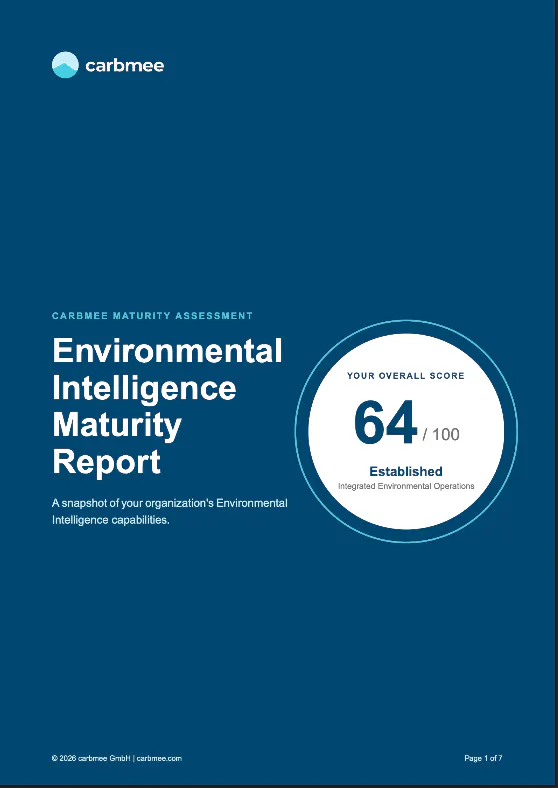
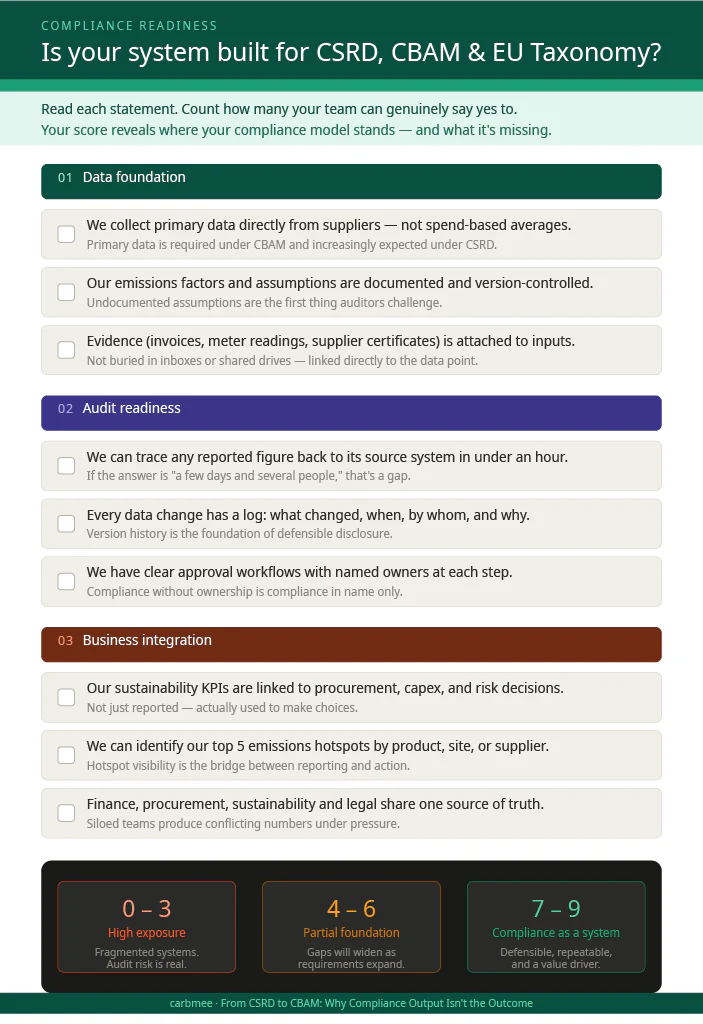
Is your compliance system built for 2026 and beyond ? Take the quick readiness check.
Before you move on, here is a fast way to gauge where your organisation actually stands. Read each statement below and count how many your team can genuinely say yes to. Nine questions, three themes, one honest score.
Score 0 to 3: high exposure. Your systems are fragmented and audit risk is real. Score 4 to 6: partial foundation. The gaps exist and will widen as regulatory requirements expand. Score 7 to 9: compliance as a system. Your data is defensible, repeatable, and starting to drive business value.
Click here to download the readiness check
If you scored lower than you would like, book a free consultation with one of our experts and learn where and how your company could improve.
What we are building at Carbmee
Carbmee turns real, supplier-level primary data into audit-ready product and corporate carbon footprints, and links those hotspots directly to measurable decarbonisation actions inside one platform.
That matters because EU regulations are pushing companies beyond simply having a footprint. Increasingly, they need to be able to substantiate it, govern it, and act on it across the value chain.
This is not only about reporting faster. It is about making carbon data trustworthy enough to use in procurement, product decisions, supplier engagement, and investment planning.
What changes in 30 days
Within the first month, teams can begin shifting from carbon reporting as a periodic scramble to carbon as an operating metric across procurement, products, and suppliers. In practice, that means:
- replacing spend-based averages with supplier- and material-specific inputs where they matter most
- generating traceable PCFs and CCFs with documented assumptions and evidence trails
- identifying top emissions drivers, where a small set of items often dominates overall footprint
- turning hotspots into a prioritised decarbonisation backlog based on CO₂ and cost impact
- running supplier engagement as a structured programme with coverage, data quality, and follow-up workflows
- tracking progress continuously as new data and actions come in
- aligning sustainability, procurement, product, and finance around a single source of truth
That shift creates momentum quickly because it replaces fragmented effort with shared operational visibility.
Features tied to outcomes
Enterprise teams do not buy features in isolation. They buy outcomes.
- Enterprise and supplier data ingestion: defensible CSRD/CBAM reporting.
Outcome: stronger audit readiness and fewer fire drills.
- Supplier engagement: primary data at scale.
Outcome: better coverage and higher-quality inputs across the value chain.
- Audit trail and version control: governance-grade traceability.
Outcome: reduced compliance risk and faster alignment across internal teams.
- Hotspots to actions to measurable reductions.
Outcome: a shift from disclosure to performance, with initiatives that can be prioritised, tracked, and defended.
Proof in the real world
The value of this approach is already visible in practice.
Maersk + Carbmee
By combining logistics expertise with automated emissions reporting, the partnership helps streamline CBAM compliance, reduce regulatory risk, and improve emissions data accuracy.
Heraeus + carbmee EIS™
The result includes compliance support, third-party audited sustainability reporting, efficient carbon calculations, CSRD readiness, and dashboards tailored to the needs of the business.
Why this matters now
CSRD/ESRS, CBAM, and the EU Taxonomy are not just new reporting obligations. They signal a new standard for enterprise compliance: audit-grade, multi-framework-ready evidence that scales across global supply chains.
The companies that stay ahead will not be the ones that publish the fastest. They will be the ones that can prove the number, explain the change, and connect compliance to business outcomes, including risk, cost, procurement decisions, and investment priorities.
Bringing it full circle
The core insight is simple: compliance output does not equal compliance outcome.
Fragmented systems and manual workflows cannot scale to multi-framework EU demands.
The target state is clear: audit-ready traceability, supplier-level reality, and actions tied to measurable impact. The solution is equally clear: one system that turns primary data into auditable footprints and measurable decarbonisation.
Are you ready to see what this looks like for your organisation?
That is the question more enterprise teams are asking now, not because reporting got harder, but because the definition of good enough has changed.
Today, it is not enough to have a report. You need proof. You need traceability. And you need to be able to turn compliance into action.