What Is the SBTi? A 2026 Guide to Science-Based Targets and the New Net-Zero Standard
The SBTi (Science Based Targets initiative) validates corporate emissions targets against climate science. More than 10,000 companies now hold validated targets. In June 2026 the SBTi published Corporate Net-Zero Standard Version 2.0, its first major overhaul in five years. This guide explains what the SBTi is, how validation works, what changed under V2.0, and how to hit your targets.


Why Your SBTi Status Matters in 2026
If your customers, investors, or auditors have started asking about your SBTi status, you are not alone. The Science Based Targets initiative has become the reference point for credible corporate climate targets, and by January 2026 more than 10,000 companies held validated targets, a near 40% jump in a single year. Being outside that group is now a competitive question, not just a reputational one.
The rules also moved. On 11 June 2026 the SBTi released a new Corporate Net-Zero Standard, changing how targets are set, reported, and renewed. Meanwhile 239 well-known companies lost their commitments in 2024 for missing the mark, most of them stuck on the same problem: Scope 3. This guide gives you the current picture and a practical route through it.

What is the SBTi?
The SBTi is an independent body that reviews and certifies corporate greenhouse gas reduction targets to confirm they align with climate science. Founded in 2015, it is a partnership between CDP, the UN Global Compact, the World Resources Institute, and the World Wide Fund for Nature. It sets the method, then validates company targets against it.
The initiative grew out of the Paris Agreement goal of limiting warming to well below 2 degrees Celsius, and it has since raised its minimum bar toward 1.5 degrees. Its core functions are narrow but influential: define best practice, provide technical guidance, and independently validate targets. David Kennedy took over as chief executive in January 2025.
For most manufacturers, the SBTi now functions as the de facto standard that investors, customers, and regulators recognise. A validated target is a public, verified signal that your climate plan holds up to scrutiny.
How the SBTi works: from commitment to validated target
The SBTi does not set your target for you. Your company builds a target using SBTi criteria, submits it to SBTi Services for independent validation, then reports progress on a regular cycle. Validation is the step that turns an internal ambition into a credible, externally recognised commitment.
Historically the process opened with a public commitment letter. Under the new standard, the SBTi has replaced that public proclamation with a requirement for internal sign-off before a company pursues a target. The intent is fewer abandoned pledges and more targets that companies can actually deliver.
Two target horizons sit at the centre of the framework. Near-term targets cover the next 5 to 10 years and drive immediate cuts. Net-zero targets set a long-range destination, typically by 2050, backed by deep reductions across the value chain. Companies also face a mandatory review five years after validation, so a target is a rolling commitment, not a one-time badge.
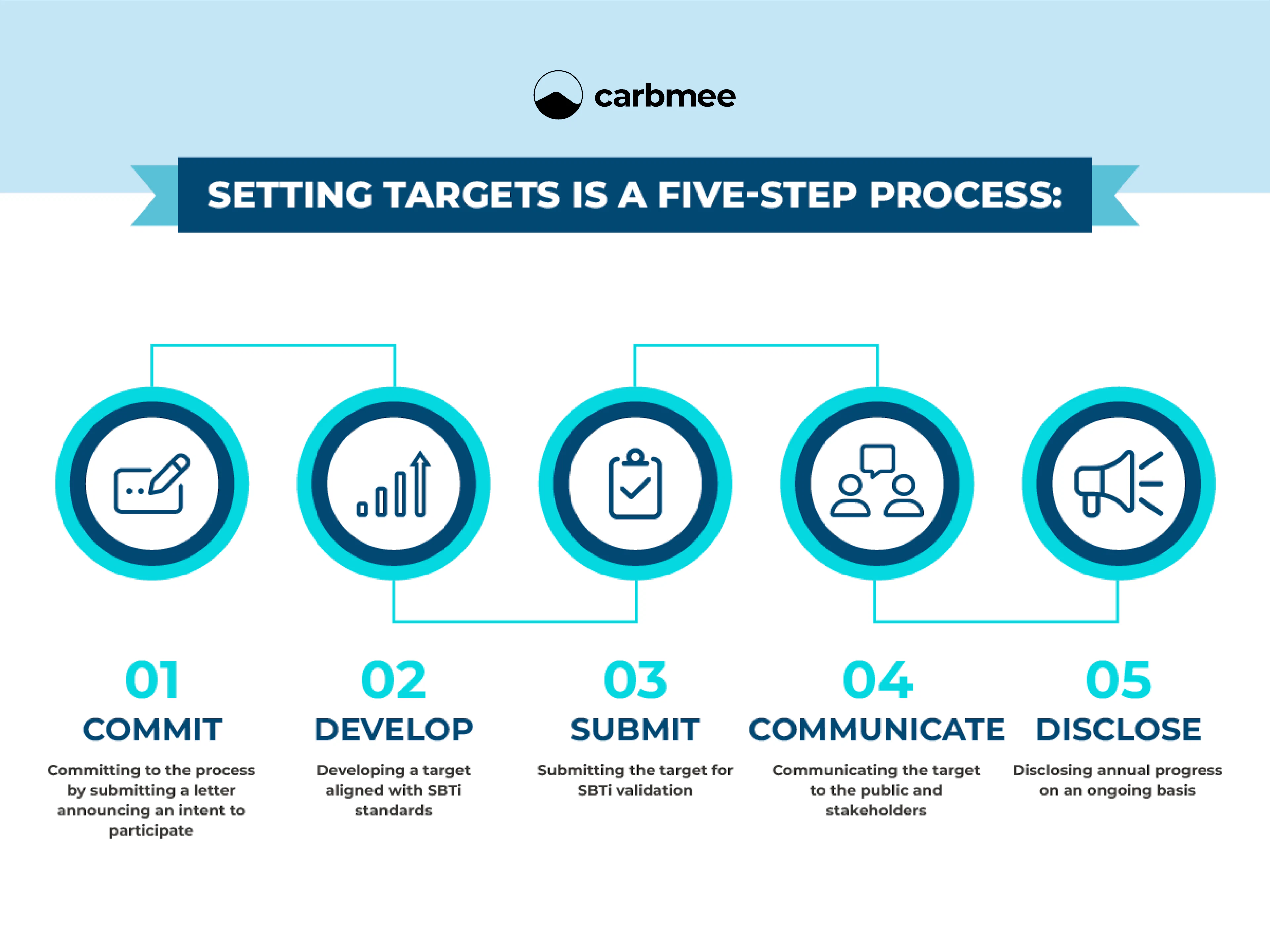
SBTi target types: near-term, net-zero, and Scopes 1 to 3
SBTi targets follow the GHG Protocol's three scopes. Scope 1 covers direct emissions you own. Scope 2 covers purchased energy. Scope 3 covers everything in your value chain, from suppliers to product use. Targets can be absolute (cut total tonnes) or intensity-based (cut per unit of output).
The scope that decides most manufacturers' fate is Scope 3. Under SBTi near-term criterion C4, a Scope 3 target is required when value-chain emissions are 40% or more of your combined Scope 1, 2, and 3 total, which is the case for the large majority of companies. Today 96% of validated targets already include Scope 3. For a fuller breakdown of the scopes, see our GHG Protocol guide.
Ambition is quantified, not vague. A 1.5-degree-aligned near-term target implies roughly a 4.2% linear cut in emissions every year. That pace is why data quality, not goodwill, determines whether a target is achievable.
How to get started: confirm whether your Scope 3 share crosses the 40% threshold before you commit to a target horizon. For most industrial manufacturers, it does.
The new Corporate Net-Zero Standard V2.0: what changed in 2026
The SBTi published Corporate Net-Zero Standard Version 2.0 on 11 June 2026, its most significant revision since the original 2021 standard. According to the SBTi's summary of changes, 42% of the standard's sections are entirely new and the rest are modified. The direction is toward practical implementation rather than pledges alone.
The timeline matters for planning. Version 1.3.1 remains the applicable framework for validation throughout 2026. From the first quarter of 2027, companies can submit under either version during a transition window, and Version 2.0 becomes mandatory for all submissions from 31 January 2028. The SBTi's own guidance is direct: if you are setting a target in 2026, do it now using Version 1.3.1.
Several changes stand out for manufacturers. The standard introduces differentiated approaches for smaller companies and lower-income markets, moves to a cycle of annual reporting with a periodic full review, and brings carbon removals and beyond-value-chain mitigation into one framework for residual emissions. Long-term targets are no longer strictly mandatory, while requirements for meeting short-term goals have been sharpened.
Behind the standard sits a strategy shift. The SBTi has repositioned itself as a "transformation partner," widening its focus from validating targets to helping companies implement them. A renewal policy for firms already in the system is expected later in 2026.
Why SBTi matters now: regulation, investors, and procurement
A validated SBTi target is no longer a nice-to-have. It has become a baseline expectation across three forces at once: regulators aligning disclosure rules with science-based approaches, investors treating validation as a proxy for climate-risk management, and customers writing science-based targets into procurement criteria.
The regulatory overlap is the most concrete. A validated SBTi submission, built on a solid emissions inventory, practically satisfies the key ESRS E1 climate disclosures under CSRD, including the target methodology, transition plan, and emissions baseline. The two are complementary rather than duplicative, so the work you do for one supports the other. Our CSRD overview sets out those reporting obligations in detail.
Adoption reflects the pressure. More than 2,300 companies now hold validated net-zero targets specifically, a subset of the wider validated population. For the reasoning behind the destination itself, see why net zero.
The Scope 3 problem: why targets get missed
In 2024 the SBTi removed the commitments of 239 major companies, including Microsoft, Unilever, Procter & Gamble, and Walmart, for failing to set required targets on time. The delisting was a public marker of the gap between climate promises and delivery. Encouragingly, around 60% of affected firms kept their near-term targets in place.
The common failure point was Scope 3. In one survey tied to the process, 54% of companies said tackling Scope 3 was too challenging. Value-chain emissions are hard to measure, spread across thousands of suppliers, and largely outside direct control.
That difficulty fuelled the initiative's sharpest controversy. In 2024 the SBTi floated wider use of carbon offsets against Scope 3 targets, and the proposal drew a public backlash, including from its own staff. Version 2.0 settled the question: the standard continues to prioritise direct emission cuts and does not treat offsets as a substitute for reductions. The lesson for manufacturers is blunt: you cannot buy your way past a Scope 3 target. You have to measure it and reduce it.
How to hit your SBTi targets: get your Scope 3 data right
A validated target lives or dies on Scope 3 data. To set a credible target and prove progress against a 5-year review, you need a supplier-level, product-level emissions baseline you can update as your value chain changes. Estimation-based averages will not carry an audit or an SBTi renewal.
carbmee EIS™ builds that foundation from your existing transactional data. Signify, the global lighting company operating in more than 70 countries, used carbmee to move from estimation to a granular Scope 3 baseline at SKU, business-unit, and supplier level. That baseline now underpins its target of a 40% reduction by 2030 and 90% by 2040. The pattern holds across industrial manufacturers: fix the data, and the target becomes deliverable rather than aspirational. For the detail on that work, see our ultimate guide to Scope 3 emissions.
How to get started: map where your Scope 3 emissions actually concentrate before you set a reduction pathway. In most supply chains, a small group of suppliers drives the majority of the footprint.
The Bottom Line for Manufacturers
The SBTi has shifted from a voluntary badge to a market expectation, and the 2026 standard raises the bar on delivery rather than pledges. Three points to carry into your planning: set targets in 2026 under Version 1.3.1 and plan your move to V2.0 before it becomes mandatory in January 2028; treat Scope 3 as the make-or-break scope, because offsets will not close the gap; and build a supplier-level data foundation now, since the five-year review is a delivery test, not a formality.
See how carbmee's carbon management and accounting platform builds the audit-grade Scope 3 baseline your SBTi target depends on. Book a demo to walk through your value chain with our team.