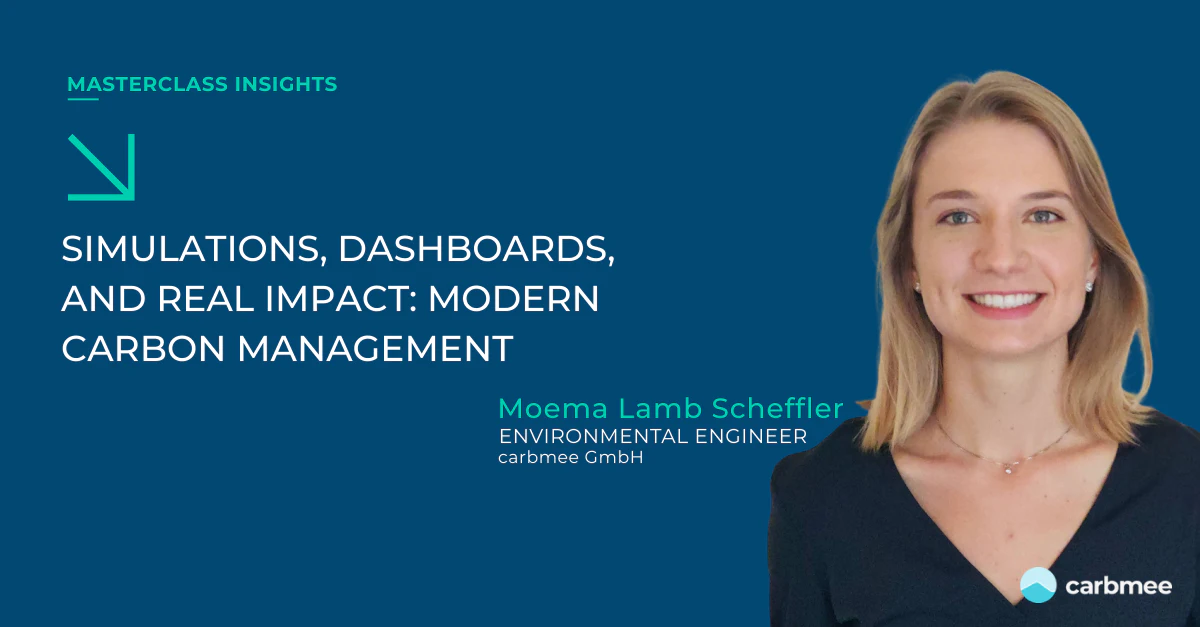
Simulations, Dashboards, and Real Impact: Modern Carbon Management

Why Visibility Is Everything
High-level carbon reports rarely provide actionable insights. Companies need SKU-level and supplier-level visibility to identify true hotspots, quantify impact, and guide reduction strategies. Without it, decarbonization initiatives risk being broad, unfocused, and inefficient.
Modeling Scenarios to Inform Strategy
Carbmee’s platform enables organizations to simulate changes in material sourcing, energy use, and production processes. For instance, replacing primary aluminum with recycled aluminum or shifting to renewable electricity recalculates emissions instantly at both the SKU and Scope 3.1 levels. Teams can compare different scenarios to evaluate the effectiveness of reduction measures before implementing them in reality.
This level of precision is exactly what many manufacturers are looking for as they work to understand and reduce their environmental footprint. As Frank Wenig, Head of Research and Development at Steinbeis Papier, highlights:
“At Steinbeis Papier, we want to manage our environmental impact with the same level of precision as we manage our business. The EIS™ will help us gain complete transparency into the carbon emissions of our products and everything that goes into them, at the highest level of granularity. From the massive amounts of secondary fibers down to the last drop of retention aid.”
Custom Dashboards and Automated Reports
Dynamic dashboards provide a complete overview of emissions per SKU, product category, and supplier. Teams can generate automated reports aligned with EU regulations such as CBAM, CSRD, and EUDR, while maintaining transparency and traceability. Customizable dashboards allow organizations to prioritize hotspots, monitor reductions over time, and communicate results internally or externally.
Driving Data-Driven Decarbonization
Ultimately, modern carbon management moves beyond static calculations. By integrating supplier data, production emissions, and scenario modeling into a unified system, companies gain a continuous, data-driven process for Scope 3 reduction.
According to a 2024 report from CDP and Boston Consulting Group (BCG), supply-chain (Scope 3) emissions reported by companies are on average 26 times higher than their direct operational emissions (Scope 1 & 2) (BCG, 2025). This highlights why granular visibility and scenario modeling across suppliers and products are essential for effective decarbonization.
This approach turns carbon management into a competitive advantage, enabling resilient, low-carbon supply chains that can respond to both regulatory and market demands.
Why Carbmee is the best solution
With its combination of granular data visibility, scenario modeling, and customizable dashboards, Carbmee empowers organizations to not only track emissions but actively reduce them with precision and confidence. Our platform transforms carbon management from a reporting exercise into a strategic tool, helping companies achieve measurable sustainability goals while creating tangible business value.