
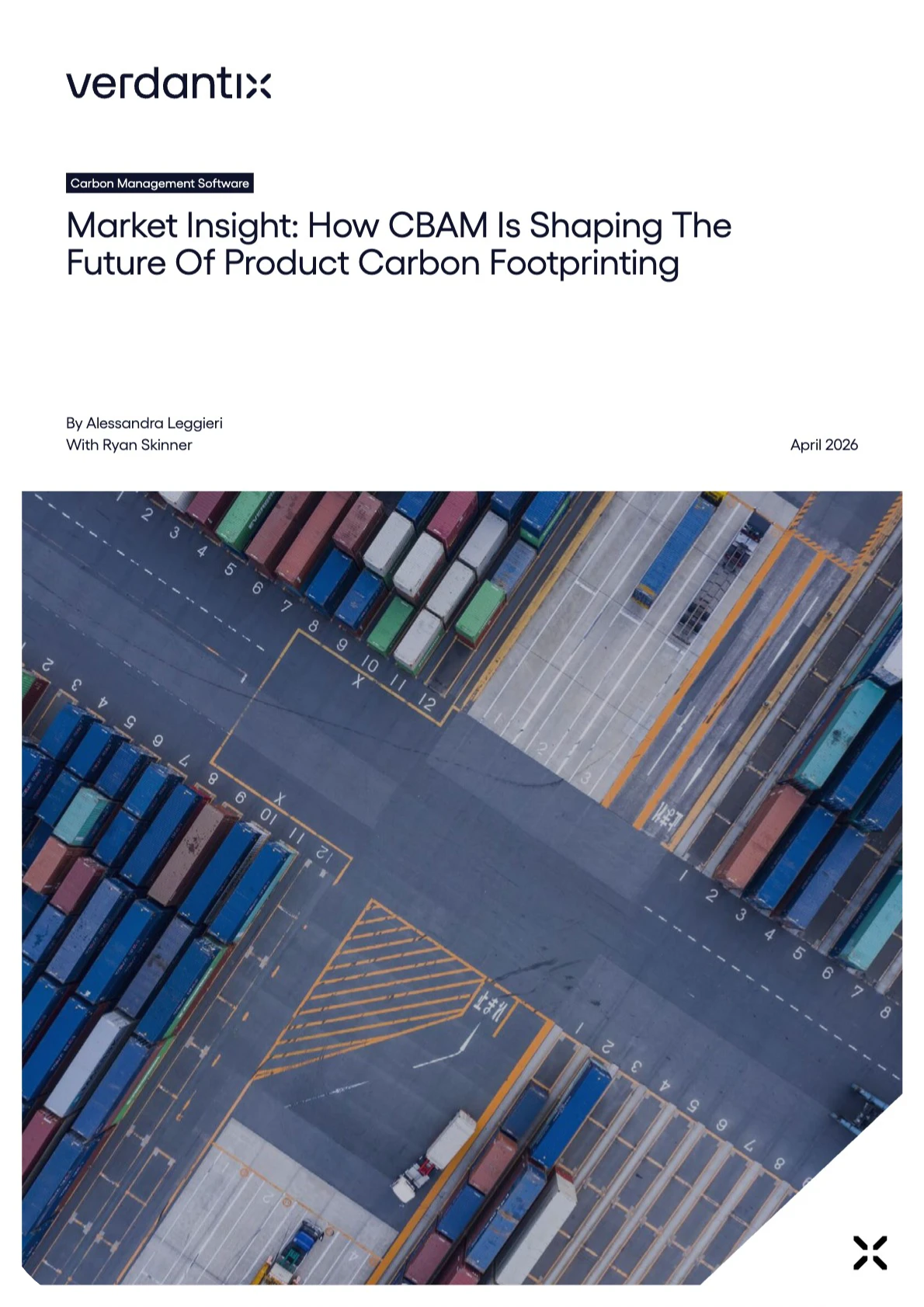
How CBAM Is Shaping The Future Of Product Carbon Footprinting
A Verdantix white paper on how the EU CBAM is transforming product carbon footprinting, why verified supplier data now matters financially, and what importers and suppliers need to do as CBAM enters its definitive phase.
Carbon is no longer only a reporting metric. It becomes a cost driver. A compliance obligation. A product-level financial variable.
From January 2026, importers of CBAM-covered goods into the EU must report embedded emissions and purchase CBAM certificates linked to those emissions. This shifts product carbon footprinting from a voluntary, customer-driven exercise to a regulated process where calculation accuracy directly affects financial liability.
This is not just a change in reporting expectations.
It is a structural shift in product carbon data, supplier engagement, and carbon cost management.
Why 2026 Is a Turning Point
Companies that cannot provide reliable, auditable product carbon data will face higher compliance uncertainty, greater reliance on default values, and weaker control over CBAM-related cost exposure.
At the same time:
- The EU CBAM entered its definitive phase with certificate obligations from 2026
- Embedded emissions now directly influence financial liability
- Default values can increase declared emissions and carbon costs
- Supplier-level primary data is becoming essential for accurate reporting
- Importers need visibility into carbon exposure by product, supplier, and production site
CBAM is moving product carbon footprinting beyond voluntary reporting into core decision-making across finance, procurement, compliance, supply chain, and strategy.
Get your Full Copy of the CBAM & Product Carbon Footprinting Whitepaper
What’s Inside the Whitepaper
This white paper explains how the EU CBAM’s definitive phase is reshaping product carbon footprinting for importers, suppliers, and software providers. It outlines what robust readiness looks like when embedded emissions data becomes a driver of certificate obligations, carbon costs, and compliance risk.
What You Will Learn:
How CBAM shifts product carbon footprinting from voluntary transparency to regulated financial compliance
Why 2026 is a turning point for verified, installation-level product carbon data
How embedded emissions directly affect CBAM certificate obligations and cost exposure
What makes CBAM different from traditional ISO-style product carbon footprinting
Why default values can increase declared emissions and erode commercial advantage
What CBAM-ready software capabilities look like across data collection, supplier engagement, calculation, reporting, and audit trails
How carbon accounting, ESG reporting, ERP, supply chain, and CBAM-native vendors are adapting their solutions
Why granular supplier data and auditable product carbon footprints are becoming essential for importers and suppliers
Download the Whitepaper
Prepare your organization for CBAM-driven product carbon footprinting, supplier data requirements, and carbon cost exposure.