
The Margin Protection Strategy
An executive playbook for CPOs, CFOs and CSOs. It shows how enterprise manufacturers turn Scope 3 transparency into supply chain resilience, and why unmeasured carbon already sits in their cost base. Carbon is now a line item in cost of goods sold. CBAM certificates carry a price. CSRD assurance carries an auditor. Sustainability-linked debt carries a margin ratchet.
Each of these mechanisms converts a number your team produces into cash that leaves your business. Most manufacturers still calculate Scope 3 once a year from spend data. That method was built to size a footprint. It was not built to defend a tax position or direct capital.
The question is no longer whether carbon is priced into your cost base.
It is whether you are the one pricing it.
Why Spend-Based Estimates No Longer Hold
Spend-based models cannot tell you which supplier, plant, alloy or shipping lane generates the liability. That leaves you exposed in audits, in customs declarations, and at the negotiating table.
At the same time:
- Spend-based proxies inflate reported emissions when input prices rise, even when nothing changes at the supplier
- CBAM applies deliberately conservative default values wherever verified primary supplier data is missing
- On a single high-volume import line, the gap between verified data and default values can move annual certificate costs by seven figures
- CSRD auditors ask for the evidence chain behind material figures, and category averages cannot provide one
- Reshoring and dual sourcing change the carbon intensity of parts, often without anyone noticing until a customs declaration or assurance finding
Scope 3 is moving from the sustainability report into the P&L. Ownership of the conversation is moving with it, from the CSO to the CFO and CPO.
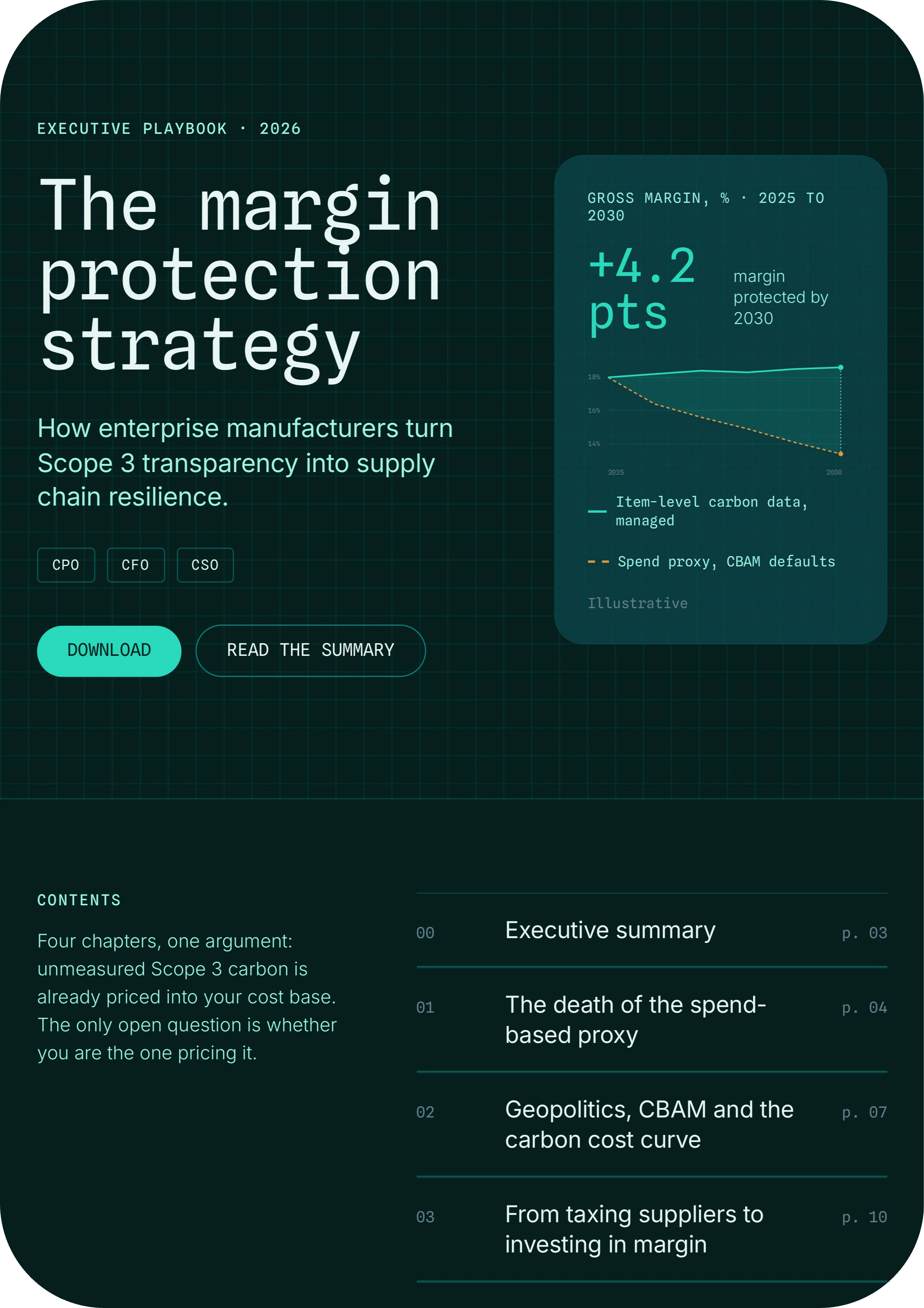
Get Your Full Copy of The Margin Protection Strategy Playbook
What's Inside the Playbook
The playbook argues for treating Scope 3 as an embedded cost liability rather than a disclosure metric. It covers the audit risk of spend-based proxies, how CBAM prices data quality, where supplier abatement concentrates, and what mature environmental intelligence looks like. It closes with five boardroom audit questions for your next audit cycle.
What You Will Learn:
- Why spend-based models misreport emissions when prices move, and what that means under CSRD assurance
- How Carbontology™ shifts carbon accounting from annual spend categories to item-level transactional data
- How CBAM default values turn missing supplier data into a direct cost
- Why roughly 80% of actionable Scope 3 sits with 10% to 15% of tier-1 and tier-2 suppliers
- How to use a marginal abatement cost curve to allocate capital
- Three commercial structures suppliers actually sign
- Where your organization sits on the four-stage environmental intelligence maturity curve
Download the Playbook
Prepare your organization for CBAM default-value exposure, audit-grade Scope 3 requirements, and rising carbon costs across your supply base.