CBAM Cost Management: How to Hedge Carbon-Price Exposure Before It Hits Your Margins
For years, the Carbon Border Adjustment Mechanism (CBAM) was a reporting task. From 2026 it becomes a cost. CBAM is now financially binding on emissions embedded in goods imported from 1 January 2026, even though certificate purchases only begin in February 2027, according to EY's analysis of the CBAM Omnibus regulation. For importers of steel, aluminum, and fertilizers, that turns carbon into a live line item. Good CBAM cost management is how you see that number early and act before it reaches your margins.


Why CBAM is now a margin question, not a compliance one
CBAM costs are not fixed. They track the EU Emissions Trading System (ETS) carbon price, and that price is built to rise. Free ETS allowances phase out by 2034 as CBAM phases in, while covered industries must cut emissions 62% against 2005 levels by 2030, as confirmed in the EU's ETS reform. Tighter supply means a higher price. BloombergNEF forecasts EU ETS prices more than doubling by the end of the decade. The exposure sitting in your bill of materials today will cost more tomorrow.
The questions your team is already asking
For most buying committees, the challenge is not whether CBAM matters, but where to start. Leaders are asking practical questions. Which imported materials carry the most embedded carbon? How much will that cost as ETS prices climb? Can we lower our assessed emissions with better data? Where can we re-source or redesign to cut the bill? CBAM cost management answers all four with numbers instead of guesswork.
What you gain by managing exposure early
The payoff is control. You get forward visibility of cost exposure, a ranked list of the SKUs and suppliers that drive it, and lower assessed emissions where verified data replaces conservative defaults. You also get budgets and provisions that finance can defend, and sourcing and design decisions grounded in cost, not intuition.
A practical CBAM cost-management playbook
- Map exposure by material and supplier. Identify which imported goods fall under CBAM and rank them by embedded carbon. You cannot manage a cost you have not located.
- Replace default values with verified primary data. Default values assume worst-case emissions. Using supplier-specific primary data for CBAM often lowers your assessed cost, and it is frequently the single biggest lever available.
- Model carbon-price scenarios. Test your liability against a range of ETS prices so you know the size of the problem before it lands.
- Provision against the forward cost, not today's price. This is the real hedge. Carbon cost forecasting lets finance budget for the price you will pay, not the one you see now.
- Engage your top-emitting suppliers. A small number of suppliers usually drives most exposure. Work with them to cut embedded emissions at source.
- Feed CBAM data into sourcing and product decisions. Route the insight back into procurement and design so exposure keeps falling.
How ZF turned CBAM cost exposure into a decarbonization advantage
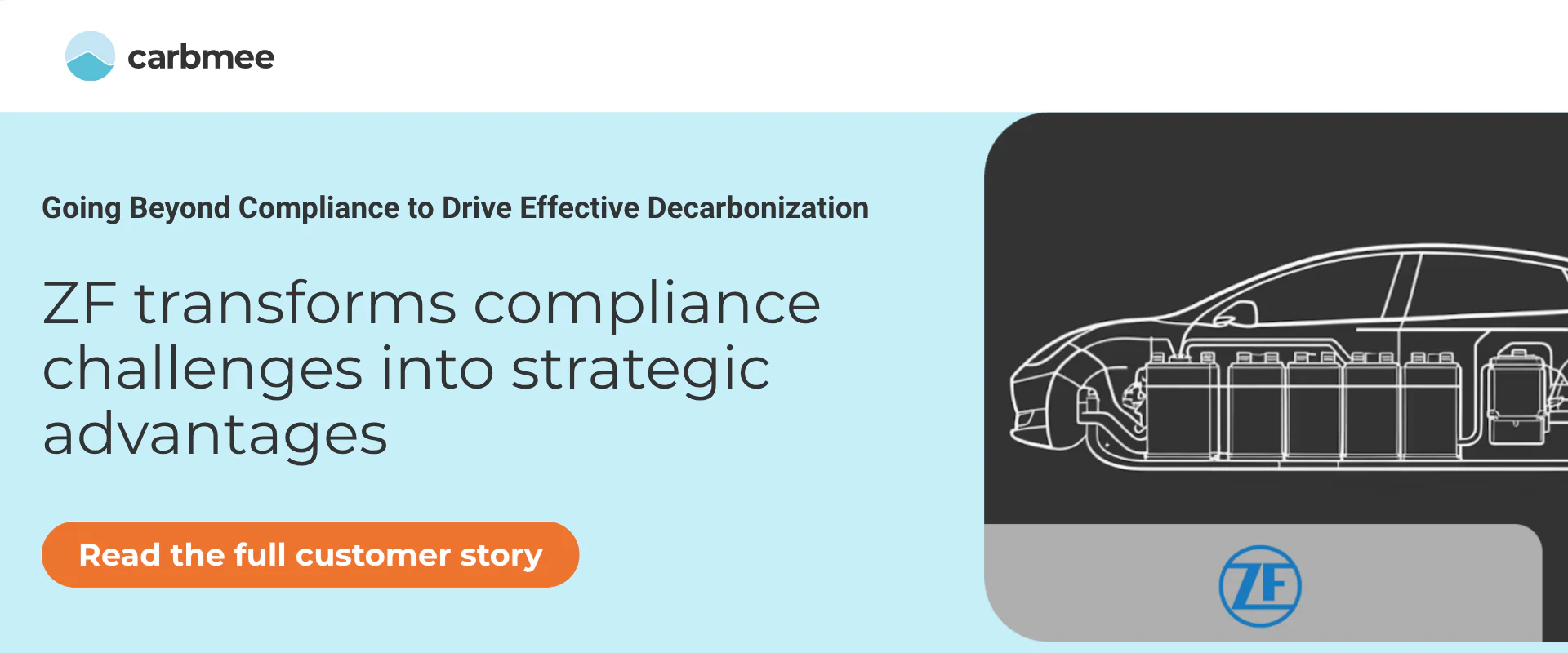
ZF, the global automotive technology supplier, faced CBAM across a large European footprint. Working with carbmee, ZF submitted more than 40 CBAM reports across 35+ EU legal entities and met every deadline. The data revealed roughly 600,000 tons of CO₂e imported in aluminum and steel, with projected CBAM costs of about €8M by 2034 under current scope. That visibility turned a compliance obligation into a prioritized decarbonization plan.
How carbmee EIS™ turns CBAM data into cost decisions
carbmee EIS™ is the environmental intelligence platform that connects your products, sites, suppliers, and transaction data into one view. It supports Scope 1, 2, and 3 carbon management, primary-versus-default data for CBAM, carbon cost forecasting, scenario modelling, and supplier collaboration. By linking material codes from your ERP to emissions data, it shows exposure at the level where you actually make decisions.
CBAM cost is coming for your 2026 imports. The importers who act early will budget accurately and reduce the bill. Book a classic carbmee demo for a walkthrough of your CBAM cost exposure, and point your finance and procurement teams to carbmee Academy to build the skills to manage it.