Great Britain Deforestation Policy: What GBDP Means for UK, Irish and EU Supply Chains
The UK government has set out its proposed approach to strengthening deforestation regulations across the UK, with a particular focus on the emerging Great Britain deforestation policy, or GBDP. For compliance teams, procurement leaders, sustainability managers and carbon professionals, the message is clear: deforestation due diligence is moving from a narrow timber-focused requirement to a broader supply chain obligation covering several high-risk commodities.


Great Britain Deforestation Policy: A New Direction for Forest-Risk Supply Chains
The GOV.UK policy paper explains that the government aims to introduce regulations in Great Britain, including under the Environment Act 2021, alongside legislation designed to strengthen the UK Timber Regulation. The proposed Great Britain deforestation policy would require businesses in GB with annual turnover above £1 million, and that use forest-risk commodities or wood products, to carry out due diligence to ensure these commodities are produced in line with relevant local laws.
The intended product scope includes wood, cattle, cocoa, coffee, palm oil, rubber, soy and selected derived products such as chocolate and furniture. Businesses would need to establish a due diligence system, report on their activity and hold proof of compliance, including geolocation data showing the origin of relevant products.
In practical terms, GBDP is not just another environmental policy. It is a signal that supply chain traceability, supplier data quality and evidence-based compliance are becoming core requirements for market access.
What GBDP Means for UK Businesses
For businesses in Great Britain, the proposed Great Britain deforestation policy would create a new compliance layer for companies that source, trade, manufacture or sell products containing forest-risk commodities. The £1 million turnover threshold means the regime could capture a wide range of businesses beyond the largest multinationals, including importers, manufacturers, food and beverage companies, retailers, packaging businesses and furniture suppliers.
The most immediate impact will be data-related. Companies will need to understand which commodities they use, which suppliers provide them, where those commodities originate, and whether production complied with local laws. That requires more than a supplier code of conduct or a generic sustainability certificate. It means building a repeatable process for collecting, validating and retaining evidence.
Procurement teams will need to work more closely with compliance and sustainability functions. Supplier onboarding may need to include origin data, commodity-level declarations, documentation of legal production and geolocation information. Sustainability teams will need systems that can translate supplier responses into auditable due diligence records. Compliance teams will need to monitor regulatory alignment between GB, Northern Ireland and the EU.
According to the UK government’s deforestation policy paper, legislation to implement the GB regime is expected in 2027. However, companies should not wait for final rules before preparing. The businesses best positioned for GBDP will be those that start mapping commodity exposure now.
Impact on Irish and EU Businesses
For businesses in the Republic of Ireland and the wider EU, the EU Deforestation Regulation, or EUDR, remains the primary regulatory driver. EUDR applies to operators and traders placing relevant products on the EU market or exporting them from the EU. It requires companies to prove that in-scope products are deforestation-free, legally produced and covered by due diligence before they are placed on the market or exported.
The Irish market is especially relevant because of the interaction between the Republic of Ireland, Northern Ireland and Great Britain. The UK government has confirmed that EUDR will apply in Northern Ireland as part of arrangements maintaining Northern Ireland’s access to the EU single market. That means businesses moving relevant goods into Northern Ireland, or operating across the island of Ireland, will need to consider EUDR requirements.
For EU and Irish companies trading with Great Britain, GBDP matters because the UK government intends the GB regime to operate consistently alongside EUDR. The aim is to reduce regulatory divergence and make the information GB businesses must hold broadly similar to what is needed for an EUDR due diligence statement. This alignment should help businesses serving both the UK internal market and EU single market, but it will not remove the need for robust product-level and supplier-level traceability.
UKTR vs EU Timber Regulation
The UK Timber Regulation and the EU Timber Regulation share the same origin but now sit in different legal and market contexts.
The EU Timber Regulation, or EUTR, entered into application in 2013. Its central purpose was to prohibit illegally harvested timber and timber products from being placed on the EU market. It required EU operators placing timber products on the market for the first time to exercise due diligence, including information gathering, risk assessment and risk mitigation. Traders further down the supply chain were required to keep records of suppliers and customers.
The UK Timber Regulation, or UKTR, is the UK’s post-Brexit version of this timber due diligence framework, as assimilated and amended in UK law. In Great Britain, it prohibits the placing of illegally harvested timber and timber products on the GB market and requires operators first placing those products on the market to exercise due diligence. Traders must retain records that allow timber and timber products to be traced.
The key difference is jurisdiction. EUTR applied across the EU and is being replaced by EUDR when the new EU rules apply. UKTR applies in the UK context, with specific arrangements for Great Britain and Northern Ireland. In Northern Ireland, EU timber rules and, moving forward, EUDR-related arrangements are relevant because of Northern Ireland’s access to the EU single market.
The proposed GB deforestation policy would build on this timber framework but expand the policy logic beyond timber alone.
GBDP vs EUDR: How Great Britain’s Policy Compares with the EU Regime
The Great Britain deforestation policy and EUDR are closely connected, but they are not the same instrument.
EUDR is an EU regulation that applies to relevant commodities and products placed on the EU market or exported from it. It covers commodities including cattle, cocoa, coffee, oil palm, rubber, soy and wood, as well as derived products. Operators must carry out due diligence, submit due diligence statements where required, and demonstrate that products are deforestation-free and legal.
GBDP, by contrast, is the UK government’s proposed Great Britain regime. According to the GOV.UK policy paper, the government aims to introduce GB regulations that apply to businesses with annual turnover above £1 million using forest-risk commodities and wood products. The GB approach focuses on due diligence to ensure products are produced in compliance with relevant local laws, with businesses expected to hold broadly similar information to what is required for EUDR due diligence statements.

The most important difference is that EUDR already has a defined EU legal architecture, implementation timeline and role-based compliance model. GBDP is still being developed, with legislation expected in 2027 and consultation with businesses, civil society and international partners still to come.
The most important similarity is the direction of travel. Both regimes point toward mandatory traceability, geolocation data, supplier evidence and stronger accountability for commodity supply chains. Businesses operating across GB, Northern Ireland, Ireland and the EU should therefore prepare for convergence in practical compliance requirements, even if the legal regimes remain separate.
How Carbmee Helps Companies Prepare for EUDR Compliance
EUDR compliance is not simply a legal exercise. It is an operational challenge involving suppliers, product data, geolocation evidence, documentation and audit-ready due diligence workflows. For companies with complex supply chains, manual spreadsheets and fragmented supplier outreach will quickly become a bottleneck.
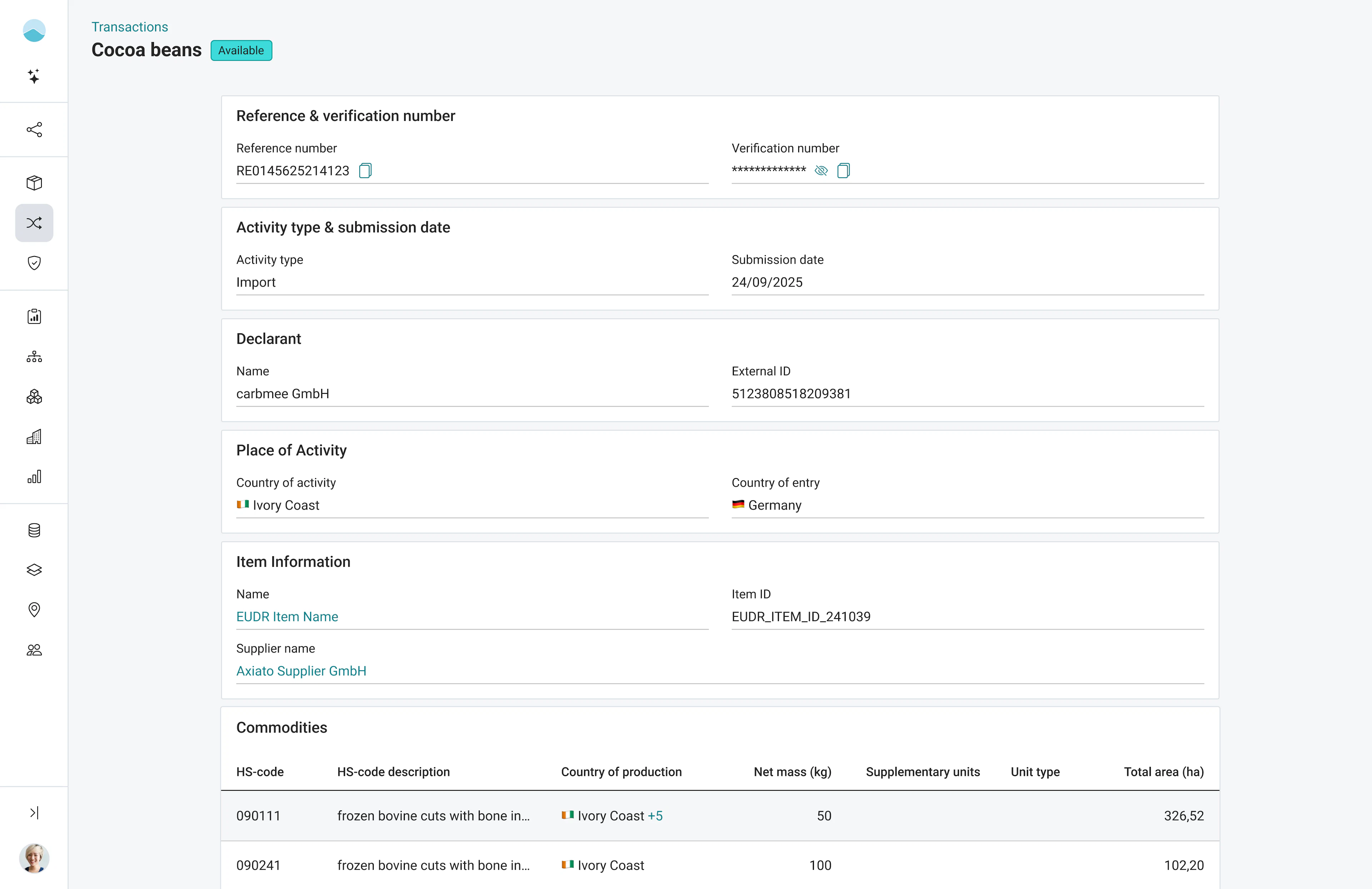
Carbmee EIS™ is designed to help companies operationalise EUDR compliance at scale. The platform supports full traceability and audit-grade accuracy, helping teams prepare Due Diligence Statements with confidence. Built on Carbmee’s Carbontology™ data foundation, Carbmee EIS™ uses AI-enabled workflows to automate geolocation verification, streamline supplier outreach and support end-to-end EUDR compliance across global supplier networks.
Carbmee helps companies identify who must respond across the supply chain, segment suppliers and producers by role, and understand which due diligence scenario applies. Teams can launch targeted questionnaires to collect producer confirmation, commodity information, crop or harvest timing and supporting documentation. The platform also supports plot-level land information, mapped areas where required, structured geolocation inputs and automated validation workflows.
For compliance leaders, the value is control. For procurement teams, it is supplier engagement without endless manual follow-up. For sustainability and carbon professionals, it is a structured data foundation that connects regulatory compliance with broader environmental intelligence.
As EUDR deadlines approach, companies that wait risk last-minute supplier outreach, incomplete documentation and weak evidence trails. Carbmee gives teams a faster, more reliable way to close data gaps, prepare defensible Due Diligence Statements and protect EU market access.
Preparing for the Next Phase of Deforestation Compliance
The Great Britain deforestation policy marks an important shift in the UK’s approach to forest-risk commodities. While UKTR focused on illegal timber, GBDP signals a broader move toward commodity-level due diligence, geolocation evidence and alignment with EUDR.
For businesses in the UK, Ireland and the EU, the practical takeaway is straightforward: start building the systems, supplier processes and evidence trails now. Whether complying with EUDR, preparing for GBDP or managing trade across GB and Northern Ireland, companies will need reliable commodity data, clear supplier accountability and audit-ready documentation.
Deforestation regulation is becoming a market access issue. The companies that act early will be better placed to reduce risk, protect supply continuity and demonstrate responsible sourcing in a more demanding regulatory environment.