How to Prepare a PPWR Declaration of Conformity: A Step-by-Step Guide for Manufacturers
The PPWR Declaration of Conformity has been mandatory since 12 August 2026. It sits in Article 39 of Regulation (EU) 2025/40 and follows the model in Annex VIII, covering Articles 5 to 12. The signatory bears personal liability. Behind it sits an Annex VII technical file built from supplier evidence, retained for five years, and produced to authorities within ten days. This guide walks through the eight steps in sequence.


A defensible DoC starts before the document itself
The Declaration of Conformity is the legal cornerstone of PPWR. Every packaging type placed on the EU market since 12 August 2026 requires one. The signatory bears personal liability. The document must be kept current every time materials, design, or suppliers change. And if a regulator, customer, or auditor asks to see it, you need to be able to produce it alongside the full evidence file that backs every claim inside it. Article 15(10) gives you ten days to do so.
Most manufacturers understand the obligation in broad terms. What is less clear is the actual sequence of work required to produce a DoC that would survive scrutiny. This post walks through that sequence in practical terms.
Before getting into the steps, one framing point is worth making. The DoC is not the starting point. It is the output of a process that begins with supplier data collection and runs through material verification, conformity assessment, and document governance. Companies that try to start with the document and work backwards will find the gaps quickly.
What you can declare today, and what enters the DoC later
PPWR applies in phases. A correct DoC states, for each of Articles 5 to 12, whether the requirement applies at the date of issue. Declaring conformity against a requirement that is not yet in force, or against a methodology that does not yet exist, weakens the document rather than strengthening it.
Steps 4 and 5 below therefore prepare you for 2030 rather than producing a 2026 declaration item. Both still belong in the sequence, because the design decisions they drive are being made today.
Step 1: Map your packaging portfolio
Before any assessment can happen, you need a complete and current inventory of every packaging type you place on the EU market. This means primary packaging, secondary packaging, transport packaging, e-commerce packaging, and service packaging. Each distinct packaging type requires its own DoC, so the portfolio map directly determines the scope of work. For most global manufacturers, this step surfaces packaging types that are not centrally documented, have unclear ownership, or have changed without a corresponding update to records.
One DoC per packaging type, not per SKU
The obligation is framed per packaging type, not per SKU or per market. Several SKUs can share one DoC when they genuinely share the same packaging type definition and version. That makes your packaging-type taxonomy the most consequential data decision in the programme. Define it too loosely and a single material change invalidates declarations across unrelated products.
There is no general transport packaging exemption
Transport packaging is fully in scope. Article 15(11) of Regulation (EU) 2025/40 carves out only custom-made transport packaging for configurable medical devices and medical systems used in industrial and healthcare environments. There is no B2B exemption either.
Step 2: Assign legal accountability per packaging type
PPWR defines the legal manufacturer as the entity whose name or trademark appears on the packaging, regardless of who physically produces it. For every packaging type in your portfolio, you need to confirm which legal entity in your organisation is the manufacturer of record, who within that entity will sign the DoC, and whether any packaging types involve shared accountability with importers or distributors that needs to be resolved before the assessment begins.
Brand owners versus converters
Article 3(1)(13) defines the manufacturer as whoever designs or manufactures packaging, or has it designed or manufactured, and markets it under their own name or trademark. A brand owner using a converter is the manufacturer; the converter is not. Only one manufacturer exists per packaging item across the entire EU market, so shared accountability is a contractual arrangement, never a legal one.
Authorised representatives, importers and distributors
When a distributor becomes a manufacturer
An importer or distributor who places packaging under their own name or trademark, or modifies packaging in a way that affects conformity, is treated as the manufacturer and takes on the full obligation. Private-label programmes and retailer own-brand ranges sit squarely in this category. If your brand is on the pack, the obligation is yours. PPWR procurement compliance covers how to reflect that in supplier contracts.
Step 3: Collect the required supplier data
This is where most compliance programmes slow down. The technical file requires material-level evidence that can only come from suppliers. Under Article 16 of PPWR, suppliers are legally required to provide it, but the structured requests still need to be designed and sent. For each packaging type, you need a layer-by-layer bill of materials with material weights and mass percentages, substance compliance test reports confirming PFAS absence and heavy metals below 100 ppm combined, verified post-consumer recycled content percentages with the calculation methodology and accepted certification standard, and chain-of-custody documentation linking recycled content claims to plant-level sources. Generic supplier questionnaires are not sufficient.
What Article 16(1) actually obliges a supplier to give you
Suppliers of packaging or packaging materials must provide the manufacturer with all information and documentation necessary to demonstrate conformity, including the Annex VII technical documentation, in a language the manufacturer easily understands, on paper or electronically. That is a legal obligation, not a commercial request. It is the provision to cite when a supplier declines to share substance data or treats a bill of materials as confidential.
Get the substance thresholds right in the request
Article 5 caps lead, cadmium, mercury and hexavalent chromium at 100 mg/kg combined. For food contact packaging, PFAS limits apply from 12 August 2026, and testing must reflect those thresholds rather than a general absence claim. A supplier statement asserting compliance is not the same as a test report demonstrating it. Our guide to turning supplier data into a Declaration of Conformity covers the request design field by field.
Step 4: Conduct the recyclability assessment
Every packaging type must be assigned a recyclability grade of A, B, or C using a methodology that follows harmonised EU standards. Grade A requires 95 percent or more of packaging weight to be recyclable at scale, Grade B 80 percent or more, and Grade C 70 percent or more. Grade C packaging will be banned from the EU market from 2030. The assessment must be documented and referenced in the technical file.
The methodology is not yet available
There are no harmonised recyclability standards to assess against today. Article 6(4) requires the Commission to adopt design-for-recycling delegated acts covering 22 packaging categories by 1 January 2028. The December 2025 Environmental Omnibus proposed delaying that date, and no amended date is confirmed, so plan against 1 January 2028.
Grading a portfolio against criteria that have not landed produces a number you will have to revise. Use this step now to build the layer-level material data the grading will consume, and to identify the multi-material formats most likely to fall below 70 percent.
Step 5: Check empty-space compliance for relevant packaging types
For secondary packaging, transport packaging, and e-commerce packaging, the empty-space ratio must not exceed 50 percent of total package volume from 2030. If you are preparing DoCs now and your packaging design decisions are still open, factoring this in now avoids a redesign cycle closer to the deadline.
What Article 10 requires today
The qualitative minimisation obligation applies now. Your technical file must justify the weight and volume of the packaging against its performance requirements, even though the 50 percent cap is a 2030 item.
One change catches teams out here. EN 13428:2004 no longer creates a presumption of conformity for packaging minimisation after 12 August 2026, and the Commission must request updated standards by February 2027. Certificates against the old standard do not carry the declaration on their own.
Step 6: Compile the technical file
The technical file is the evidence package that makes the DoC defensible. It should contain the completed bill of materials, all substance compliance test reports, recycled content certification with calculation methodology, the recyclability assessment and grade, any empty-space measurements for applicable formats, and the supplier documentation that underpins each of the above. The file must be versioned, dated, and retained for five years for single-use packaging and ten years for reusable.
What Annex VII specifies
Annex VII requires a general description of the packaging, construction drawings at component level, material specifications for every layer and part, and the explanations needed to understand them. It must also list the standards or common specifications applied, identify any applied only in part, and include an analysis of the risks of non-conformity. For packaging bought from a converter, most of this already exists upstream, which makes compiling the file a collection exercise rather than a design exercise.
The ten-day clock
Under Article 15(10), documentation must be provided within ten days of a reasoned request from a national authority, in electronic form and on paper if requested. That window is the practical test of whether your file is organised or merely complete.
Step 7: Draft and sign the Declaration of Conformity
With the technical file complete, the DoC itself can be produced. Annex VIII prescribes the structure, and a missing field is treated as a defective declaration.
There is no CE mark on packaging
PPWR deliberately avoids CE marking. The regulation uses internal production control rather than third-party conformity assessment, known as Module A, so no notified body reviews the file. Where test or calculation methods are performed by conformity assessment bodies accredited under Regulation (EC) No 765/2008, that provides a presumption of conformity with the relevant requirements. The packaging DoC is also separate from any product DoC you already issue.
Language and combined declarations
The DoC must be in the language or languages required by the Member State where the packaging is placed on the market, so packaging sold in Germany needs a German version. Where packaging falls under several EU legal regimes, the Commission's guidance confirms a single combined declaration is acceptable provided the relevant Union acts are clearly identified.
Step 8: Build a process to keep it current
A DoC signed once and filed is not a compliant DoC. The regulation requires that it be updated every time materials, design, or suppliers change. That means the governance process matters as much as the document itself. You need a clear trigger system that flags when a change has occurred, an owner responsible for initiating the update, and a version control process that maintains the history of every previous iteration.
Add a fourth trigger to the three above: regulatory change. The recyclability and recycled content requirements arriving in 2030 mean every DoC issued today already has a scheduled revision ahead of it. Auditors ask what the file looked like at the point of sale, not what it looks like now.
For manufacturers with large and complex packaging portfolios, steps three through eight cannot be run manually at scale without significant risk of gaps, delays, and errors. We built carbmee EIS™ specifically to automate the supplier data collection process, structure it at the packaging-type level, connect it to recyclability assessments and DoC generation, and keep the full evidence chain current as requirements evolve and packaging changes.
The same data has more than one use. Ravensburger reached Scope 3 carbon transparency in 20 days with carbmee, then cut packaging carbon emissions by 80 percent by switching shrink wrap to plastic labels. The material-level data that supports a declaration also supports design decisions that reduce cost and emissions.
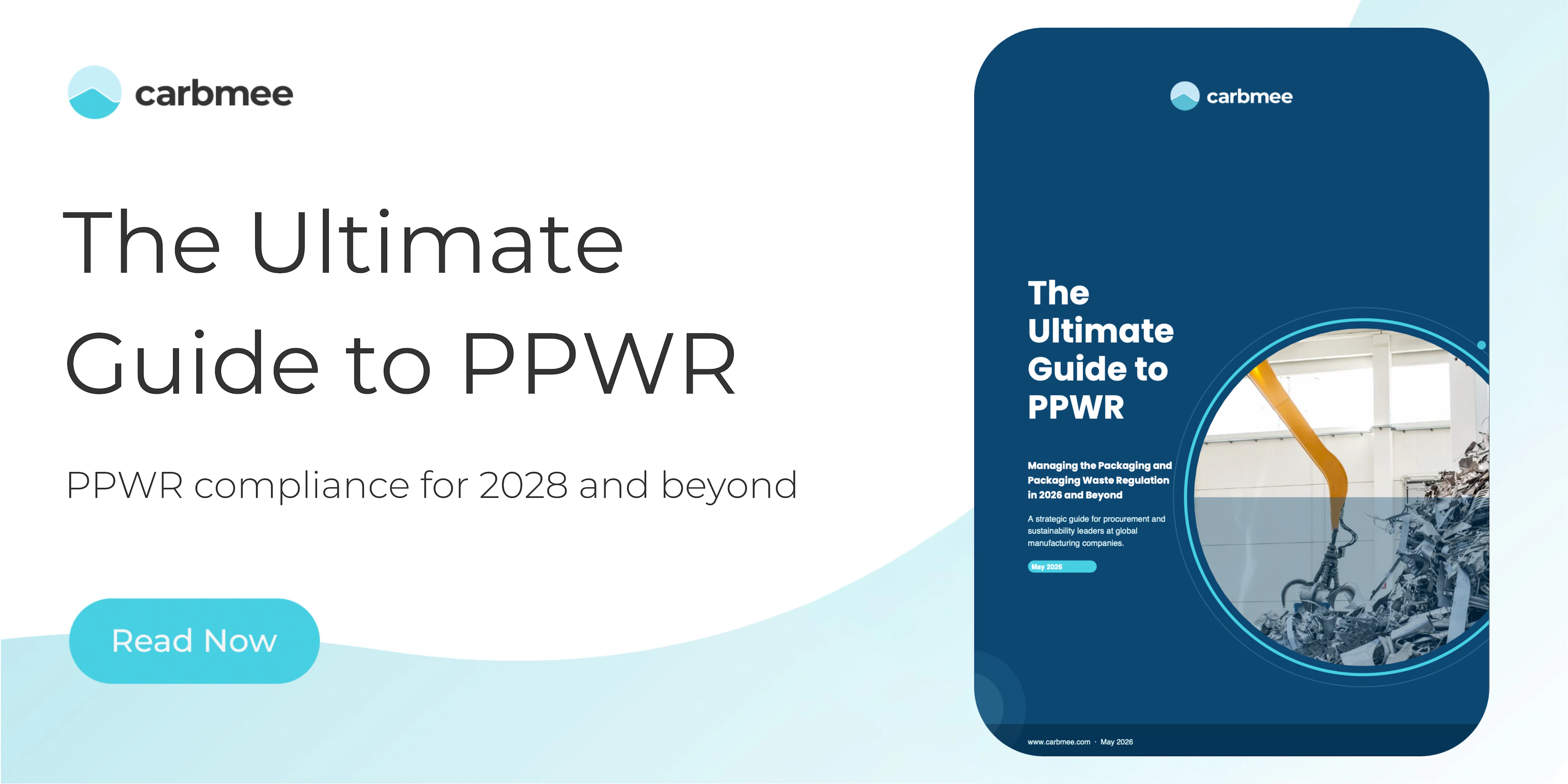
Read our Ultimate Guide to PPWR for the full picture on deadlines, recyclability grades, EPR registration, enforcement risk, and the 14-point action checklist for procurement and sustainability leaders.
What to do next
Three things determine whether your declarations survive scrutiny. The file behind the signature, not the signature itself, is what an authority reviews. The signatory carries personal liability, so accountability mapping has to be explicit and current. And declarations decay, which makes the governance process more durable than any single document.
The requirements arriving in 2030 will land on the same supplier data foundation. Building it once, properly, is cheaper than rebuilding it twice.