Did You Know You Can Use carbon cost in sales and procurement negotiations?
Carbon is now a priced input, not a reporting footnote. It sits inside the materials you buy and the products you sell, and it moves with regulation and market demand. The teams that can put a number on it gain leverage in both directions. On the buy side, carbon cost sharpens supplier negotiations. On the sell side, it justifies a premium and steers customers toward the right products. This is how you turn carbon cost from a compliance line into a commercial tool.


Carbon cost is already moving money
The market has already put a price on carbon, in both demand and cost terms.
On the demand side, low-carbon claims sell. A joint study by McKinsey and NielsenIQ tracked five years of US sales data and found that products with sustainability claims grew 28% cumulatively, against 20% for products without them. The same research found more than 60% of consumers said they would pay more for products in sustainable packaging. Demand for lower-carbon products is real, and it shows up in revenue.
On the cost side, the numbers work in the buyer's favor. Research by BCG and the World Economic Forum found that the green premium on raw materials is a small share of end-product prices, and full decarbonization would raise consumer prices by only 1% to 4% in sectors such as autos, fashion, and electronics. That single fact reframes the most common objection at the table. A large percentage increase on a raw material often translates into a tiny increase on the finished product. Once both sides see that math, the negotiation changes.
The questions negotiators should bring to the table
For most teams, the challenge is not whether carbon matters, but how to use it. The strongest negotiators arrive with sharper questions.
On the buy side: Which suppliers carry the highest carbon cost per unit? Where does that cost become price leverage? Which suppliers can lower it, and which cannot? On the sell side: Which products earn a defensible green premium? How do we prove the footprint to a skeptical buyer? Which SKUs should we steer customers toward for better margin and lower carbon? Answering these turns carbon data into a bargaining position.
What you gain when carbon cost enters the negotiation
The payoff is commercial, not just environmental. Procurement gains input-cost leverage, because a supplier's carbon cost becomes part of the landed price you negotiate. Sales gains a defensible premium, backed by verified data rather than marketing language. Product teams gain a steering tool, routing demand toward low-carbon, higher-margin SKUs. And finance gains a shared number that connects all three functions. Carbon stops being a separate report and becomes part of how the business prices, buys, and sells.
A playbook for putting carbon cost to work
- Quantify carbon cost per product and per supplier. You cannot negotiate a number you do not have. Start by attaching a carbon cost to each material, SKU, and supplier so the figure is concrete.
- Rank suppliers by carbon cost, not just price. Two suppliers with the same quoted price can carry very different carbon costs. Ranking on total landed cost, including carbon, reveals the real winner.
- Use carbon data as a procurement lever. Request primary supplier data instead of accepting industry averages. Reward suppliers who cut emissions, and price the gap for those who will not.
- Build a defensible green premium. On the sell side, a premium only holds if you can prove it. Back it with a verified product carbon footprint so buyers see the evidence, not a claim.
- Steer the portfolio toward low-carbon, higher-margin SKUs. Use product-level carbon data to shift sales and marketing effort toward the products that win on both cost and carbon.
- Model carbon-price scenarios. Carbon prices rise over time. Forecast the cost so a deal you sign today still holds up as prices move.
- Align procurement, sales, and finance on one number. A single carbon-cost figure, shared across functions, prevents three teams from negotiating against three different assumptions. Integrating procurement and decarbonization starts with that shared view.
How Galp turned supplier data into €13M in carbon cost savings
Galp, the energy company, wanted to see the carbon cost hidden in its supply chain. Working with carbmee, Galp analyzed around 40,000 items from more than 2,000 suppliers across 140 categories and identified roughly €13M in quantifiable carbon cost savings in the base case.
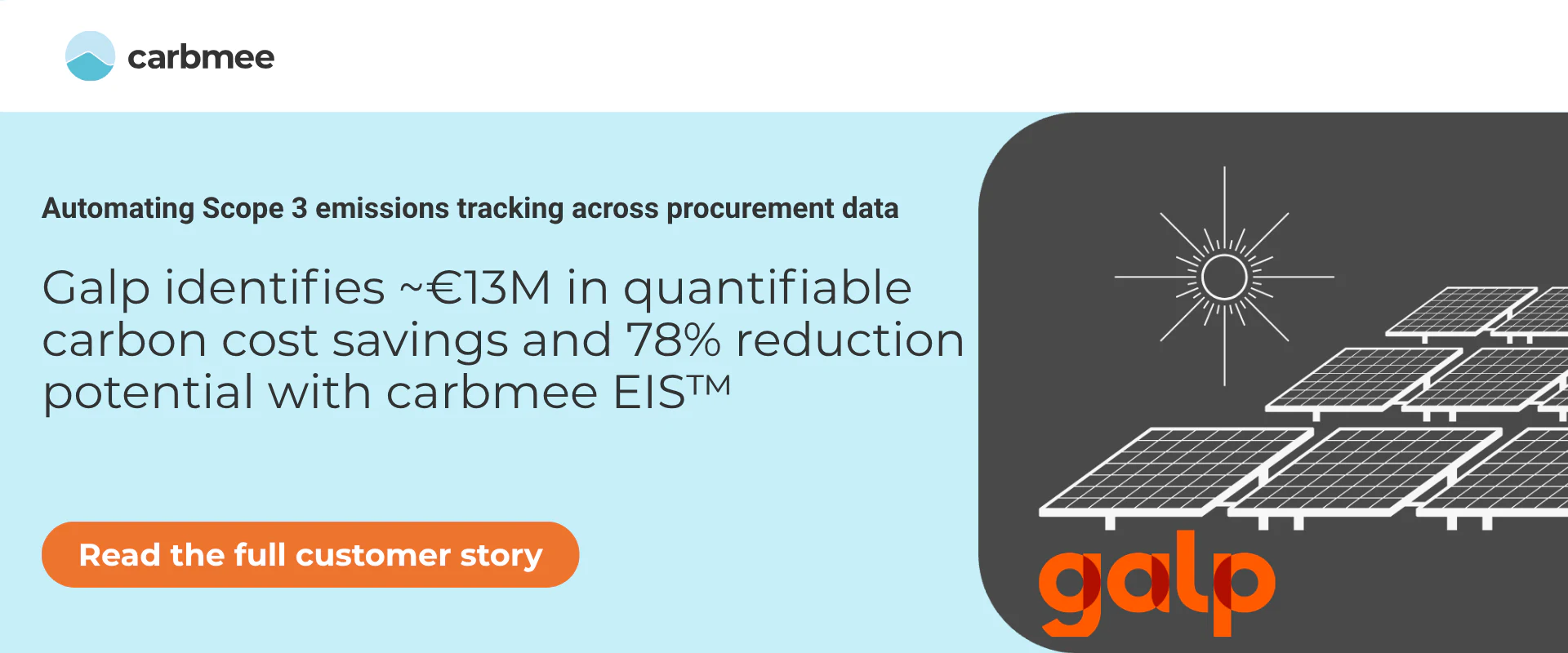
The analysis surfaced 78% emissions reduction potential and measured Scope 3.1 and 3.4 for the first time. The baseline was built without contacting a single supplier, which means Galp entered supplier conversations already knowing where the cost sat. That is carbon cost used as leverage, not paperwork.
How carbmee EIS™ turns carbon cost into negotiation-ready data
carbmee EIS™ is the environmental intelligence platform that connects your products, suppliers, sites, and transaction data into one view. It supports Scope 1, 2, and 3 carbon management, supplier carbon scores, carbon cost forecasting, and scenario modelling. It produces product carbon footprints and dynamic PCFs at SKU level, and it links material codes from your ERP to emissions data. Supplier collaboration sits on the same platform, so the number you take into a negotiation is the same number your suppliers and colleagues can see. That is what makes carbon cost usable at the table.
Carbon cost is already priced into your materials and your products. The teams that quantify it negotiate better, on both sides of the deal. Book a classic carbmee demo to see your carbon cost broken down by supplier and SKU, and point your procurement and sales teams to carbmee Academy to build the carbon-cost fluency that wins negotiations.