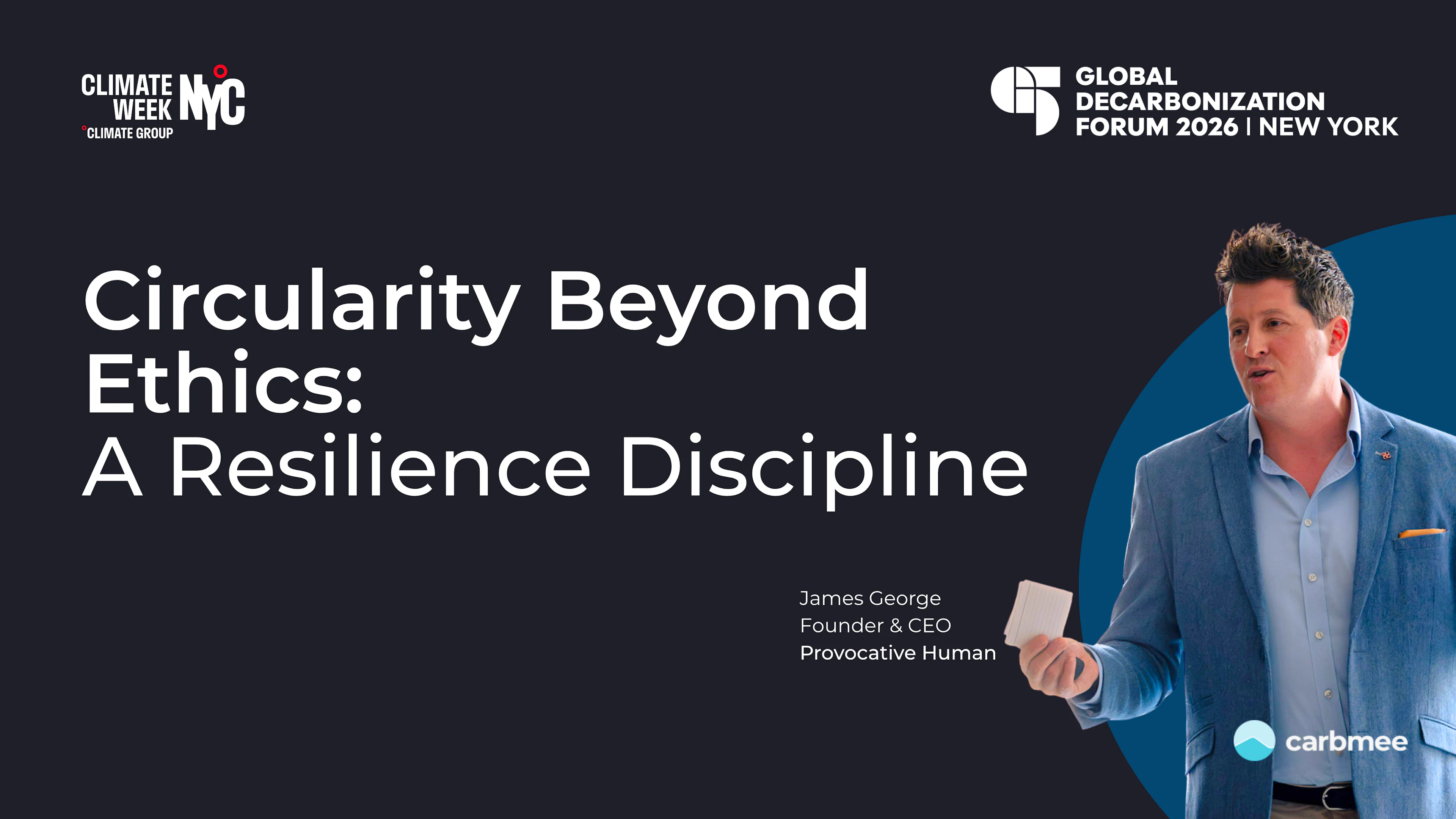
Circularity Beyond Ethics: A Resilience Discipline
At the Global Decarbonization Forum 2026 - New York held during Climate Week NYC, James George, Founder & CEO of Provocative Human, challenged the way companies often frame circularity. The opportunity case is familiar: reduce waste, lower emissions, and create more sustainable products. But James argued that this framing misses a more immediate business concern. Circularity can be a resilience discipline, one that strengthens security of supply, reduces material exposure, and protects businesses against disruption.

The Other 45%
Clean energy and efficiency are essential to decarbonization, but they address only part of the emissions challenge. James highlighted the role of the materials economy: making and using everyday products such as cars, buildings, clothing, and food accounts for around 45% of global greenhouse gas emissions. That makes circularity more than an environmental strategy. Strategies that reduce dependence on virgin materials can also reduce exposure to commodities and supply chains vulnerable to climate and geopolitical disruption. The Ellen MacArthur Foundation and Material Economics estimate that applying circular strategies across sectors including cement, steel, aluminum, plastics, and food could reduce emissions by 9.3 billion tonnes of CO₂e in 2050.
Why Circularity Needs to Be Treated as Risk
James’ central argument was that companies have often sold circularity as an opportunity: an upside initiative owned by sustainability teams and demonstrated through pilots and reports. But when margins tighten, opportunity-driven initiatives can be deprioritized. A risk-based approach changes the ownership and the business case. Circularity becomes about downside protection: security of supply, cost exposure, material availability, and resilience. That puts procurement, operations, HSE and finance much closer to the center of the conversation. The question therefore shifts from “What opportunity does circularity create?” to “What happens to the business if we cannot access the materials we depend on?”
Two Industries, One Blind Spot
James illustrated this through two very different examples: a UK defence prime working through its critical minerals exposure, and a consumer goods business with carbon embedded in materials its suppliers specify. Despite their different industries, both faced the same underlying problem: material exposure became difficult to see below tier one. The shared question was simple: Where does a material become invisible, and who owns the consequence? In the consumer goods example, the response was to move beyond supplier screening and build supplier capability. Working directly with a small group of suppliers cut the carbon in the materials in scope by around half, with no increase in cost. The example illustrates the difference between collecting information from suppliers and changing the underlying material system.
Four Moves to Build Resilience
James presented four practical moves for turning circularity into an operational discipline.
1. Make the material visible.
Map exposure below tier one, including components, origins, switching lead times, and the potential cost of disruption.
2. Write it into the specification.
Procurement determines what actually gets purchased. If lower-carbon or more resilient materials are not reflected in specifications and contracts, the strategy remains disconnected from the buying decision.
3. Pool demand and qualify a second route.
A single site or business unit rarely has the leverage to move a supplier. Aggregating demand across your own sites and divisions, and beyond that through pre-competitive industry platforms with the right legal guardrails, creates enough scale to support an alternative supply route without creating another single point of failure.
4. Build suppliers, don't just screen them.
Instead of relying on questionnaires, companies can work directly with suppliers on material transitions and develop the capabilities required to deliver them.
Together, these moves connect circularity directly to procurement and supply chain resilience.
From Strategy to Action
The final message of the talk was deliberately practical: circularity becomes meaningful when it changes how decisions are made. Make the material visible. Name the owner. Put it in the decision. Data is the baseline, strategy is the response, behavior change is the action. For companies facing increasing material, carbon, and supply chain exposure, circularity is therefore not only about reducing environmental impact. It can also become a way to understand dependencies, build alternative supply routes, and make critical materials more resilient.