The Industrial Endgame: How Energy, AI and Carbon Are Rewriting the P&L
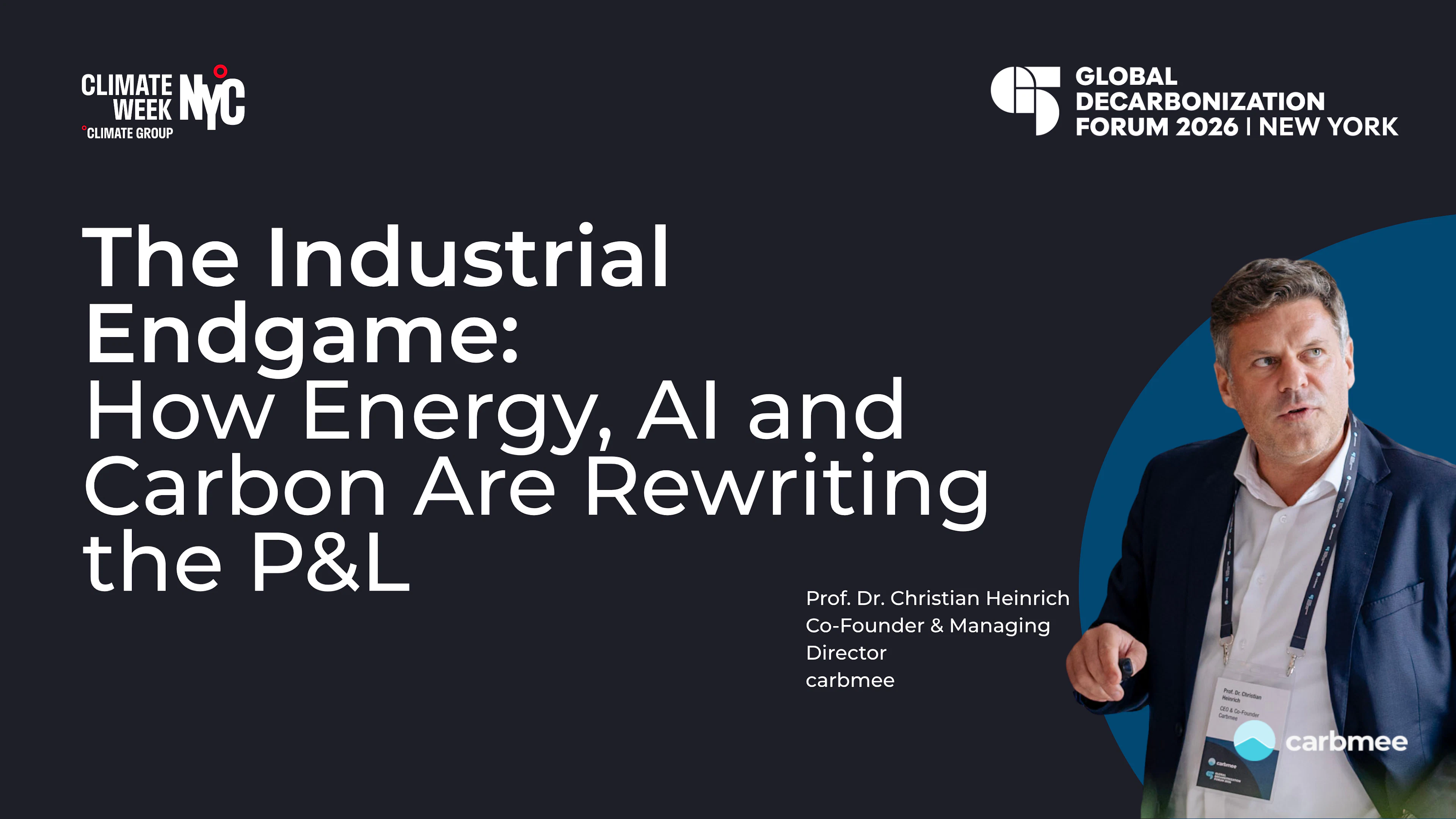
At the Global Decarbonization Forum 2026 - New York held during Climate Week NYC, Prof. Dr. Christian Heinrich, CEO and Co-Founder of carbmee, explored what it takes to move product carbon footprints and supplier data from isolated sustainability exercises into the core processes that run a business.
His keynote focused on a central challenge facing complex industrial companies: environmental data is becoming increasingly important to revenue, costs, procurement, product design, and compliance, but the underlying processes and systems are often not connected. The opportunity, Christian argued, is not simply to collect more environmental data or apply AI to existing information. It is to build the data foundation, operating model, and workflows that allow environmental intelligence to influence decisions at a transactional level and ultimately reach the boardroom.

From Environmental Data to Business Value
For Christian, the business case for environmental intelligence starts with three areas: growing revenue, reducing costs, and ensuring compliance. Compliance creates urgency, but the greater opportunity lies in connecting environmental information with commercial decisions.
Credible product carbon footprints can, for example, support green pricing and help companies respond to increasing customer demands for product-level environmental information. On the cost side, carbon-related costs from mechanisms such as CBAM, energy consumption, and material choices can increasingly affect margins and sourcing decisions. The key is making these connections operational. Environmental information needs to become part of the same business processes that already govern purchasing, product development, supply chain management, and financial decisions.
The Complexity Behind a Product Carbon Footprint
A product carbon footprint can appear straightforward at a high level. In practice, calculating and managing one across a complex product portfolio can involve hundreds of suppliers, multiple tiers, numerous materials, sites, transactions, and enterprise systems. Christian illustrated this through the example of a complex product such as a shoe, where a single product can involve hundreds of suppliers across different purchasing categories and segments. The challenge is not simply calculating the footprint. It is connecting the relevant information without overwhelming the organization. As Christian explained, a purchasing manager responsible for rubber needs to know that a regulation such as the EUDR affects their category, but does not need to deal with requirements like CBAM that do not apply to them. This is where the process operating model becomes critical: environmental requirements need to be embedded into existing responsibilities and workflows rather than added as another layer of complexity.
Environmental AI Starts With a Trusted Data Foundation
Christian emphasized that AI cannot compensate for unreliable underlying data. Before companies can use AI effectively, they need to connect enterprise transactions, bills of materials, suppliers, sites, and environmental information.
The presentation describes this foundation as a connected model linking transactions and BOMs with structured environmental data, supplier inputs, and enterprise systems. This is particularly important for product carbon footprints. A product does not necessarily have one static footprint. The footprint can change depending on the supplier, production site, energy mix, material, and other transactional factors. Instead of treating a PCF as a static study stored separately from the business, companies can connect it to the underlying supply chain and product data. When primary supplier information changes, the product footprint can change with it. The result is a shift from static carbon accounting toward dynamic product carbon footprints that reflect the reality of the supply chain.
From Supplier Data to Transactional PCFs
Supplier data is one of the biggest challenges in building credible product-level environmental information. Christian argued that companies need to move beyond the idea of simply collecting PCFs from suppliers and storing them somewhere. The more scalable approach is to connect supplier data directly to procurement and business processes. Companies can start with existing data and secondary factors, then replace or improve those inputs as verified primary supplier data becomes available.
This creates a continuous process rather than a one-time data collection exercise. Procurement teams can work with suppliers on the relevant environmental information while also using that information for sourcing, negotiations, and cost analysis. The same foundation can support multiple requirements. Rather than maintaining separate processes for Scope 3 data, CBAM, EUDR, PPWR, and other environmental or regulatory requirements, companies can connect these data flows through a common business and data architecture.
From Product Design to Scenario Planning
Once environmental data is connected to products and transactions, it can become a tool for decision-making rather than simply measurement. Christian presented scenario modelling as an example. Companies can model changes to materials, suppliers, or energy sources and assess how those changes affect the product footprint.
The presentation shows this approach through scenarios such as material substitution and changes in the energy mix, with the resulting impact calculated at both unit and annual-volume level. This creates a direct connection between environmental performance and product decisions. Instead of asking what the footprint of an existing product is, teams can ask what happens if they change a material, switch suppliers, or use a different energy source. For product development and procurement teams, this makes environmental intelligence actionable: the objective becomes understanding which changes create the greatest environmental and potentially financial impact.
From the Transaction to the Boardroom
A recurring theme of the keynote was the importance of connecting operational detail with executive-level decisions. Christian argued that companies should start at the bottom, with individual products, suppliers, purchasing categories, or sites, and then aggregate the results upward. A reduction initiative on one product line can become a business case that demonstrates its impact on costs, margins, and the wider portfolio. The presentation describes this as moving “from BOM to boardroom”: initiatives are anchored to the product, BOM position, supplier site, or plant where the change actually occurs, while the resulting impact can be rolled up into the corporate trajectory.
This bottom-up approach can make environmental topics more relevant to finance and executive leadership. Instead of presenting carbon reduction as an abstract target, teams can demonstrate what a specific change means for a product, a purchasing category, a site, or ultimately the business as a whole.
Environmental Intelligence as an Operating Model
The keynote ultimately positioned environmental intelligence as more than a reporting capability or standalone technology layer. For complex industrial organizations, environmental information needs to flow through the same architecture as the rest of the business: enterprise transactions provide the foundation, a connected data model structures the information, the process operating model defines responsibilities, and AI and workflows support decisions on top.
Christian summarizes this architecture through four connected layers: enterprise transactions, Carbontology™, the process operating model, and AI and agents. The goal is to move from managing environmental information to optimizing products, supply chains, and costs, and ultimately creating business value. As companies face increasingly complex supply chains, environmental requirements, and cost pressures, the challenge is therefore not simply to calculate more carbon. It is to connect environmental intelligence to the decisions that shape the business. The next step is to bring that intelligence down to the transaction level, and then all the way back up to the boardroom.