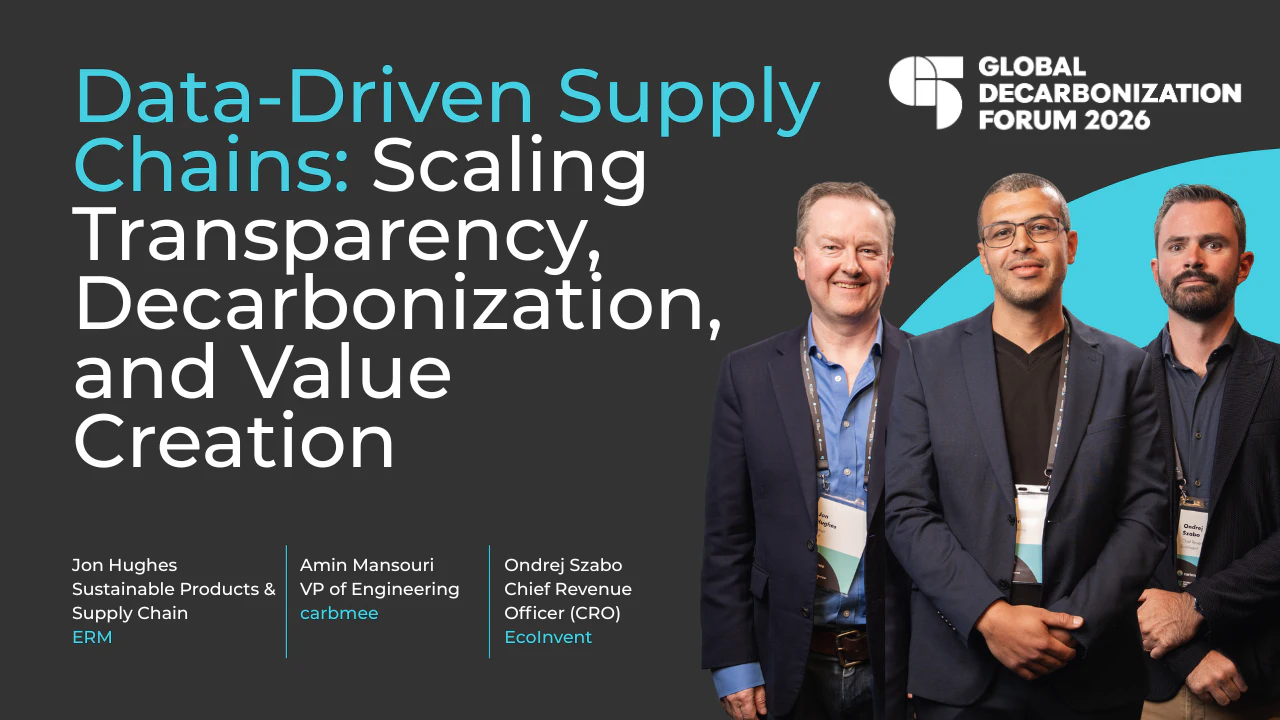
Data-Driven Supply Chains: Scaling Transparency, Decarbonization, and Value Creation
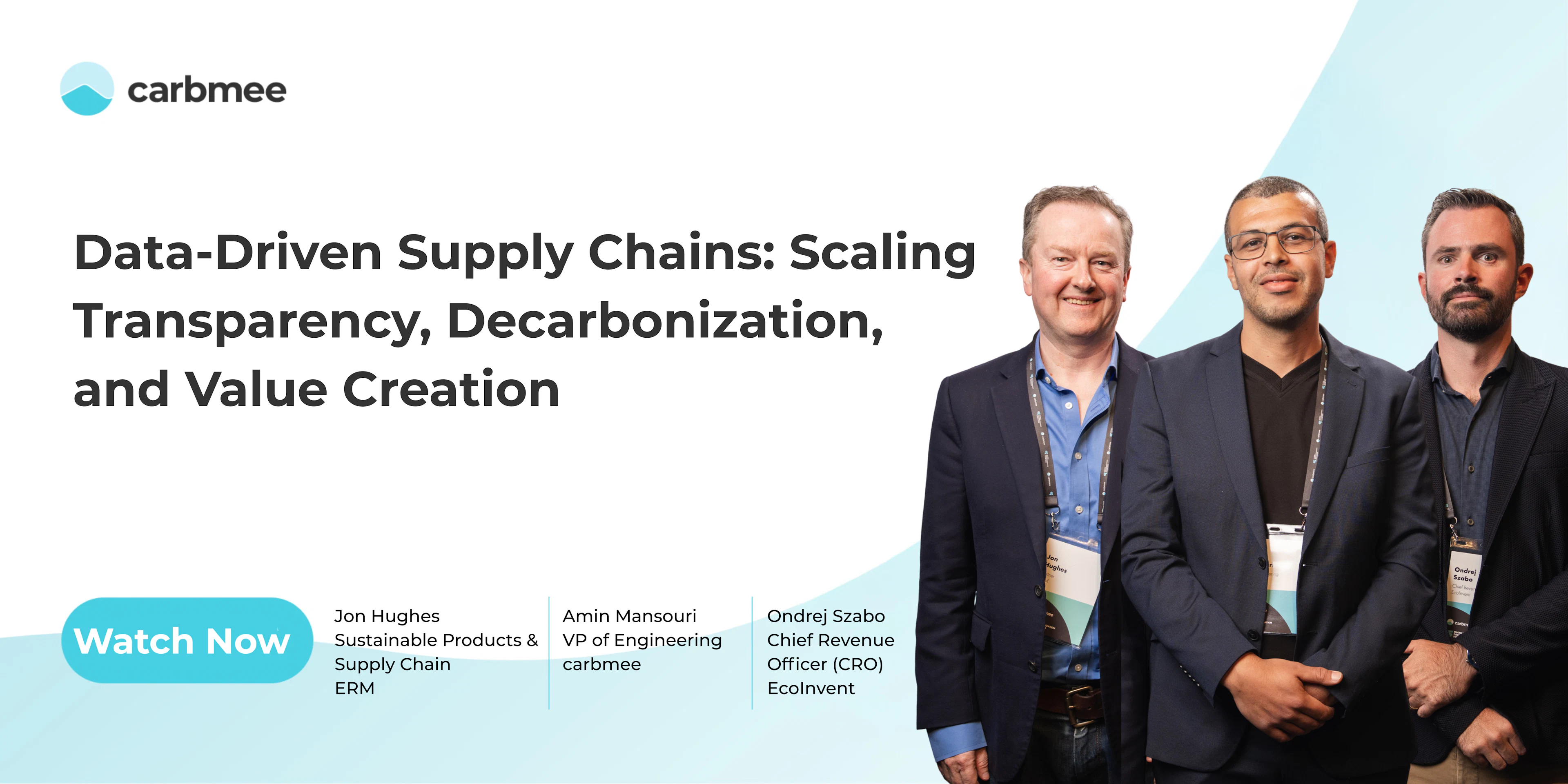
At the Global Decarbonization Forum 2026 in Berlin, Amin Mansouri (carbmee), Jon Hughes (ERM) and Ondrej Szabo (ecoinvent) took the stage for a conversation that arrived at a single uncomfortable conclusion: most companies have been collecting sustainability data for years, but the gap between measurement and meaningful action has never been wider. The data quality debate, while legitimate, has become a hiding place. And 2030 is no longer far enough away to justify waiting.

From Spend-Based Estimates to Something You Can Actually Act On
Most companies enter scope 3 with spend-based emissions data. It is directionally correct. It surfaces hotspots. It gives organizations a place to start. But it has a ceiling, and most organizations have hit it.
Jon Hughes framed the shift clearly. The two reasons to improve data quality are, first, to be able to report meaningfully on the actions you take to reduce emissions, and second, to give you the targeted intelligence needed to identify which decarbonization levers to actually pull. Spend-based data cannot do either of those things at the precision that progress requires.
But the more important shift the panel identified is not about data quality at all. It is about the decision to move on two tracks simultaneously: continuing to mature data while beginning to act on what you already have. The organizations making real progress are not waiting for a perfect data set. They are running decarbonization programs in parallel with data improvement, and they are pulling ahead.
The Real Barrier Is Not the Data. It Is the People and the Process Around It
When the conversation turned to what actually separates companies where sustainability programs are working from those where they are stalling, Amin Mansouri's answer was precise: it comes down to involving the right people at the right time, and knowing where to draw the line between data collection and action.
The framework he put forward is worth holding onto: people, process, and technology. Thinking big from the start, even when beginning with a small use case. Building on a data foundation that serves multiple use cases simultaneously rather than solving for one problem and starting over the next time a regulation arrives. And integrating systems − ERP, procurement, supplier data − in a way that is scalable from day one rather than bolted together as requirements accumulate.
The organizations that get this right are not necessarily the ones with the most sophisticated tools. They are the ones that aligned the right stakeholders early, built a data architecture that was designed for growth, and resisted the temptation to let the perfect become the enemy of the useful.
Environmental Data Needs to Become a Business Intelligence Tool, Not a Compliance Output
Ondrej Szabo brought a perspective that reframes the entire data quality conversation. The problem, he argued, is not simply that environmental data is imperfect. It is that most environmental data formats such as LCAs and EPDs were designed from the beginning as compliance outputs. They were built to satisfy a regulatory requirement, not to inform a procurement decision or a product design choice.
That structural misalignment is what makes it so difficult to move from data to action. Environmental insights are not being treated the same way as financial insights or market share data. They sit in a separate function, in a separate system, and are consulted at a separate point in the decision-making process, usually after the commercially significant decisions have already been made.
The switch that needs to happen is conceptual before it is technical. Environmental data needs to be positioned inside the organization as decision-making infrastructure: something that informs cost projections, supplier selection, product design, and risk management, not something that gets reported on after the fact. Once that shift happens, the question of how to act on the data answers itself.
Static Data in a Dynamic World − The Next Frontier
One of the sharpest exchanges of the panel came when Ondrej pressed on a challenge that most carbon accounting frameworks have not yet solved: the world that generated the data changes faster than the data can be updated. Supply chains are being reconfigured at speeds that outpace any organization's ability to procure new emissions data on those configurations. Land use change, trade route shifts, supplier relocations − these are happening in near real time. The background databases that sit underneath most carbon calculation engines were built for a more stable world.
The response ecoinvent is developing is a move away from binary static datasets toward trade models that can be modified by software, expertise, or agent-based systems to reflect the actual situation an organization is operating in. The goal is not real-time data in the digital advertising sense. It is data that is designed to be dynamic, to travel through the ecosystem of software and surface better insights faster as the world changes around it.
Amin connected this directly to the carbmee approach: combining dynamic background databases with real supplier data updated on a regular basis is the gold standard. It is also the only configuration that gives procurement teams the visibility to respond to supply chain shocks before the exposure has already been absorbed.
Scaling Decarbonization Across the Supply Chain: Seven Actions, Three to Start
Jon Hughes offered the clearest practical framework of the session. Based on ERM's work with leading organizations that have made measurable decarbonization progress, there are seven actions that consistently separate movers from stayers. He walked through three.
The first is speaking the language of the CFO. Unlocking investment for decarbonization programs requires translating emissions into financial terms: return on investment, net present value, cost exposure over a sourcing lifecycle, financing terms, asset valuation. Sustainability leaders who have made the most progress are not operating as sustainability leaders. They are operating as business leaders who happen to be driving sustainability, and that distinction shows up in every conversation they have with the executive team.
The second is recognizing that scope 3 emissions are, at their core, your suppliers' scope 1 and 2, and that the actions needed to address them are not new. They are the same energy efficiency measures, renewable procurement strategies, thermal energy transitions, and material substitutions that leading companies have already executed inside their own operations. The challenge is not inventing new interventions. It is scaling the ones that already work across hundreds or thousands of suppliers, with the resources and support that smaller suppliers down the value chain will need to actually execute.
The third is collaboration. No single company reaches net zero alone. The Scope 3 Peer Group and similar industry forums exist precisely because the problem is too large and too interconnected for any organization to solve within its own boundaries. Shared programs, shared standards, and shared accountability are what allow decarbonization progress to travel down supply chains rather than stall at the edge of a single company's operations. The ambition is not what one organization achieves internally. It is whether what works internally can be designed, resourced, and scaled across the hundreds or thousands of suppliers that sit behind it.
Connected Data, Not Just Better Data
Amin Mansouri closed with a principle that reframes the data quality debate entirely. The goal should not be better data in isolation. It should be connected data. Organizations that solve for one use case at a time − pulling data for a CBAM submission, then pulling it again for an ESRS report, then pulling it again for a supplier engagement program − are paying a compounding cost in time, effort, and inconsistency. Every time a new regulation arrives or a new use case emerges, they are starting over.
The organizations that are building genuine competitive advantage through sustainability intelligence are the ones that invested early in a data foundation designed to serve multiple use cases simultaneously. The same underlying data that informs a carbon footprint calculation also feeds a supplier risk assessment, a product design decision, and a procurement negotiation. The integration work happens once. The value compounds. That is what unlocks the shift from sustainability as a reporting function to sustainability as a source of business intelligence, and it is the infrastructure that makes decarbonization at scale possible.
carbmee EIS™: The Data Foundation for Smarter Decarbonization
The capabilities the panel described − connected supply chain data, dynamic emissions modeling, supplier collaboration at scale, and carbon intelligence integrated into procurement and product decisions − are core to carbmee EIS™, carbmee's environmental intelligence platform built for large industrial companies. From data ingestion to audit-ready reporting, carbmee EIS™ helps organizations:
Collect and centralize environmental data across operations and supply chains.
Connect ERP, PLM, MES, and procurement systems in a single data model.
Identify emission hotspots and reduction opportunities with AI-powered analytics.
Streamline supplier collaboration and primary data collection at scale.
Ensure compliance with CBAM, ESRS, LCA, and EUDR from one platform.
Whether your priority is CBAM cost visibility, scope 3 accuracy, or equipping your procurement team with the carbon intelligence to make better sourcing decisions today, carbmee EIS™ provides the infrastructure to make it happen, without a five-year implementation.