
EUDR for Automotive: What's Still in Scope After the 2026 Leather and Rubber Changes
The 2026 changes to the EU Deforestation Regulation narrowed automotive scope sharply. Cattle leather and motor vehicle seats are out. Natural-rubber tyres and components are still in, synthetic rubber never was. For an automaker or supplier, the job is now to find the natural rubber inside a multi-tier bill of materials, and to avoid wasting effort on the leather you no longer need to chase.
For two years, automotive teams prepared for EUDR on two fronts: leather and rubber. As of 2026, only one of those still matters. On 13 July 2026 the European Commission adopted a delegated act that removed cattle leather and motor vehicle seats from the scope of the EU Deforestation Regulation, while natural rubber stayed in. With obligations applying from 30 December 2026 for large and medium operators, automotive teams need to re-map their exposure against the new list, not the old assumptions. Here is what changed, what is still in scope, and how to find it in your bill of materials.

Is the automotive industry in scope of the EUDR?
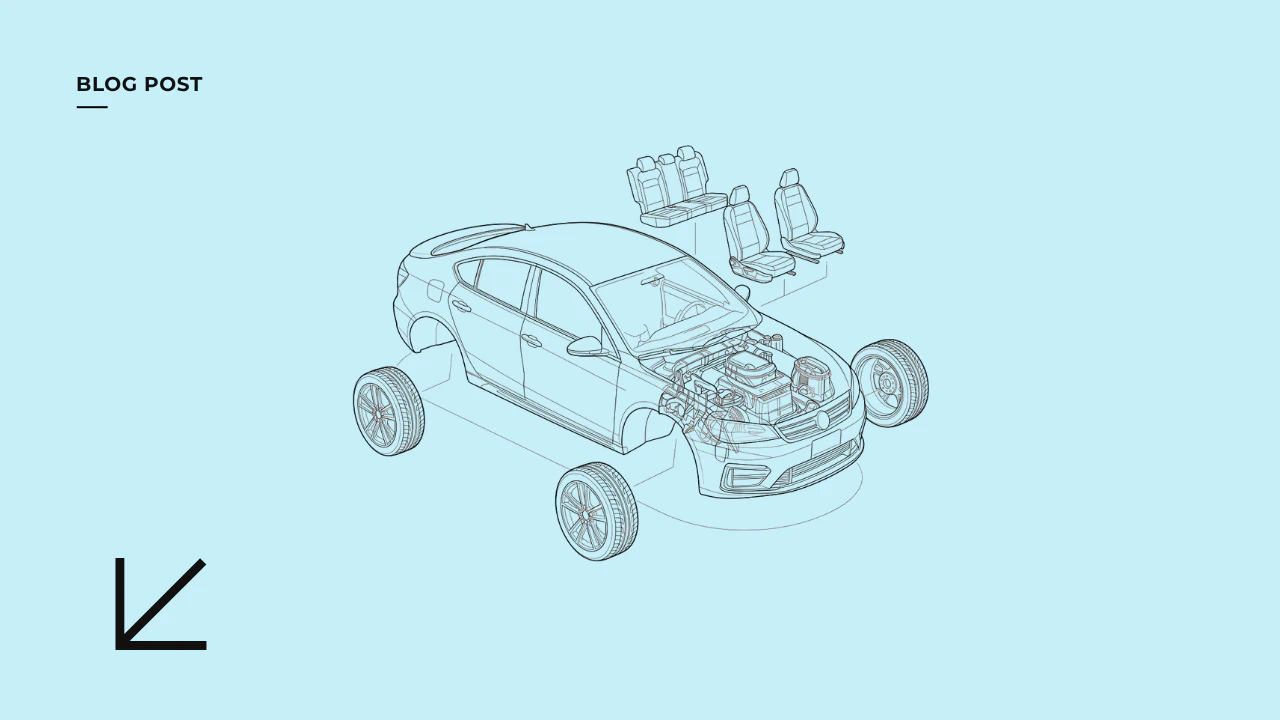
Yes. The automotive industry is in scope through the materials inside its products, not through raw commodities it buys directly. A vehicle contains natural rubber in tyres, hoses and seals, and EUDR scope is decided by the customs code on those goods, not by the category a manufacturer uses internally.
That is the core point automotive teams keep missing. You do not need to import a bale of rubber to be caught. If a component's CN or HS code is listed in Annex I of the regulation, and the material is one of the seven regulated commodities, the obligation applies. For a car, the commodity that matters most is natural rubber, and it can sit several tiers down in the supply chain, inside a part a Tier-1 supplier assembled from inputs of its own.
What the 2026 changes removed from automotive scope
The July 2026 delegated act took several automotive-relevant products off the list. Cattle leather, vehicle seats, vulcanised rubber articles and power-transmission belts are now out. This is a real reduction in the automotive compliance load, and it is worth acting on.
The adopted delegated act removes cattle hides, skins and leather (CN 4101, 4104 and 4107), so the leather value chain, including automotive upholstery, no longer falls under EUDR obligations. It removes aircraft and motor vehicle seats (heading 9401). It removes articles of vulcanised rubber and conveyor and transmission belts (headings 4010 and 4016), judged to contain too little natural rubber to justify the compliance load. The table below sets out the automotive picture.
Status reflects the delegated act adopted 13 July 2026, which is subject to Parliament and Council scrutiny. Codes are indicative; confirm each against the current Annex I.
One caveat on timing. The delegated act was adopted on 13 July 2026 but is still in its scrutiny period, during which the European Parliament and Council may object. Neither can amend it, only veto it, which observers consider unlikely, and if no objection is raised the list is expected to take effect in the second half of 2026. Until then, treat the published list as the working baseline and keep your rationale documented.
What is still in scope: natural rubber, not synthetic
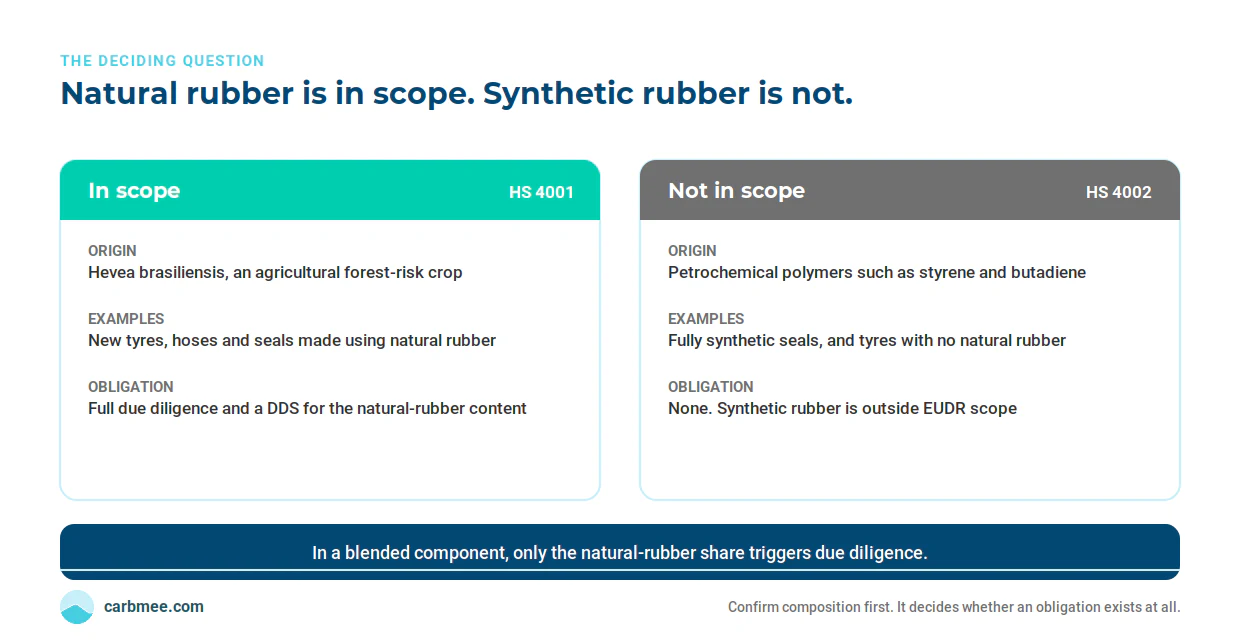
Natural rubber is the commodity that keeps automotive in scope. New tyres and rubber components made from natural rubber remain listed. Synthetic rubber was never covered, and the distinction decides everything.
Under Annex I, natural rubber (heading 4001) and its derived products, including new pneumatic tyres (heading 4011), stay in scope. Retreaded tyres are narrowed to just the new tread. Synthetic rubber (heading 4002) is not covered, because it is a petrochemical product, not a forest-risk commodity. The regulation also narrows the botanical definition: only rubber from Hevea brasiliensis counts, excluding other latex sources. For a mixed component, the "ex" marking in Annex I means only the natural-rubber part triggers due diligence, so a tyre blended from natural and synthetic rubber is in scope for its natural-rubber content alone.
The real problem: finding natural rubber in a multi-tier bill of materials
Knowing that natural rubber is in scope is easy. Locating it across thousands of parts and hundreds of suppliers is the actual work. A modern vehicle has tens of thousands of components, and the natural rubber is buried inside assemblies bought from Tier-1 suppliers who bought them from someone else.
Three things make automotive scoping hard. First, composition is hidden. Whether a seal or hose is natural, synthetic or a blend is often known only to a lower-tier supplier, and it determines scope. Second, the codes live in, and disagree across, your systems. CN and HS codes sit in customs records, ERP, procurement and PLM, and they rarely match. Third, the answer must be defensible per part, because a competent authority assesses your system and your reasoning, not a single statement.
On top of that, over-scoping is now a live risk: teams that keep chasing leather and vehicle-seat data after the 2026 removals are spending supplier-engagement effort they no longer owe. Scoping accuracy is a resource-allocation decision, in both directions. This is a supply-chain data problem before it is a compliance problem, which is why a transactional data foundation that tests every part against the current Annex I, at the component level, beats a manual spreadsheet that is out of date the moment the list moves.
Who files what in an automotive supply chain
Not everyone in the chain files a Due Diligence Statement. The operator that first places a good on the EU market carries the due diligence and the DDS. The first downstream buyer generally collects the DDS reference number, and companies further down carry lighter obligations. Your role sets your workload.
An OEM or supplier importing natural-rubber tyres or components from outside the EU acts as the operator for those goods and owes the full due diligence, including plot-level geolocation and a filed DDS. A downstream operator buying an already-placed product generally references the existing statement rather than re-doing the diligence. Getting this mapping right, per product and per supplier relationship, avoids both gaps and duplicated effort across a large automotive network.
How carbmee EIS™ makes automotive EUDR manageable
Automotive EUDR comes down to one question repeated across a vast portfolio: which parts contain natural rubber, and can you prove their origin. carbmee EIS™, built on the Carbontology™ data foundation, is designed to answer that at scale and turn it into an audit-ready Due Diligence Statement.
It works at the level the regulation cares about. It tests components against the current Annex I from your transactional data, so natural-rubber parts are identified across the bill of materials rather than sampled, and removed categories like leather are dropped without manual rework. Where you are the operator, carbmee's supplier engagement model collects the plot-level geolocation and legality data from lower-tier suppliers and validates it.
It then generates audit-ready records, connecting the evidence to each DDS so it can be reviewed and retrieved. And because the same data foundation also serves CBAM and CSRD, EUDR does not become a fourth siloed project for a sector already carrying heavy regulatory load. ZF, an automotive supplier, uses carbmee EIS™ for supply-chain compliance and generated more than 40 CBAM reports while identifying around 8 million euros in exposure, an indication of what one data foundation can do across regulations.
Timing is the pressure point. Collecting geolocation and legality data from a multi-tier automotive supply base takes months, and the deadline does not move. An independent Verdantix study found a 345% operational ROI and a four-month break-even for carbmee EIS™. That is the difference between a defensible statement and a line stoppage at the border.
What to get right before 30 December 2026
Three points decide automotive EUDR readiness. First, scope follows the code, so you are in through the natural rubber in your components, not through raw commodities you buy. Second, the 2026 changes removed leather and vehicle seats, so re-map your portfolio and stop chasing what you no longer owe. Third, the real work is finding natural rubber across a multi-tier bill of materials and proving its origin, per part.
The teams that re-map against the current list and scope from their own data will be ready. The teams still working from the old leather-and-rubber assumption will spend the run-up to December solving the wrong problem.
See exactly which of your components are still in scope after the 2026 changes. Request a free EUDR scope and exposure check with carbmee's compliance experts.


