Did You Know You Can Use Transition Planning to Make Your Business Strategy More Resilient?
A transition plan should not sit in a sustainability report and gather dust. Done well, it becomes a practical business strategy tool: one that helps manufacturers understand climate-related risks, prioritize decarbonization levers, engage suppliers, and protect long-term competitiveness.
For companies with complex supply chains, transition planning creates a clearer way to answer the questions leadership teams are already asking: Which parts of the business are most exposed? Which suppliers matter most? Which decarbonization actions should we prioritize first? And how do we turn sustainability strategy into measurable business value?


From Climate Ambition to Business Resilience
The pressure to move from ambition to execution is growing. IFRS S2 includes requirements for companies to disclose climate-related transition plans and use scenario analysis to assess the resilience of their strategy and business model to climate-related changes and uncertainties. The European Sustainability Reporting Standards also ask companies to explain how transition plans and mitigation actions contribute to resilience, and to present climate actions by decarbonization lever.
This is why transition planning is becoming much more than a compliance exercise. It connects sustainability strategy to operational decisions across procurement, product development, finance, risk management, and supplier engagement.
The immediate value is clarity. A strong transition plan helps teams understand where climate-related risk sits in the business, which decarbonization levers are realistic, and how sustainability decisions can strengthen long-term resilience.
Why transition planning matters now
Transition planning connects sustainability strategy to business reality. It helps teams move from “we need to reduce emissions” to a structured view of what needs to change across products, suppliers, operations, capital allocation, procurement, and risk management.
McKinsey notes that companies need to think through their decarbonization strategy, keep up with shifting market opportunities and policy developments, and make faster decisions. It also highlights that long-term supplier partnerships and carbon transparency across the value chain are key to replacing high-emission inputs with lower-emission alternatives.
The immediate value is clarity. A transition plan helps leadership see which parts of the business are most exposed, which investments are most urgent, and which suppliers or product lines need action first.
A Practical Transition Planning Playbook for Business Resilience
1. Diagnose: Where is the business exposed?
Start by mapping emissions, supplier dependencies, product lines, materials, sites, and markets. For manufacturers, this means looking beyond Scope 1 and 2 to understand where Scope 3 emissions and supply chain dependencies create risk.
Ask: Which products could become more expensive under carbon pricing? Which materials are exposed to regulation or availability risk? Which suppliers lack reliable emissions data?
2. Prioritize: Which risks and levers matter most?
Not every issue needs immediate action. Rank opportunities by emissions impact, cost, feasibility, supplier readiness, customer relevance, regulatory exposure, and margin impact.
This helps teams focus on the decarbonization levers that can create the greatest business value, such as renewable electricity, material substitution, logistics optimization, recycled inputs, product redesign, or lower-carbon sourcing.
3. Collaborate: Which suppliers need to be involved?
For supply-chain-heavy businesses, transition plans only work if suppliers are part of the roadmap. Priority suppliers should be engaged for primary emissions data, reduction plans, process improvements, and lower-carbon alternatives.
Instead of broad, generic supplier outreach, focus collaboration where it can reduce the most risk or unlock the greatest reduction potential.
4. Integrate: How does the plan influence business decisions?
A resilient transition plan should connect directly to procurement, finance, product, and executive decision-making. That means linking decarbonization actions to sourcing strategies, investment needs, product portfolio decisions, cost exposure, and risk management.
The goal is to make the transition plan a working business tool, not a standalone sustainability document.
5. Adapt: How will the roadmap evolve over time?
Transition planning is not a one-off exercise. Regulations, carbon prices, supplier data, market expectations, and business priorities will continue to change.
Track progress against targets, update assumptions, refine supplier data, and adjust the roadmap as better information becomes available. This keeps the strategy resilient in a changing environment.
Why supplier investment matters now
Supplier engagement is no longer just a reporting exercise. It is becoming a business lever.
Many companies still rely on spend-based estimates or broad supplier averages. But those methods rarely show where carbon costs are actually hiding. McKinsey notes that Scope 3 emissions sit across the value chain and are not directly controlled by the company, which means reducing them requires engagement with suppliers, distributors, and customers. McKinsey also highlights that this collaboration is essential to turning emissions targets into action.
The immediate value is clear: when companies understand supplier-level emissions, they can prioritize the suppliers and categories where action will reduce both carbon and cost exposure.
How to save carbon costs by investing in suppliers
- Start with supplier-level carbon visibility
Before investing in supplier programs, build a reliable baseline. Map emissions by supplier, category, SKU, region, and material. The goal is to move beyond generic averages and understand which suppliers drive the greatest carbon and cost exposure. - Identify the highest-impact suppliers
Not every supplier needs the same level of engagement. Prioritize suppliers based on emissions intensity, spend, strategic importance, data quality, regulatory exposure, and reduction potential. Carbmee’s supplier engagement platform supports this shift from spend-based to supplier-specific insights, helping companies surface carbon hotspots and build verified reduction roadmaps. - Model the carbon cost exposure
Apply carbon price scenarios, internal carbon pricing, CBAM exposure, or future regulatory assumptions to understand where emissions may become financial risk. This helps procurement and finance answer: What could this supplier cost us if carbon prices rise? - Define supplier investment levers
Supplier investment does not always mean direct capital funding. It can include better data collection, supplier education, renewable energy support, joint reduction plans, preferred-supplier incentives, longer-term contracts, or co-development of lower-carbon materials. - Prioritize by ROI, not just emissions volume
A high-emission supplier is not always the best first investment. Use a prioritization framework that weighs reduction potential, cost, implementation effort, supplier readiness, and expected business value. BCG and EcoVadis report that up to 50% of supplier emissions can be reduced on a cost-neutral basis, with one-third reducible for less than $12 per metric ton of CO₂e. - Embed carbon into procurement decisions
Supplier collaboration creates more impact when carbon data enters sourcing workflows. McKinsey describes “dual-mission sourcing” as procurement that minimizes both cost and carbon footprint. That means procurement can compare suppliers on price, quality, risk, and carbon performance together. - Track progress and reinvest where it works
Measure supplier improvements over time. Track emissions reductions, cost avoidance, carbon price exposure, supplier data quality, and business impact. Then reinvest in the supplier programs that deliver the strongest combination of carbon reduction and financial value.
How Everllence Built the Foundation for a Data-Driven Transition Journey
Everllence, formerly MAN Energy Solutions, used Carbmee EIS™ to rapidly gain supply chain emissions transparency and meet CBAM requirements. Within weeks, the company delivered verified Scope 3 data, integrated it into official corporate figures, and established procurement as a key lever for emissions transparency.
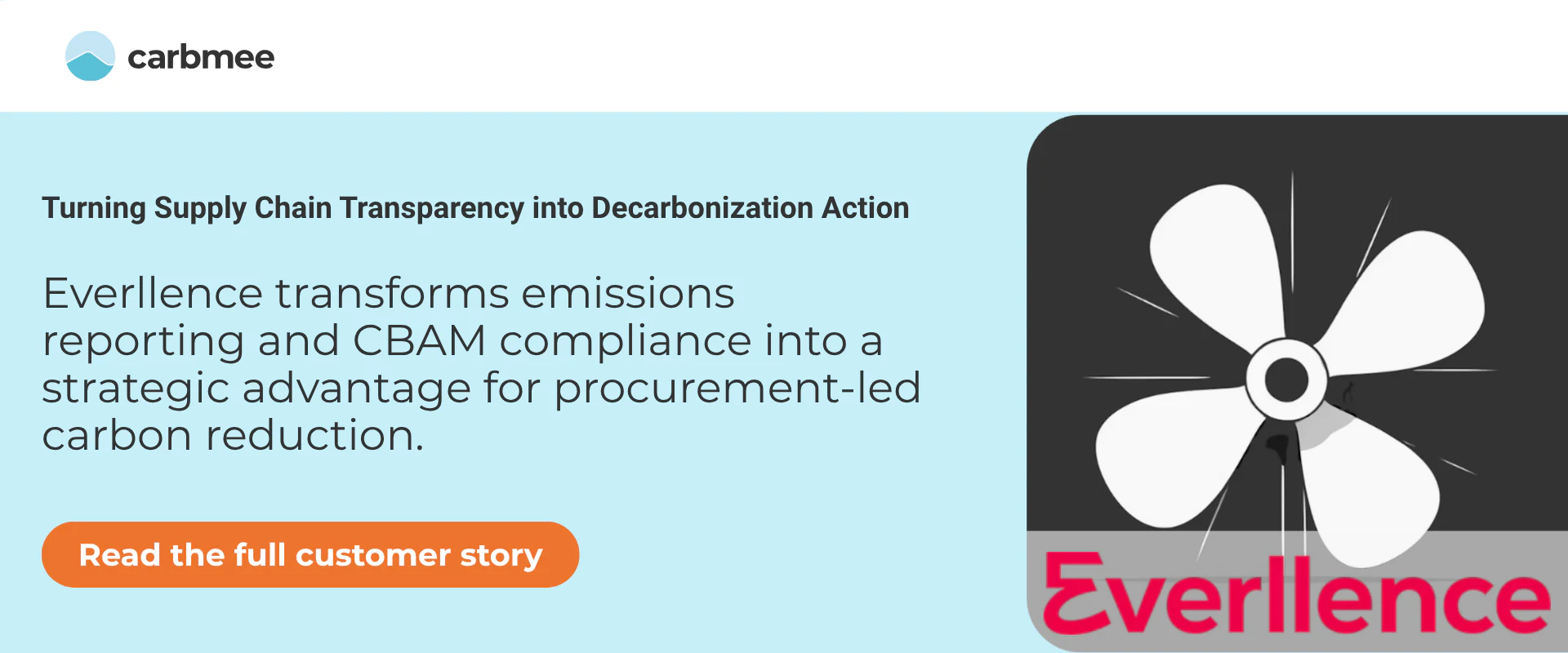
The partnership also initiated a global supplier program to collect primary emissions data, supporting Everllence’s move toward activity-based reporting and deeper supply chain insights. As the case study notes, this positioned Everllence to reduce carbon tax exposure, comply with evolving regulations, and advance a scalable, data-driven decarbonization journey.
Ready to make your transition plan more actionable? Book a classic Carbmee demo or join Carbmee Academy to see how Carbmee EIS™ can help turn environmental data into a more resilient business strategy.
How Carbmee can help
Carbmee EIS™ helps manufacturers connect products, sites, supply chains, suppliers, and transactions, transforming environmental data into strategic business insight with Profit & Loss impact beyond compliance. The platform supports integrated Scope 1, 2, and 3 carbon management, actionable decarbonization pathways, scenario modelling, supplier collaboration, carbon cost forecasting, and financial integration.
With Carbmee EIS™, sustainability teams can identify hotspots, procurement can engage suppliers, finance can model abatement costs and carbon price scenarios, and executives can track progress against transition priorities. This makes environmental intelligence part of everyday business decision-making.