EUDR for Packaging and Paper: What Is in Scope, and What Is Exempt
Paper and pulp are in scope of the EU Deforestation Regulation, so packaging is where almost every manufacturer meets EUDR, even one that handles no other regulated commodity. But scope for packaging depends on how the item is placed on the market, not only its code. The same carton can be exempt when it protects your product and in scope when you sell it empty. Printed products and fully recycled paper are out.
Most companies think EUDR is someone else's problem: a concern for timber traders or cocoa importers. Then they look at their pallets, cartons and paper stock. Paper and paperboard are regulated as wood-derived products, which means the EU Deforestation Regulation reaches almost every business that ships or sells physical goods. With obligations applying from 30 December 2026 for large and medium operators, packaging and paper are worth a careful look, because the rules here are more nuanced than a simple code check. Here is what is in scope, what is exempt, and how to tell the difference across a real portfolio.


Is paper and packaging in scope of the EUDR?
Yes. Paper and pulp are regulated as wood-derived products, so paper-based packaging falls under the EUDR. For many manufacturers, packaging is the single point where the regulation touches them, even if they handle no cattle, cocoa, coffee, oil palm, rubber or soya at all.
That is what makes this topic different from the other commodities. A company can reasonably say it does not deal in rubber or leather. Almost none can say they do not use paper and packaging. Cartons, paper stock, labels and wooden pallets run through nearly every supply chain, which is why "EUDR does not apply to us" is so often wrong. The question is rarely whether paper appears in your operation. It is which of your paper items are actually in scope.
Which paper products are in scope, and which are out
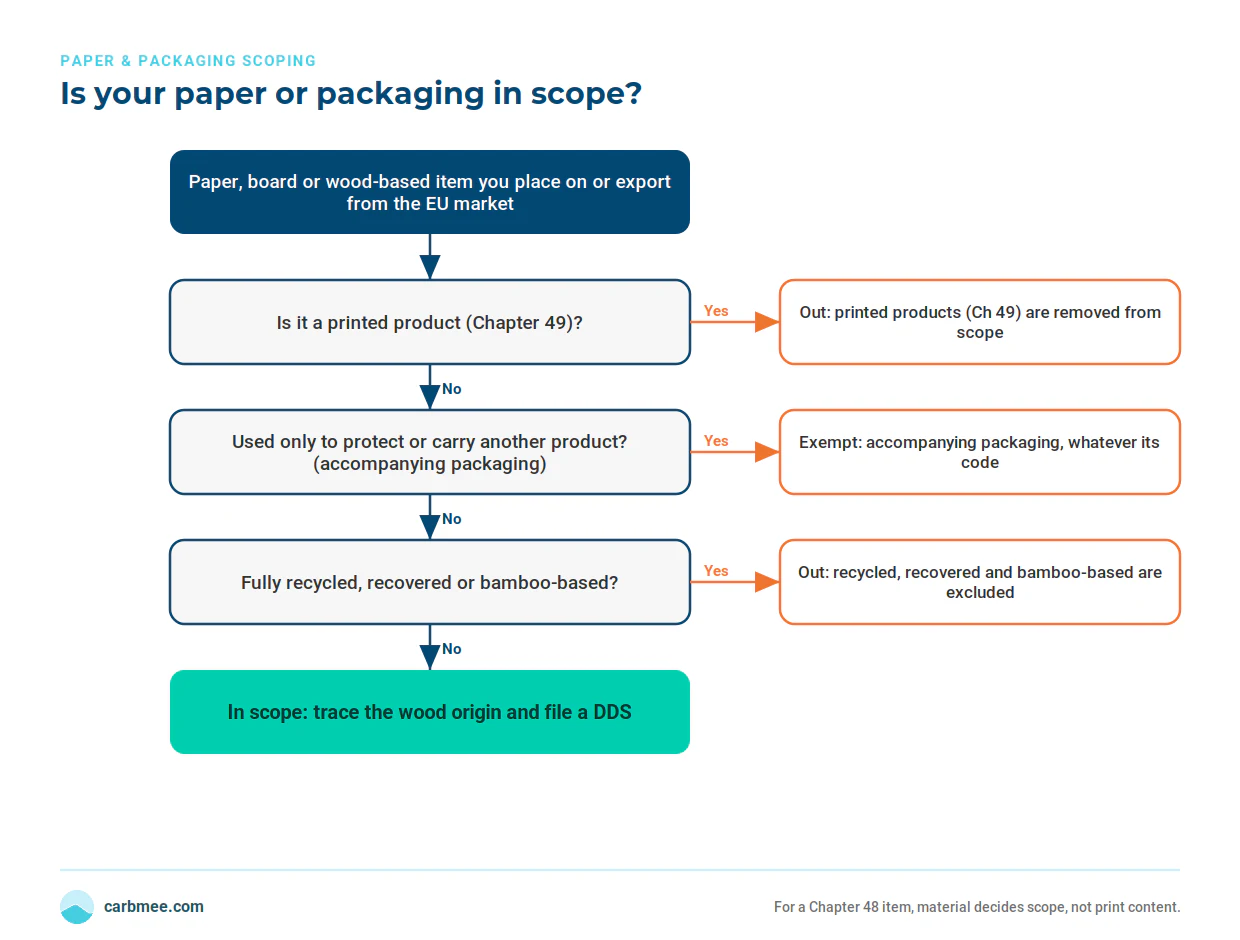
The rule is set by the customs code and the material. Pulp and paper in Chapters 47 and 48 of the Combined Nomenclature are in scope. Printed products in Chapter 49 are not. Fully recycled and bamboo-based paper are excluded.
Chapter 47 (pulp) and Chapter 48 (paper, paperboard and articles of paper) are listed in Annex I, so kraft paper, paperboard, cartons sold as products and similar goods are covered. Two carve-outs matter. Recovered or waste pulp and paper (headings 4706 and 4707) and bamboo-based papers are excluded, and any fully recycled item is out. And Regulation (EU) 2025/2650, published in December 2025, deleted printed products under Chapter 49 from Annex I, so books, newspapers, magazines, brochures, catalogues, maps and cards are no longer regulated. For a Chapter 48 item, material composition decides scope, not print content: a mainly paper product is in scope, while a product defined by what is printed on it is treated as a Chapter 49 printed good and is out. The table below shows how this plays out.
Codes are indicative and shown at heading level. Status reflects Annex I as amended to 2026; confirm each item against the current list.
The packaging exemption: same carton, two answers
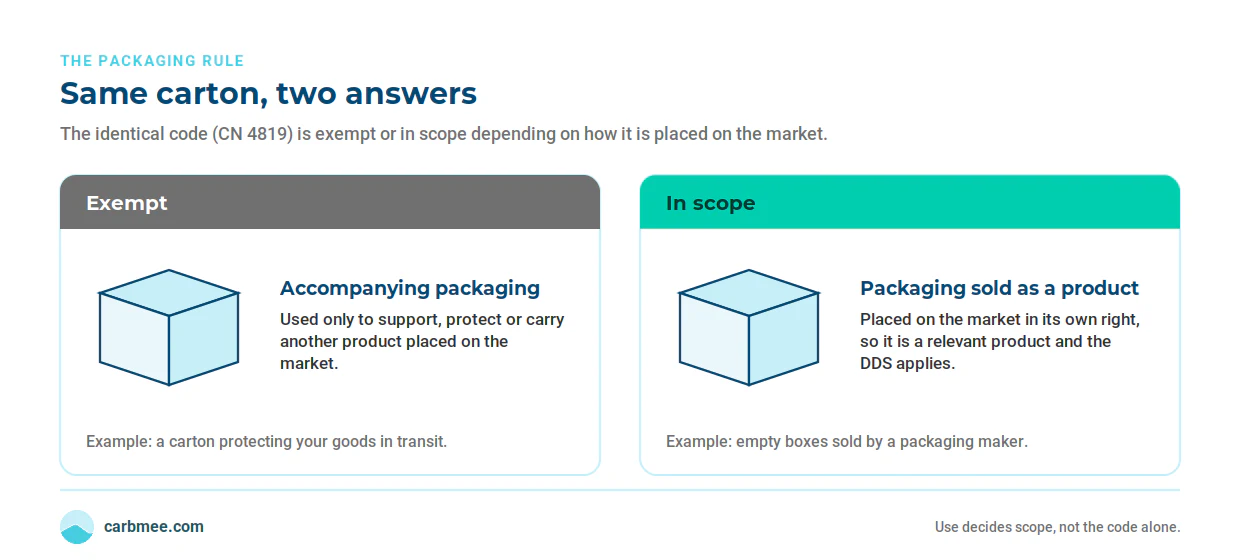
Here is the rule that catches people. Packaging used solely to support, protect or carry another product placed on the market is exempt, whatever its own code. The identical carton is in scope when you sell it empty as a product in its own right. Use decides scope, not the code alone.
The Commission's guidance confirms that packaging accompanying a finished good, used only as a protective container and not resold, is not covered. The 2026 changes widened this to packaging of any material, including reusable packaging, and also removed marketing materials and correspondence from Chapters 47 and 48. But the moment packaging becomes the product, empty cartons, gift boxes, wooden pallets or paper rolls sold on their own, it is a relevant product and the due diligence applies. The wooden pallet under your coffee shipment is exempt. The same pallet sold empty by a pallet maker is in scope.
Why paper and packaging scope is a data problem, not a lookup
Because the packaging exemption is use-based, scope cannot be read off a code alone. The same carton code can be exempt on one order and in scope on another, depending on whether it left your site around a product or as a product. That distinction lives in your commercial and order data, not in the HS code, and resolving it across thousands of SKUs is a data problem.
Three things make paper and packaging scoping hard at portfolio scale.
First, context determines status, and context sits in ERP and order data rather than the classification.
Second, recycled content is partial: a board that is half recovered fibre is in scope only for its non-recycled part, and proving the recycled share needs supplier data.
Third, the pulp origin is tiers away, through mills and converters, so the plot-level data the regulation wants is far from the buyer.
On top of that, the EUDR paper scope keeps moving: printed products left in December 2025, and the packaging exemption widened in 2026, so a static spreadsheet is quickly wrong, and teams that keep chasing exempt accompanying packaging waste effort they do not owe. Testing every item against the current Annex I from a single transactional data foundation, with the use context attached, is what turns this from guesswork into a defensible position.
What you still have to do for in-scope paper
For the paper and packaging that is in scope, a certificate or supplier declaration is not the end of the work. You need to trace the wood to source and file a Due Diligence Statement. That means real data, gathered across a multi-tier chain.
For each in-scope item you need plot-level geolocation of where the wood was harvested, evidence that it is deforestation-free and legally produced, a documented risk assessment, and a filed DDS, with records kept for the retention period. Where a product mixes recycled and virgin fibre, you also need to document the recycled share so the in-scope portion is clear. Most of this data sits with paper mills and converters below your direct suppliers, which is why structured supplier engagement, rather than manual email chasing, is what gets it collected in time.
How carbmee EIS™ makes paper and packaging EUDR manageable
Paper and packaging come down to two repeated questions across a large portfolio: which items are actually in scope, and can you prove the origin of the ones that are. carbmee EIS™, built on the Carbontology™ data foundation, is designed to answer both and turn them into an audit-ready Due Diligence Statement.
It works at the level the regulation cares about. It tests every paper and packaging item against the current Annex I from your transactional data, and because it draws on your commercial and order data, it can separate accompanying packaging from packaging sold as a product, and drop recycled and printed items, rather than treating a code as a single answer. Where you are the operator, carbmee's supplier engagement collects the plot-level geolocation and legality data from mills and converters and validates it.
It then generates audit-ready records, connecting the evidence to each DDS so it can be reviewed and retrieved. And because the same data foundation also serves CBAM and CSRD, packaging does not become a separate compliance silo. Ravensburger, a packaging-intensive manufacturer, reached supply-chain transparency in 20 days with carbmee and identified up to 80% reduction potential in its packaging emissions, an indication of how fast a data-led approach moves once the sourcing data is connected.
Timing is the pressure point. Collecting pulp origin across mills and converters takes months, and the deadline does not move. An independent Verdantix study found a 345% operational ROI and a four-month break-even for carbmee EIS™. That is the difference between a defensible statement and a shipment held at the border over a carton.
What to get right before 30 December 2026
Three points decide paper and packaging readiness. First, paper is in scope, so packaging is probably your most widespread EUDR exposure, even with no other commodity. Second, the packaging exemption is use-based, so the same carton can be exempt or in scope depending on how it is placed on the market, and printed products and fully recycled paper are out. Third, resolving this across a portfolio is a data problem, and the in-scope items still need plot-level origin and a DDS.
The teams that scope packaging from their own data will know exactly what they owe. The teams that treat "it is just cardboard" as a scope decision will either miss obligations or waste effort on packaging they do not owe.
See exactly which of your paper and packaging items are in scope. Request a free EUDR scope and exposure check with carbmee's compliance experts.