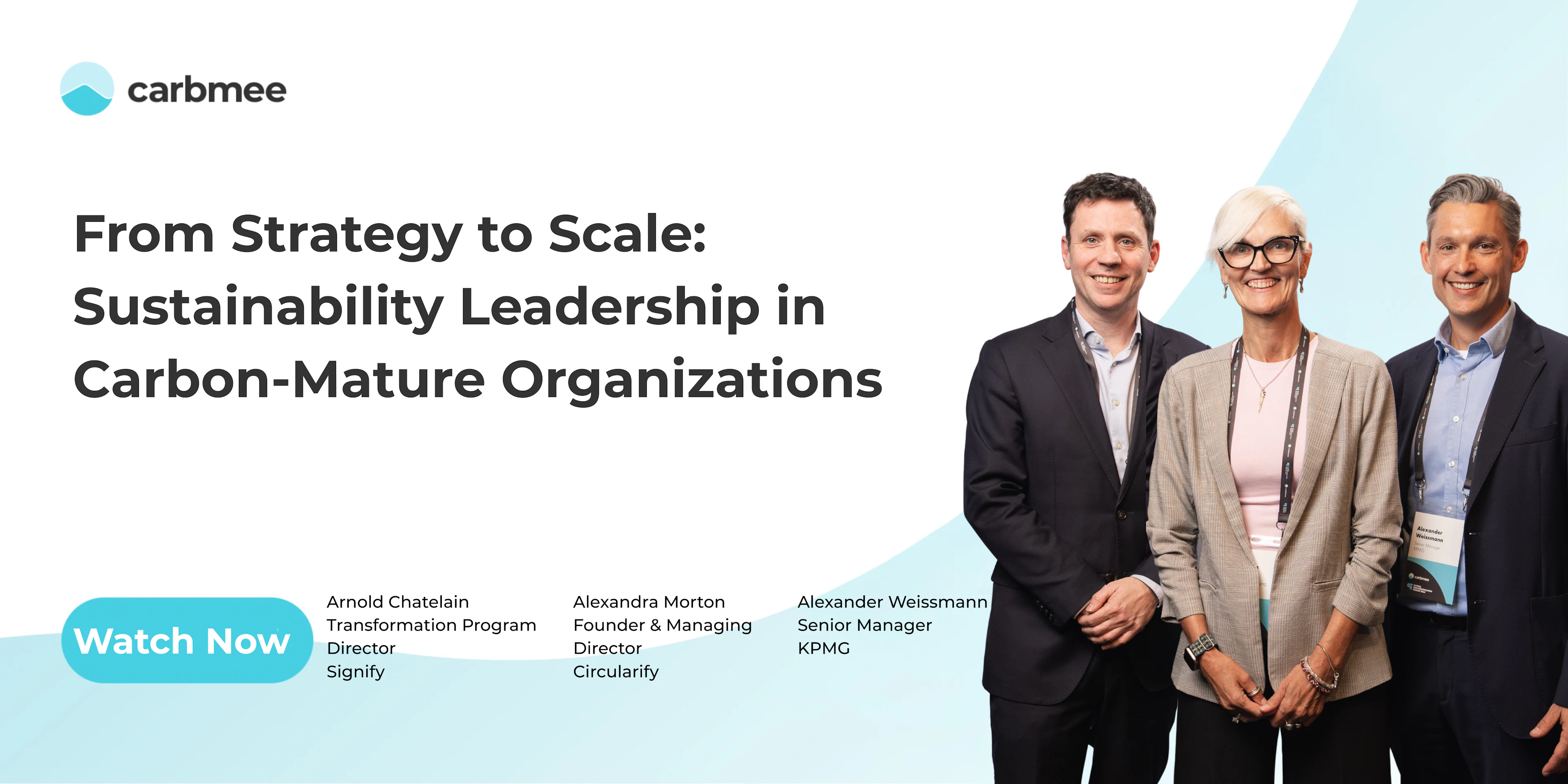
From Strategy to Scale: Sustainability Leadership in Carbon-Mature Organizations
At the Global Decarbonization Forum 2026 in Berlin, Alexandra Morton (Circularify), Arnold Chatelain (Signify), and Alexander Weissmann (KPMG) took the stage for a conversation that picked up where most sustainability discussions stop. The targets have been set. The roadmaps have been written. The commitments have been made. And yet the distance between sustainability strategy and operational reality remains one of the most persistent and costly gaps in industrial organizations today. The panel did not debate whether to act. They examined what it actually takes to scale.


Stop Selling Sustainability. Start Talking About Risk
The first barrier to scaling sustainability in any organization is rarely technical. It is cultural, and it shows up most clearly in how the conversation is framed.
Alexandra Morton opened with a reframe that cut through the usual sustainability narrative. Walking into a boardroom and making the case for decarbonization on environmental grounds is, in her experience, a losing proposition. Half the room disengages before the second slide. The organizations that have made real progress did not win that argument. They changed it.
The questions that open ears at the executive level are not about emissions targets or regulatory timelines. They are about customer exposure: how many of our largest customers are already asking for carbon data? About supplier access: which markets are we at risk of losing if we cannot demonstrate compliance? And about cost: what is the financial impact of doing nothing, compounded over the next five years? Framed that way, decarbonization stops being a sustainability conversation and becomes a risk management conversation, one that P&L owners already know how to have.
Embedding Carbon Across the Business, Not Just Within a Team
Even in organizations where leadership is convinced, the next failure point is structural. Sustainability gets assigned to a team, that team produces reports, and the rest of the business continues operating as it always has. The data exists. The decisions do not change.
Alexander Weissmann named this directly. The challenge is not producing sustainability metrics. It is breaking them down into a strategic, tactical, and operational view that connects to product strategy, competitiveness, and risk at the board level, and then making that view actionable for every function that touches the value chain.
The parallel he drew is worth holding onto. No organization asks only its finance department to care about financial performance. Every team has budgets, targets, and accountability for the financial health of the business. Carbon needs to be treated the same way. Every part of the organization needs to understand the role it plays in achieving the company's net zero goals, not as a reporting obligation, but as a performance metric with real consequences for how teams are evaluated and rewarded.
The front-runners, in his observation, are already doing this. They have brought carbon into product design. They have made it a live input to supplier and customer relationships. And they are treating it not as a compliance burden but as the mechanism through which they intend to stay ahead of the market.
The Technology Has to Follow the Strategy, Not Lead It
Arnold Chatelain brought the operational perspective from Signify, and with it a grounding point that the panel returned to repeatedly. Technology is an enabler. It is not the starting point.
The organizations that have scaled sustainability most effectively did not begin by selecting a platform or building a data architecture. They began by defining what decisions they needed to make differently — and then building the digital infrastructure to support those decisions. At Signify, that meant identifying where carbon data could change a sourcing outcome, where it could inform a packaging decision, where it could shift an engineering trade-off. The technology question followed from the business question, not the other way around.
He also pushed back on the assumption that sustainability always comes at a cost. The examples from Signify's own operations are concrete. Reducing packaging dimensions and removing plastic saved money. Using recycled fishing net waste as a material for 3D-printed lamp components opened an innovation pathway that was both commercially interesting and meaningfully more sustainable. The framing of sustainability as a cost to be managed, rather than a constraint that drives better design, is one of the most expensive assumptions an organization can carry.
Leaders Do Not Chase the Ball. They Change the Game.
One of the sharpest exchanges of the panel came when the conversation turned to what distinguishes a sustainability leader from a sustainability follower — not in ambition, but in behavior.
Alexandra's framing was precise. A follower reports on data and waits to see what happens. A leader decides what to do with what the data is telling them, takes the next step, and does not get pulled off course by the next crisis. Because there is always going to be a next crisis. The organizations making structural progress are the ones that have learned to hold their focus on decarbonization even when geopolitical noise, market disruption, or internal pressure creates reasons to pause.
Arnold took it further. Leadership in an industry, he argued, means more than executing well within the existing rules. It means changing the norms. Setting the standard that others then have to follow. Signify's ambition is not to be the best company operating within the current sustainability framework. It is to define what the framework looks like for the lighting industry — and to build an organization capable of sustaining that position indefinitely. Not an endgame, but an infinite game.
System Leadership and the Speed of Decision-Making
Alexander closed with a dimension that connected the individual organization to the wider value chain. The term he used was system leadership — and it points to something that carbon-mature organizations are beginning to understand that earlier-stage organizations have not yet grasped.
The pace at which a company can act on carbon intelligence is not just a function of its internal capabilities. It is a function of how tightly it is connected to its suppliers and customers, how quickly information travels across those relationships, and how fast the whole system can reconfigure in response to a new input. A large US company he had visited earlier that week had done exactly this: convening its suppliers one day and its customers the next, moving through a fast cycle of shared intelligence and joint decision-making that no single organization could have achieved on its own.
That is the competitive model that is emerging. Not the company with the best internal sustainability program, but the company at the center of the most responsive, most carbon-intelligent value chain. The question is not whether your organization has a sustainability strategy. It is how fast your brain can execute from the information it has access to.
Sustainability Is Becoming a Financing Variable, Not Just a Reporting One
The panel closed with a question from the audience that opened a dimension the earlier conversation had not fully explored: the relationship between sustainability performance and access to capital.
The panel's response was unified. Banks are already assessing sustainability strategy as part of risk profiling. Regulation in several markets now requires loan applicants to present sustainability strategies to certain lenders. That requirement will expand. The cost of capital for organizations without credible decarbonization plans is going up — not as a distant scenario, but as a present reality that is already showing up in financing terms and investor appetite.
Arnold pointed to the investor side: sustainability funds are growing, and the next generation of investors is already directing capital toward companies with credible sustainability stories. Alexandra confirmed the regulatory trajectory. Alexander added the strategic dimension that ties it together: the question is not just how to access capital today, but where future profits will come from. The organizations thinking one step ahead are not just managing their risk profile for the next financing round. They are positioning themselves in the markets, supplier relationships, and product categories where the value will be created over the next decade.
Sustainability, the panel concluded, is not a synonym for cost. It is increasingly a synonym for resilience — and for the commercial position that comes with building an organization that is structurally prepared for what is already underway.
carbmee EIS™: The Intelligence Platform for Carbon-Mature Organizations
The capabilities the panel described − carbon embedded in product design, supplier collaboration at scale, carbon intelligence integrated into procurement and financial decision-making, and the organizational infrastructure to act on it − are core to carbmee EIS™, carbmee's environmental intelligence platform built for large industrial companies. From data ingestion to audit-ready reporting, carbmee EIS™ helps organizations:
Collect and centralize environmental data across operations and supply chains.
Connect ERP, PLM, MES, and procurement systems in a single data model.
Identify emission hotspots and reduction opportunities with AI-powered analytics.
Streamline supplier collaboration and primary data collection at scale.
Ensure compliance with CBAM, ESRS, LCA, and EUDR from one platform.
Whether your priority is embedding carbon into sourcing decisions, scaling supplier engagement programs, or equipping your leadership team with the intelligence to move from strategy to execution, carbmee EIS™ provides the infrastructure to make it happen, without a five-year implementation.