FSC and PEFC Certified Is Not EUDR Compliant. Here Is Why.
FSC and PEFC certification support EUDR compliance, but they do not deliver it. EU law treats certification as one input to your risk assessment, not a substitute for due diligence. Certification proves your system meets a standard; the EUDR asks you to prove a specific consignment is deforestation-free and legal, at plot level, and to file a Due Diligence Statement. It also covers only wood, while the EUDR spans seven commodities.
Many procurement and sustainability teams assume that a warehouse of FSC or PEFC certified material settles their EUDR obligation. It does not. Under the EU Deforestation Regulation, a certificate is useful evidence inside your due diligence, not a pass that discharges the legal duty. With obligations applying from 30 December 2026 for large and medium operators, the "we are certified" assumption is one of the fastest ways to arrive at the deadline exposed. Here is what certification does, what it does not, and what you still have to do.


Is there such a thing as EUDR certification?
No. There is no EUDR certificate you can obtain and move on. The EUDR is a legal obligation you meet through due diligence and a Due Diligence Statement (DDS) filed for the products you place on or export from the EU market.
That distinction is the root of the confusion. FSC, PEFC, RSPO and Rainforest Alliance work like certifications: an independent body audits you against a standard and issues a certificate. The EUDR does not work that way. It sets a legal duty on the operator, verified by member-state competent authorities, and proven with data, geolocation, a risk assessment and a DDS. Treating it like a label is the core mistake, because no third party can accept the legal liability that the regulation places on you.
What FSC and PEFC actually prove, and what they don't
FSC and PEFC Forest Management and Chain of Custody certification prove that material comes from responsibly managed forests and that custody is controlled along the supply chain. They do not prove that a specific consignment is deforestation-free at plot level, which is what the EUDR requires.
The gap is one of purpose and granularity. Certification answers a sustainability question about an organisation's systems and practices. The EUDR answers a legal question about a particular product entering the market. A certificate shows your processes meet a standard. It does not show that the batch on today's shipment is compliant. The table below sets the two side by side.
Why EU law treats certification as support, not a substitute
The regulation is explicit. Certification and third-party verified schemes may inform your risk assessment, but they never transfer the operator's responsibility. Certification is not a green lane into the EU market.
This is written into the law, not inferred. Article 10 of the EUDR, which governs risk assessment, and Recital 52 recognise that certification can provide useful information when you assess and mitigate risk. The European Commission's EUDR guidance reinforces that certification is one input among several, used to support due diligence rather than replace it. The operator still has to collect the information, assess the risk, reduce it where needed, and file the DDS. If a competent authority challenges a statement, the legal responsibility sits with the operator, not the certification body.
The bigger gap: certification covers wood, the EUDR covers seven commodities
Here is the point most manufacturers miss. FSC and PEFC certify wood, and PEFC touches natural rubber. The EUDR regulates seven commodities: cattle, cocoa, coffee, oil palm, rubber, soya and wood. A forestry certificate says nothing about the leather in your seats, the palm-oil derivatives in your formulations, the soya in your inputs, or the cocoa and coffee in your products.
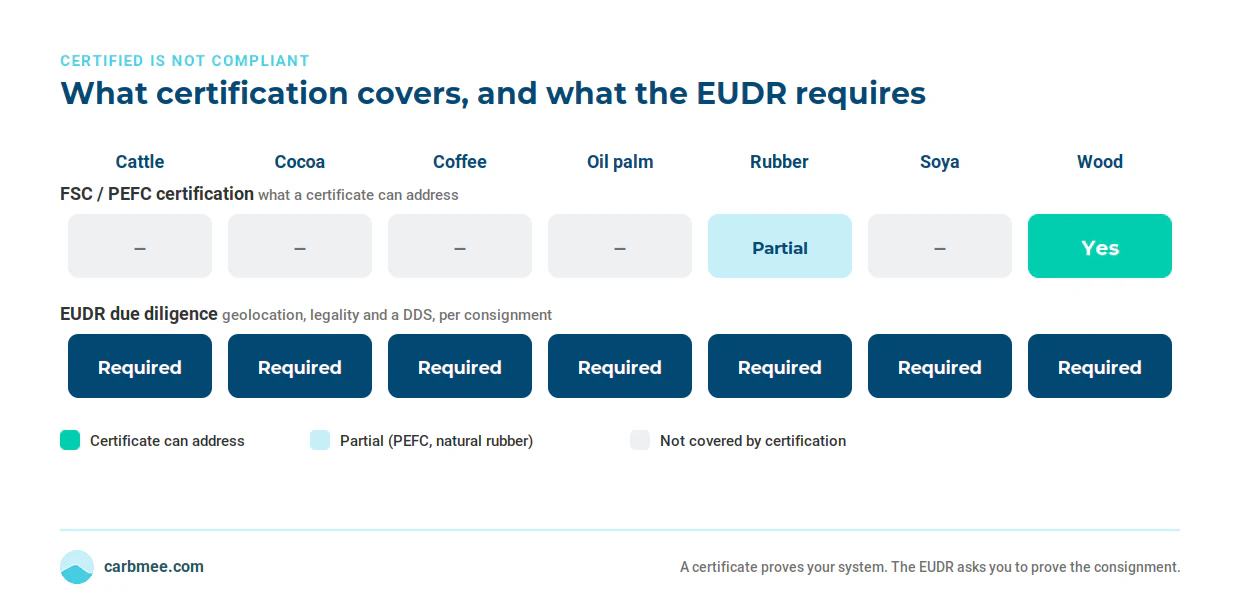
For a single-commodity timber business, "certified" at least covers the right commodity, though it still leaves the consignment-level proof to do. For a manufacturer with a multi-commodity bill of materials, certification is partial by design. It can only ever address the wood-based part of the portfolio, and even there it does not remove the DDS obligation.
The complexity compounds inside real portfolios. Most manufacturers hold a mix of FSC, PEFC, controlled or FSC Mix, and non-certified material across thousands of SKUs. FSC Mix and controlled-wood claims are percentage-based and reduce visibility of a single forest of origin, which is exactly the plot-level detail the EUDR wants. Reconciling all of that into one auditable record, per consignment, is the real work, and no certificate does it for you.
The FSC and PEFC EUDR modules, and what they still leave to you
Both schemes have built voluntary EUDR add-ons. They help, but they do not cross the finish line for you. You still have to trace to source, capture geolocation, and file the DDS.
FSC has published the FSC Regulatory Module and an updated Risk Assessment Framework, together marketed as FSC Aligned Certification for EUDR. PEFC has published its EUDR Due Diligence System standard (PEFC ST 2002-1:2024), with a revised version out for public consultation in July 2026. These are genuine improvements that translate EUDR requirements into practical steps within the certification framework. They are also still evolving, and independent analysis has found that even the strongest scheme aligns with only part of the EUDR's requirements. Relying on a module means tracking two moving targets at once: the regulation, which is being revised, and the standard, which is being updated. In every version, the operator remains responsible for the geolocation data, the risk assessment and the statement.
How carbmee EIS™ turns certification data into audit-ready DDS
Certification gives you signals. The EUDR asks for a defensible, consignment-level record across every regulated commodity. carbmee EIS™, built on the Carbontology™ data foundation, closes that gap by turning what you already have, including your certification data, into an audit-ready Due Diligence Statement.
It works because carbmee operates at the level the regulation cares about. It brings certified, non-certified and mixed material into one transactional data foundation, so wood, leather, palm-oil derivatives, soya, coffee, cocoa and rubber are handled in a single process rather than separate spreadsheets. It uses certification as one input to the risk assessment, alongside country risk and supplier evidence, rather than as a shortcut.
Where certification stops, carbmee's supplier engagement model collects the plot-level geolocation and legal documentation you still need, then validates it. And it generates audit-ready records, connecting the evidence to each DDS so it can be reviewed and retrieved when a competent authority asks. Because the same data foundation also serves CBAM and CSRD, EUDR does not become a fourth siloed project.
Timing is the constraint. Collecting geolocation and legality data across a multi-tier, multi-commodity supplier base takes months, and a certificate does not shorten it. An independent Verdantix study found a 345% operational ROI and a four-month break-even for carbmee EIS™, and at enterprise scale carbmee integrated more than one million annual transactions for Heraeus while replacing spreadsheet-based work. That is the difference between a defensible statement and a certificate that does not answer the question the border asks.
What to check before 30 December 2026
Three points decide whether certification leaves you exposed. First, certification supports EUDR compliance but never replaces it, because the law keeps the legal duty on the operator. Second, a certificate proves your system, while the EUDR asks you to prove a consignment, at plot level, with a DDS. Third, certification covers wood, so every other regulated commodity in your portfolio still needs due diligence from scratch.
The teams that use certification correctly, as one input to a single due diligence process across all seven commodities, will be ready. The teams that treat a certificate as the answer will meet the border unprepared.
See exactly where your certified and non-certified sourcing stands against the EUDR. Request a free EUDR scope and exposure check with carbmee's compliance experts.