Integrating Procurement and Decarbonization: A Joint Value Strategy for Sustainable Supply Chains
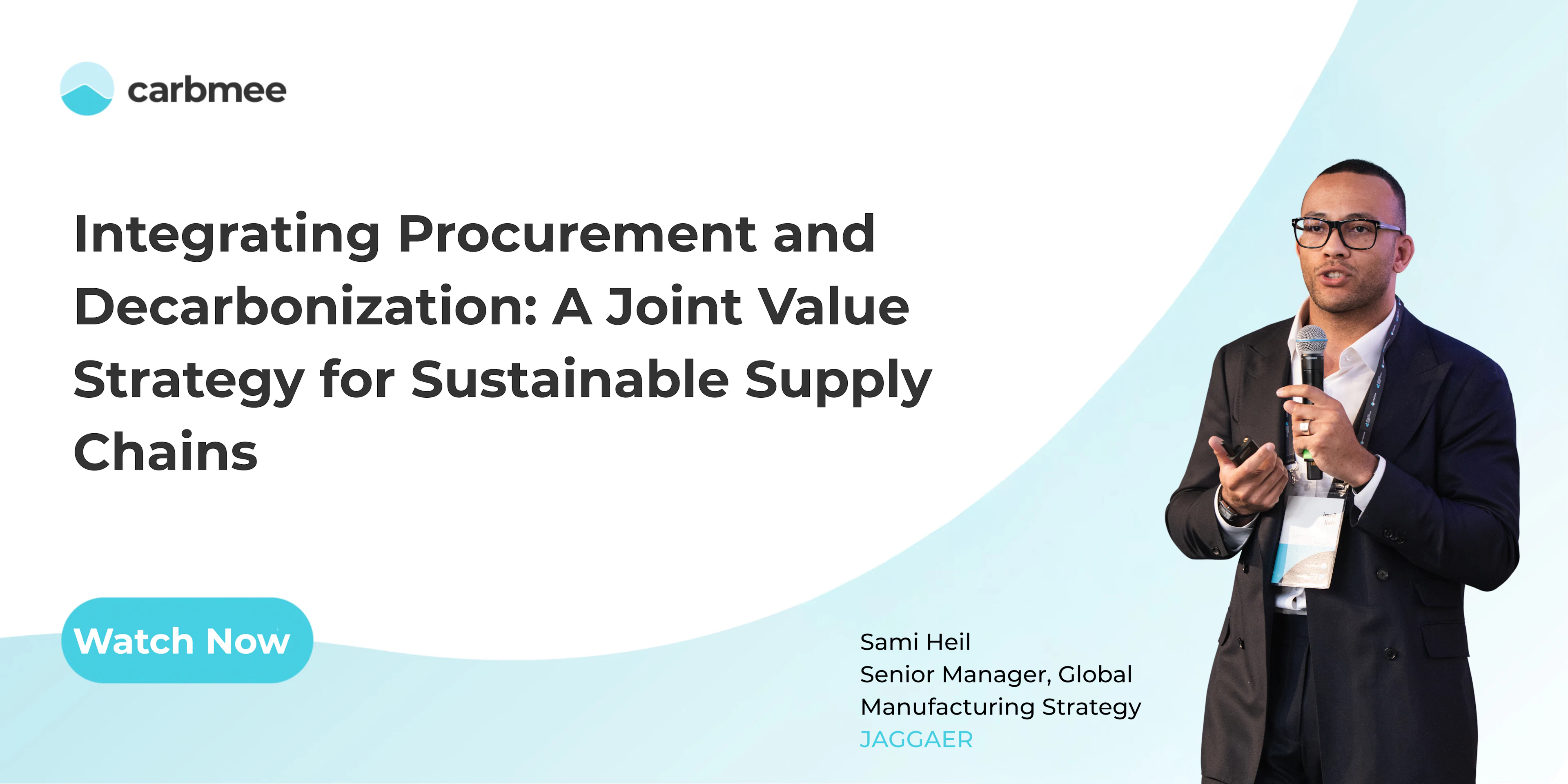
At the Global Decarbonization Forum 2026 in Berlin, Sami Heil, Director of Global Manufacturing Strategy at JAGGAER, delivered a keynote that reframed where the real decarbonization opportunity in manufacturing sits. Not in what companies do within their own operations. Not in a sustainability workstream or a reporting function. But upstream, in the suppliers, materials, and sourcing decisions that procurement and supply chain teams are making every single day. In a session that moved from personal career story to CFO value case, Sami made the argument that procurement is no longer just the function that gathers supplier data and stores it for audits. It is the function that can make or break a company's carbon future, and with the right tools, it can do both at the same time.


From Excel Sheet to Operational Intelligence: How Procurement Changed
Sami opened with a story that will resonate with anyone who has spent time in a procurement team. His first job as a working student was gathering supplier information, pivoting it in Excel, and storing it for the day something went wrong. Always reactive. Always exception-based. Never connected to day-to-day operational decisions.
Over the following decade, he watched that model become obsolete. The shift was not just technological. It was structural. The information that procurement teams were storing in the back end turned out to be the same information companies needed on a live basis to stay competitive, to retain market access, and increasingly to comply with a regulatory environment that changes faster than any static reporting cycle can keep up with.
The arrival of CBAM, CSRD, and the broader wave of product-level compliance regulations did not create a new problem. They made an existing one impossible to ignore.
Supply Chain Emissions Are Not a Sustainability Metric. They Are a Cost
One of the most clarifying moments of the keynote came when Sami put a single number on the table. Supply chain emissions are, on average, 11.5 times higher than a company's own operational emissions. That is not a sustainability statistic. It is a commercial exposure. And for most manufacturing companies, the procurement team is the only function in the organization that sits close enough to the supply base to do anything about it.
The implication is significant. If the largest share of carbon risk sits upstream, and if procurement teams are the primary interface with that upstream supply base, then procurement is not a supporting function in the decarbonization strategy. It is the strategy. The gap between where most organizations have positioned their procurement teams and where they need to be is, in Sami's framing, the gap between companies that will manage their carbon future and companies that will be managed by it.
Carbon-Intelligent Procurement: What It Actually Looks Like
Sami walked through the practical mechanics of what carbon-intelligent procurement looks like when it is built into the daily workflow rather than bolted on as a reporting layer.
The starting point was carbon-intelligent RFQs, the capability that first brought JAGGAER and carbmee together. Instead of relying on spend-based estimates that approximate emissions at a category level, buyers running a sourcing event can now see transactional, supplier-specific carbon data at the point of decision. Not historical averages. Not industry benchmarks. The actual carbon cost associated with a specific sourcing event on a specific date with a specific supplier.
From there, the integration extended into supplier profiles. One of JAGGAER's strategic customers asked for carbon data to be embedded not just in sourcing events but in the supplier 360 profile, the living record of a supplier relationship that category managers return to for every negotiation, every QBR, every development conversation. With carbmee data embedded there, carbon performance becomes a standing input to supplier development, not a one-off compliance check.
The capability Sami was most emphatic about was automated actions. With the latest integration, built and live with customers within two to three weeks, procurement teams can now set rules that trigger supplier development workflows automatically based on carbon performance data. The shift from manual reporting to automated operational response is, in his view, the moment carbon intelligence becomes genuinely useful at scale.
The CFO Case: Where Decarbonization Creates Enterprise Value
Sami was direct about the condition under which decarbonization creates real enterprise value: it has to connect to risk management, margin, and capital allocation. Everything else is noise to a CFO.
The risk management case is the most immediate. Quantifying CBAM import cost exposure at the supplier and material level gives finance teams a number they can plan against rather than a regulatory risk they have to guess at. Improving CSRD and scope 3 auditability reduces the exposure to penalties that can arrive without warning. And building the data infrastructure now means that the next wave of regulation, whatever form it takes, lands on a foundation that is already prepared rather than a team that has to scramble.
The margin case is less obvious but equally powerful. Sami pointed to examples from JAGGAER's customer base where integrating carbon data into make-or-buy decisions and product design phases had surfaced savings that traditional procurement metrics would never have identified. Repackaging decisions worth millions. Material substitutions that reduced both cost and carbon simultaneously. Supplier partnerships built around shared innovation rather than pure price negotiation.
The capital allocation case is the longest-term but increasingly the most consequential. As carbon metrics converge into integrated corporate reporting and are evaluated by investors and rating agencies with growing rigour, the companies that have built a credible, data-backed decarbonization story will have access to capital on different terms than those that have not.
The JAGGAER and carbmee Partnership: Brain Meets Muscle
Sami used a simple frame to describe what the partnership between JAGGAER and carbmee actually delivers: carbmee is the brain, JAGGAER is the muscle. carbmee provides the environmental intelligence − product carbon footprints, CBAM tracking, scope 3 data, supplier carbon profiles collected and verified at the transactional level. JAGGAER provides the execution layer − the sourcing workflows, supplier management infrastructure, contracting capabilities, and S2P suite through which that intelligence becomes operational.
Together, they offer something that neither could deliver alone: a carbon-informed procurement and supply base where decisions are made on verified data rather than estimates, and where the outcomes of those decisions, in emissions terms as well as financial terms, are visible, trackable, and improvable in real time.
The scale ambition is significant. JAGGAER runs 15 million suppliers and three trillion dollars of spend through its platform. carbmee is managing 300,000 suppliers at the transactional level. The combination creates a data foundation that is, in Sami's view, the only realistic path to the kind of supply chain decarbonization that actually shows up in a corporate carbon footprint.
What Comes Next
Sami closed with a forward look at where procurement and supply chain decarbonization is heading, and the direction of travel was clear. Commercial negotiations are beginning to shift. The question is no longer what a supplier's carbon footprint is. It is what reduction pathway they are committing to. And with the right tools, that conversation can happen at scale, not with ten suppliers in a pilot program, but with thousands simultaneously.
Tier 2 and tier 3 visibility is coming. Most companies today have line of sight to tier 1. The material hotspots increasingly sit deeper. The platforms that can extend primary data collection and verification beyond the first tier will define who has a credible scope 3 story in five years and who is still relying on estimates.
And the separation between sustainability reporting and operational procurement systems is ending. The companies that are integrating now, building the shared data foundation that connects carbon intelligence to sourcing decisions, supplier development, and financial planning, are the ones that will find the next wave of regulation an output rather than a crisis.
carbmee EIS™: Environmental Intelligence Inside Procurement Execution
The capabilities Sami described are built on carbmee EIS™, carbmee's environmental intelligence platform purpose-built for large industrial manufacturers. Integrated natively with JAGGAER's procurement and supply chain suite, carbmee EIS™ helps organizations:
Collect and centralize environmental data across operations and supply chains.
Connect ERP, PLM, MES, and procurement systems in a single data model.
Identify emission hotspots and reduction opportunities with AI-powered analytics.
Streamline supplier collaboration and primary data collection at scale.
Ensure compliance with CBAM, ESRS, LCA, and EUDR from one platform.
Whether your priority is carbon-intelligent sourcing, CBAM cost visibility, or building the supplier data foundation that makes scope 3 reduction possible rather than just reportable, carbmee EIS™ provides the infrastructure to make it happen, without a five-year implementation.