Life Cycle Assessment (LCA): A Complete Guide for Companies in 2026
Definition: Life Cycle Assessment (LCA) is a standardized method used to evaluate the full environmental impact of a product, process, or service across its entire life - from raw material extraction to production, usage, and disposal. Governed by ISO 14040 and ISO 14044, LCA provides a science-based framework to measure emissions, resource use, and ecological effects at every life cycle stage.
Goal: The primary goal of LCA is to identify and quantify environmental hotspots, improve sustainability performance, enable responsible decision-making, and ensure compliance with global standards and reporting regulations. LCA helps organizations reduce emissions, design better products, and transparently communicate their environmental impact to stakeholders.
Life Cycle Assessment is fast becoming a critical tool in corporate sustainability strategies, regulatory compliance (such as under CSRD and the EU Taxonomy), product design, and carbon accounting. It provides a structured, data-driven way to integrate environmental performance into business operations, procurement, and innovation. In this guide, learn what LCA is, how it works, which models and standards to follow, and why companies should embed LCA into their environmental strategy today.

What is Life Cycle Assessment?
Life Cycle Assessment (LCA) is a scientific, standardized method for measuring the environmental impact of a product, process, or service from its origin to its end of life. It quantifies material and energy flows, emissions, and potential environmental effects at each phase of a product’s journey - known as the life cycle.
LCA is the backbone of product sustainability assessments. It helps companies make informed decisions about materials, suppliers, manufacturing methods, and end-of-life options. By following ISO norms and internationally recognized methodologies, LCA ensures that sustainability claims are credible, consistent, and comparable across markets.
Who Needs a Life Cycle Assessment and Why?
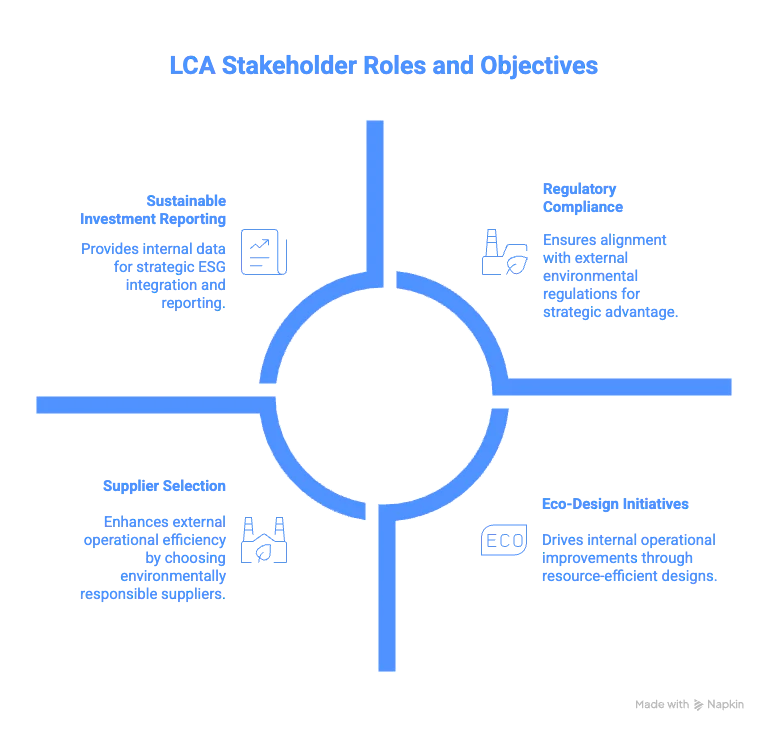
LCA is relevant to a wide range of stakeholders across an organization. As environmental regulations tighten and consumer expectations grow, different business functions are using LCA to gain insights, manage risk, and drive performance.
LCA for Product Management and Research & Development
Product teams rely on LCA to:
- Evaluate material choices and design trade-offs (e.g. recycled plastic vs. virgin plastic)
- Support eco-design initiatives that reduce resource use or emissions
- Meet sustainability certification criteria like EPDs, EU Ecolabel, or cradle-to-cradle labels
- Improve lifecycle cost efficiency by identifying resource savings across production and use phases
LCA for Supply Chain and Procurement
Procurement and supply chain managers use LCA to:
- Select lower-impact suppliers based on environmental data
- Assess Scope 3 emissions across global supplier networks
- Engage with preferred vendors offering cleaner materials or transport methods
- Build resilient and transparent sourcing strategies aligned with ESG goals
LCA for Marketing and Sales
Sustainability is now a key value proposition. Marketing and sales teams use LCA to:
- Communicate environmental performance with credibility
- Support product claims (e.g. "50% less CO₂ than market average")
- Back up ecolabels and B2B sustainability data requests
- Avoid greenwashing by referencing LCA data tied to ISO standards
LCA for Executives and Sustainability Leaders
At the strategic level, LCA supports:
- Regulatory compliance (e.g. CSRD, EU Taxonomy, CBAM, and PEF)
- Risk management and supply chain resilience
- Sustainable investment reporting and ESG integration
- Sustainability performance KPIs across product lines or sites
The Product Life Cycle in LCA
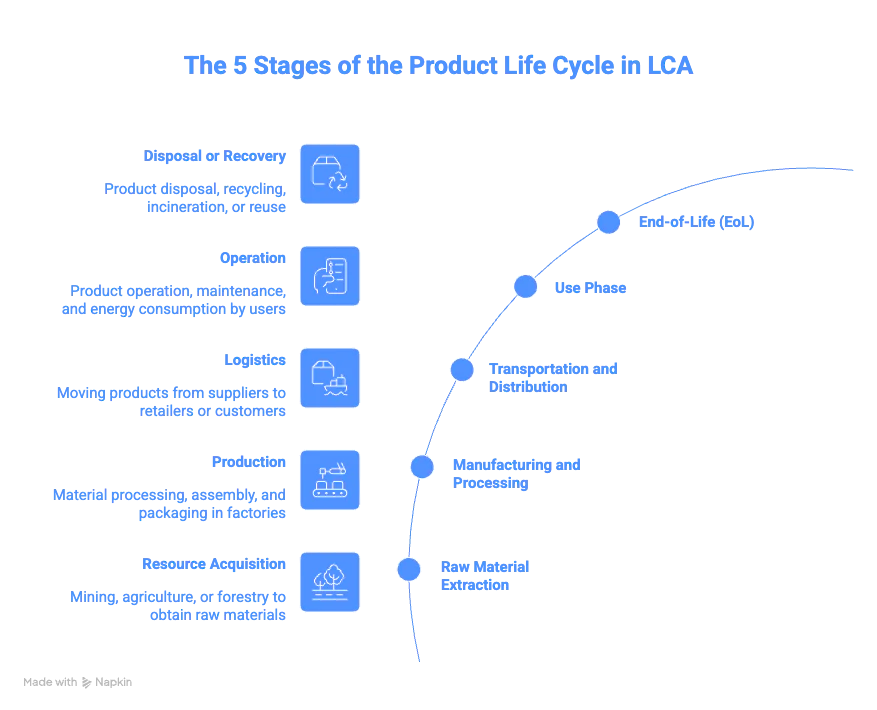
To conduct an LCA, you must first define the life cycle of the product or process you are analyzing. This is known as the product system.
The 5 Stages of the Product Life Cycle
- Raw Material Extraction
Activities include mining, agriculture, forestry, or the extraction of fossil fuels. This phase often carries the highest resource and land use intensity. - Manufacturing and Processing
Covers material processing, component assembly, packaging, and energy consumption in production facilities. - Transportation and Distribution
Includes all logistics - from supplier shipments to product delivery to retailers or customers. Transportation modes (air, sea, rail, truck) are critical variables here. - Use Phase
This includes product operation, maintenance, energy consumption during use, and replacement of consumables. - End-of-Life (EoL)
Covers product disposal, recycling, incineration, or reuse. It also accounts for landfill emissions, recovery of materials, or energy recovery.
System Boundaries
The system boundary defines what is included in the assessment. For example, some LCAs may exclude the use phase if data is unavailable or minimal (e.g. for consumables). Boundary setting is critical and directly influences outcomes and comparability.
Life Cycle Assessment Models Explained
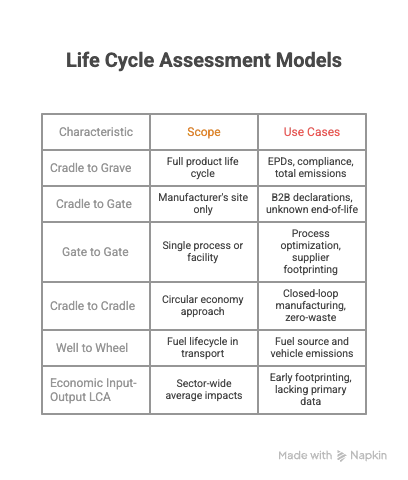
LCA can be conducted using various system models, depending on the scope and business objectives. Each model serves a different use case.
Cradle to Grave
Covers the full product life cycle from resource extraction to final disposal. This model is used when:
- Full environmental impact is required (e.g. for EPDs or compliance)
- Comparing total lifecycle emissions of two products
- Meeting reporting requirements (e.g. PEF or CSRD)
Cradle to Gate
Focuses only on emissions and impacts until the product leaves the manufacturer’s site. Common for:
- B2B product declarations
- Products with unknown usage or end-of-life phases
- Early-stage product development
Gate to Gate
Analyzes a single process or facility within the value chain. Useful for:
- Process optimization (e.g. evaluating the impact of a new machine)
- Supplier footprinting
- Incremental product improvements
Cradle to Cradle
Embraces circular economy thinking. This model assumes the product or material is reused or recycled rather than discarded. Used in:
- Closed-loop manufacturing
- Sustainable product design
- Zero-waste strategies
Well to Wheel (Transport Sector)
Specialized LCA model that splits fuel lifecycle into:
- Well to Tank: Extraction, processing, and distribution of fuel
- Tank to Wheel: Fuel consumption and emissions during use
Economic Input-Output LCA (EIOLCA)
Estimates average environmental impacts using economic activity data. Applied in:
- Sector-wide assessments
- Early-stage footprinting when primary data is lacking
The 4 Phases of Life Cycle Assessment
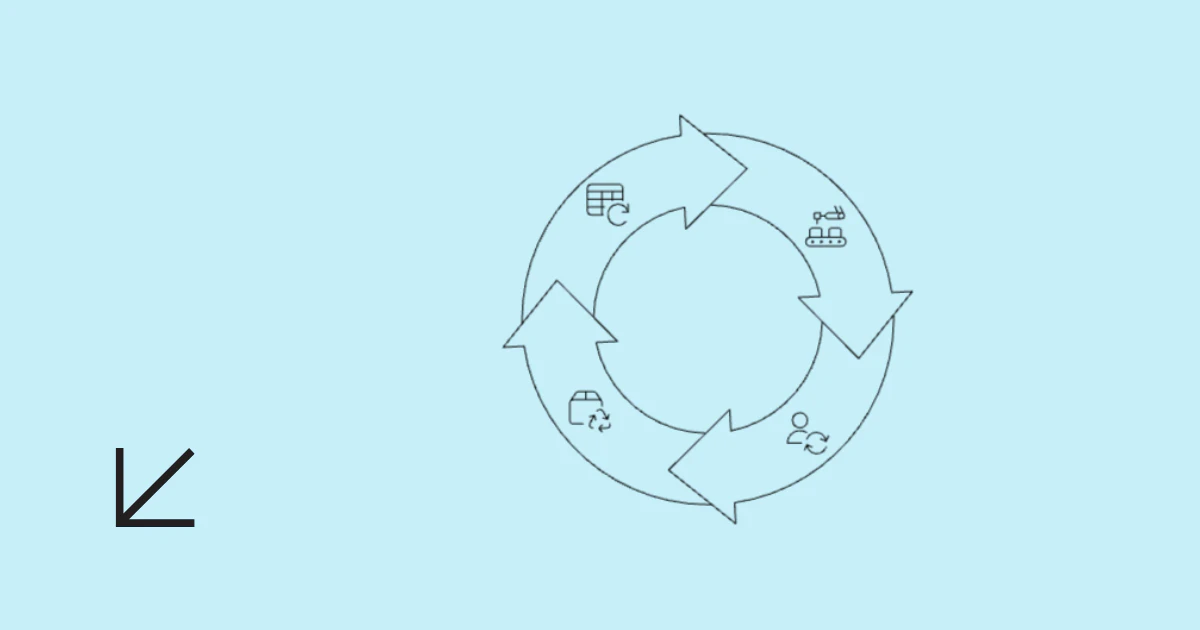
An ISO-compliant LCA must include four distinct phases. These are not linear, they often loop back as new data is discovered.
Phase 1: Goal and Scope Definition
This phase defines the objectives, the system boundaries, and the level of detail required. It ensures alignment with business goals and intended audiences.
Key Elements
- Goal: Why is the LCA being conducted? For internal decision-making? Public reporting?
- Functional unit: The measurable basis for comparison (e.g. "1 kg of packaging material")
- System boundaries: What is included and excluded?
- Impact categories: Which environmental indicators will be assessed?
Phase 2: Life Cycle Inventory (LCI)
This phase involves collecting data on all inputs and outputs across the system.
Inputs:
- Raw materials
- Energy and fuel consumption
- Water usage
- Transportation distances and modes
Outputs:
- Air emissions (e.g. CO₂, CH₄, NOx)
- Water emissions
- Solid waste
- Byproducts and secondary materials
Data Sources:
- Internal operations data
- Supplier questionnaires
- Utility bills
- LCA databases (e.g. ecoinvent, GaBi, SimaPro)
Phase 3: Life Cycle Impact Assessment (LCIA)
This step translates physical flows into potential environmental impacts using characterization models.
Common Impact Categories:
- Global warming potential (GWP) in CO₂-equivalents
- Eutrophication (nutrient pollution)
- Acidification
- Ozone layer depletion
- Human toxicity
- Ecotoxicity
- Water scarcity
- Fossil resource depletion
Each input/output is matched to its effect on these categories. For example, methane emissions are converted to CO₂-equivalents based on their warming potential.
Phase 4: Interpretation
The results are analyzed and translated into actionable insights. This phase includes:
- Hotspot identification: Which stages contribute most to impact?
- Scenario analysis: How would switching materials affect emissions?
- Limitations: What uncertainties exist in the data?
- Recommendations: What actions can reduce impact?
Interpretation should be transparent and aligned with the original goal and scope.

LCA Standards and Regulations Companies Should Know
To ensure credibility, comparability, and regulatory alignment, companies must base their Life Cycle Assessments on internationally recognized standards and frameworks. Using these standards guarantees that LCA results can be trusted by stakeholders, auditors, and regulators - and that they can be reused in environmental product declarations, ESG reporting, or regulatory disclosures.
Core LCA Standards
These ISO standards define the essential methodology and structure for conducting an LCA:
ISO 14040: Principles and Framework for LCA
Establishes the general framework for an LCA, including key principles such as system boundaries, functional units, and life cycle stages. It sets the foundation for consistency across industries and use cases.
ISO 14044: Requirements and Guidelines for LCA
Provides detailed technical guidance on how to conduct each of the four LCA phases: goal and scope definition, inventory analysis, impact assessment, and interpretation. ISO 14044 also includes criteria for data quality, sensitivity analysis, and reporting transparency.
ISO 14067: Carbon Footprint of Products
Specializes in calculating and communicating the climate change-related impacts of a product using LCA methods. It enables companies to produce credible Product Carbon FootprintsProduct Carbon Footprints (PCFs) that can be used in carbon reporting, eco-labeling, or climate strategies.
ISO 14001: Environmental Management Systems
Although not LCA-specific, this standard provides a framework for integrating environmental considerations into organizational management systems. It encourages companies to use LCA data as part of broader environmental performance tracking and continuous improvement.
European and Global LCA Frameworks
These frameworks either build upon or complement ISO standards, often tailoring them to sector-specific or regulatory needs.
EN 15804: Environmental Product Declarations for Construction
Standardizes the format and methodology of EPDs (Environmental Product Declarations) in the construction industry. It ensures that LCA results for building materials and products are presented in a consistent, comparable way across Europe.
Product Environmental Footprint (PEF): EU Methodology for Product Sustainability
Developed by the European Commission, the PEF methodology aims to harmonize how companies calculate and communicate product-level environmental performance. It expands on ISO standards by prescribing detailed rules (PEFCRs) for various product categories. PEF is likely to play a key role in upcoming EU regulations, such as green claims and ecolabeling.
PAS 2050: Carbon Footprinting Standard by BSI
Published by the British Standards Institution, PAS 2050 outlines how to assess the lifecycle GHG emissions of goods and services. It is often used for fast-moving consumer goods (FMCG) and complements ISO 14067.
GHG Protocol: Corporate and Product Standards
Developed by the World Resources Institute and World Business Council for Sustainable Development, the GHG Protocol is the most widely used global framework for greenhouse gas accounting. Its Product Standard aligns closely with LCA principles and supports carbon footprinting across Scope 1, 2, and 3 emissions.
Related Sustainability Regulations Requiring LCA-Based Data
As governments increase pressure on companies to disclose environmental performance, many regulations and directives now require LCA-based evidence or reporting.
CSRD (Corporate Sustainability Reporting Directive)
The EU’s CSRD mandates that thousands of companies publish detailed sustainability reports, including environmental impacts related to products, value chains, and business models. LCA plays a key role in meeting the European Sustainability Reporting Standards (ESRS), especially under ESRS E1 (climate change) and ESRS E5 (resource use and circular economy).
EU Taxonomy Regulation
The EU Taxonomy classifies which economic activities are considered environmentally sustainable. To prove that an activity "substantially contributes" to an environmental objective or "does no significant harm," companies must provide impact data, often sourced through LCA methodologies.
CBAM (Carbon Border Adjustment Mechanism)
For companies importing goods into the EU, CBAM introduces carbon pricing at the border based on product emissions. Importers will need to report embedded carbon in goods such as steel, aluminum, and cement, relying heavily on product-level LCA or equivalent calculations.

Limitations and Criticisms of Life Cycle Assessment
While LCA is one of the most advanced tools for understanding environmental impact, it is not without shortcomings. Companies using LCA must understand its limitations - both technical and practical - to avoid misinterpretation and ensure effective application.
Use of Averages and Secondary Data
In many cases, companies lack access to primary, site-specific data from their suppliers, especially in complex or global value chains. As a result, LCAs often rely on secondary data from databases like ecoinvent or GaBi. While these averages are useful for screening, they may not accurately reflect real-world conditions or recent changes in a supply chain.
This can lead to underestimating or overestimating impact and may introduce risk when disclosing data to regulators or customers who expect precision.
Boundary and Scope Definition Challenges
One of the most subjective aspects of LCA is setting system boundaries. What you include or exclude can dramatically change the results. For example, omitting the use phase for a durable good may overlook a significant portion of its emissions. Likewise, assumptions around recycling rates or end-of-life treatment can alter conclusions about sustainability.
Scope choices must be clearly justified and aligned with international standards, otherwise the credibility of the entire LCA can be questioned.
Lack of Social and Economic Dimensions
Standard LCA focuses only on environmental impacts. It does not account for social, ethical, or economic effects such as:
- Labor conditions
- Community health
- Human rights issues in sourcing
To address this, emerging methods like Social Life Cycle Assessment (S-LCA) and Life Cycle Costing (LCC) are being developed, but these are still evolving and not yet widely adopted or standardized.
High Cost and Complexity
Conducting a comprehensive LCA requires:
- Cross-functional data collection
- Expertise in LCA modeling and interpretation
- Specialized tools and databases
- Internal coordination across departments
This makes LCA resource-intensive, especially for companies with large or diverse product portfolios. For many organizations, scaling LCA beyond a few flagship products remains a challenge unless supported by automation or integrated software solutions.
Inconsistent Results and Lack of Comparability
Different practitioners can produce different LCAs for the same product, depending on:
- Data sources used
- Assumptions and modeling choices
- Impact categories selected
Even when standards like ISO 14044 are followed, these inconsistencies make it difficult to compare LCA results across companies or markets. This also complicates communication with stakeholders unfamiliar with the technical nuances of LCA.
The Future of LCA in Business and Regulation
As environmental transparency becomes a corporate norm, LCA is evolving from a specialist tool to a strategic enabler across industries. The future of LCA is defined by integration, automation, and regulation.
Integration into Corporate Reporting and Disclosure
LCA is no longer optional for companies under EU regulations. It is becoming a compliance cornerstone for environmental reporting frameworks such as:
- CSRD: Where quantitative environmental impact data is required under ESRS
- EU Taxonomy: Where LCA helps prove alignment with “substantial contribution” criteria
- CBAM: Where LCA-based carbon footprints are needed for import declarations
By integrating LCA into core reporting processes, companies can align with regulatory timelines and reduce audit risks.
Operationalizing Circular Economy Strategies
As companies shift toward circular business models, LCA is key to assessing trade-offs and validating environmental benefits. It helps answer critical questions:
- Does recycling reduce the product’s overall footprint?
- What are the net effects of a take-back scheme?
- Is a biodegradable material better than a recyclable one?
Through modeling and scenario analysis, LCA enables more data-driven circular economy decisions.
Scope 3 and Supply Chain Decarbonization
More than 70% of most companies' emissions lie in Scope 3, including upstream suppliers and downstream product use. LCA provides the methodology to:
- Assess supplier-level impacts
- Quantify embedded carbon in purchased goods
- Optimize logistics and packaging strategies
- Make informed supplier switching or design decisions
LCA is foundational to building effective Scope 3 reduction targets and strategies.
Life Cycle Assessment (LCA) FAQ
What is Life Cycle Assessment in simple terms?
LCA measures the total environmental impact of a product or service, from raw material extraction through manufacturing, use, and disposal.
What are the four phases of LCA?
The four phases are: Goal and Scope Definition, Life Cycle Inventory (LCI), Life Cycle Impact Assessment (LCIA), and Interpretation.
What is the difference between cradle to grave and cradle to gate?
Cradle to grave includes the full life cycle, from raw material to disposal. Cradle to gate stops at the point of manufacture, before use or disposal.
What standards define how to conduct an LCA?
The main standards are ISO 14040 and ISO 14044. Other relevant standards include ISO 14067, EN 15804, PAS 2050, and the GHG Protocol.
Why is LCA important for companies?
LCA helps companies improve product design, reduce environmental impact, comply with regulations, and support sustainability claims with credible data.
What is the difference between LCA and carbon footprinting?
Carbon footprinting focuses only on greenhouse gas emissions. LCA covers multiple environmental impact categories like water, toxicity, and resource depletion.
Can companies automate LCAs?
Yes. Modern software platforms can automate data collection, modeling, and impact analysis, allowing companies to scale LCAs across multiple products or sites.
Is LCA mandatory?
While not always legally required, LCA is increasingly used to comply with EU regulations, customer requirements, and product certification programs.
How Carbmee Helps Companies Implement Life Cycle Assessment
Carbmee’s Environmental Intelligence System (EIS™) enables companies to scale Life Cycle Assessment across their operations — without the complexity of traditional tools. Carbmee connects your product, process, and supplier data to create real-time, audit-ready LCA models that meet ISO standards and regulatory expectations.
Carbmee EIS™ supports:
- Automated data collection from procurement, production, and logistics
- Scalable product footprinting across entire portfolios
- Integration with Scope 1, 2, and 3 emissions data
- Scenario modeling to evaluate material swaps or design changes
- Alignment with CSRD, PEF, and EU Taxonomy criteria
Whether you're measuring a single product or an entire value chain, Carbmee makes LCA faster, smarter, and business-relevant.