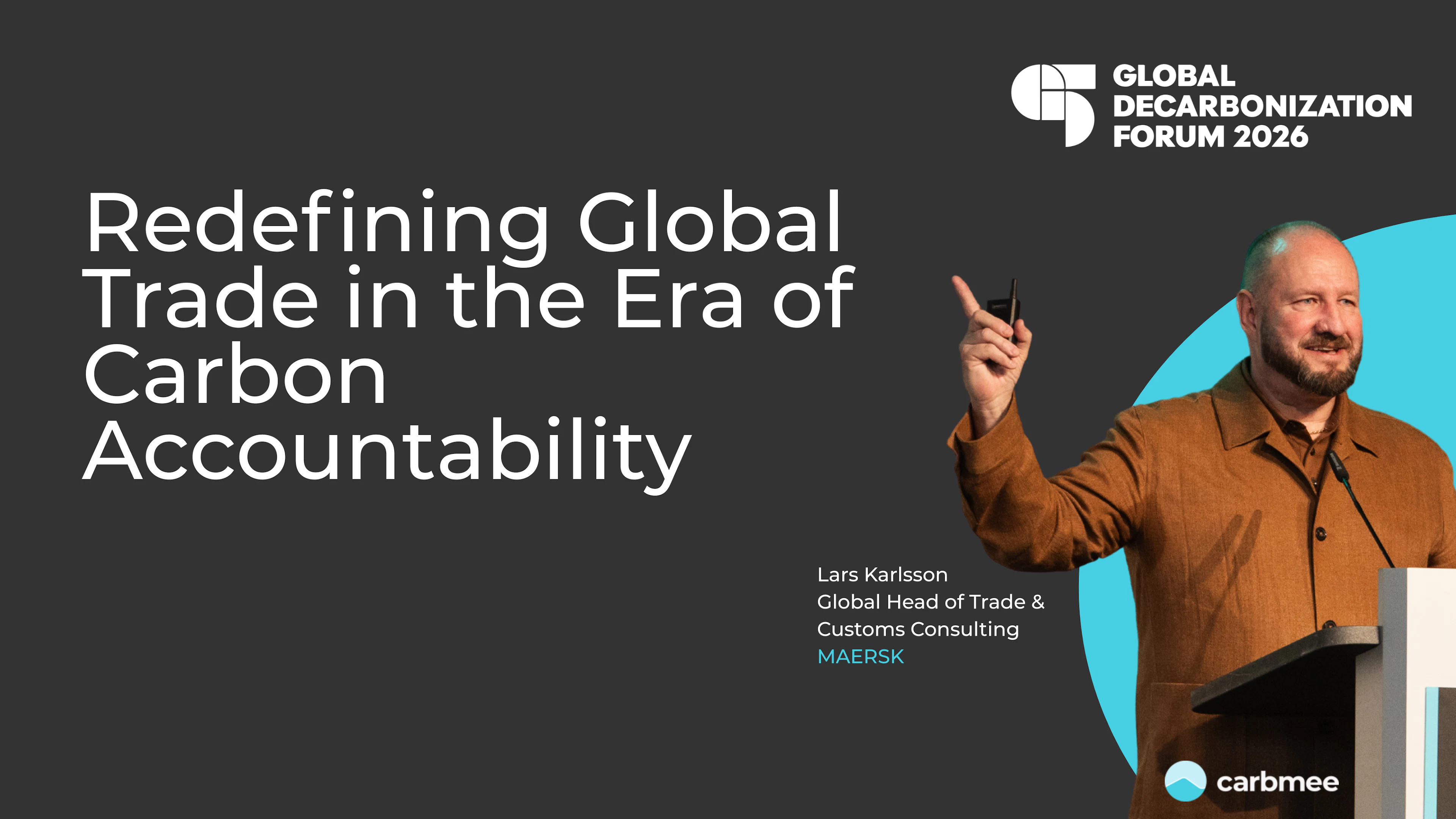
Redefining Global Trade in the Era of Carbon Accountability
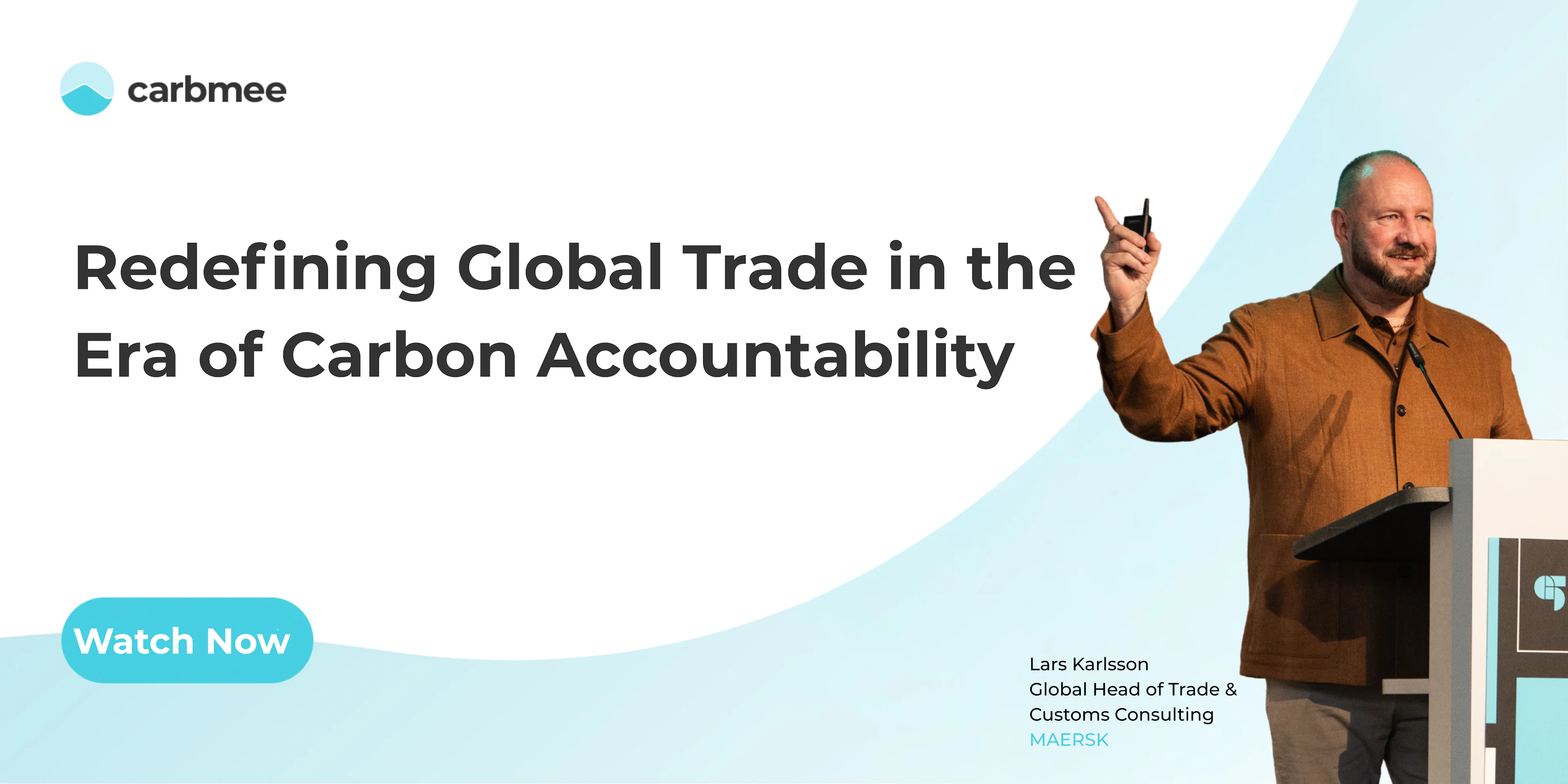
At the Global Decarbonization Forum 2026 in Berlin, Lars Karlsson, Global Head of Trade and Customs Consulting at Maersk, delivered a keynote that reframed one of the most underestimated strategic variables in global manufacturing and trade. Not carbon reporting. Not ESG strategy. Not supplier engagement programs. The border. And more specifically, what happens at it, what it costs, what it delays, and what it is about to become for every company moving goods across international supply chains. Lars made the case that trade compliance has crossed a threshold, it is no longer a back-office function. It is the mechanism through which carbon accountability, supply chain resilience, and competitive advantage are about to converge, and the companies that understand that now are the ones that will be ready when it matters.

The World Has Changed. Most Trade Compliance Functions Have Not
Lars opened with a number that reframed the operational reality most supply chain leaders are living in. A product today crosses a border an average of five times during its production cycle, before it has even reached an end consumer. In the last three years alone, 7,000 new non-tariff barriers have been added globally. Average tariffs have moved from 2.4 to 16.5 percent in a single year. And companies are, on average, overpaying five to six percent in tariffs − not because the rules are unfair, but because their data is wrong, their reporting is incomplete, and their border handling is operating the way it always has.
The pandemic made the cost of that visible in a way that could not be ignored. More than 20 percent of delays and detentions during that period were not caused by port congestion, driver shortages, or ship queues. They were caused by bad border handling, bad customs data, and bad reporting. The problem was not new. The crisis made it impossible to attribute to something else.
The regulatory environment arriving on top of that operational reality is unlike anything the trade compliance world has seen before. CBAM, EUDR, the US Forced Labor Prevention Act, and the ten to twelve similar regulations currently in implementation phases around the world are not the standard variety of trade regulation. They are supply chain regulations. Multi-tier. Source-specific. Requiring companies to know their products, their suppliers, and their emissions in a way that no corporate-level disclosure framework can deliver on its own. The companies that treat these as compliance projects are going to find them expensive and disruptive. The companies that treat them as a data infrastructure question are going to find them a source of competitive separation.
Carbon Accountability Is Not Arriving at the Border. It Is Already There
Lars drew a direct line from the regulatory cascade to the commercial reality already playing out in global trade. CBAM is not a future scenario. It is already requiring importers to report embedded carbon in specific product categories, with financial liability attached. The EU deforestation regulation is entering new implementation phases. The forced labor regulations are already holding shipments at borders.
The challenge, as Lars framed it, is not that companies lack the ambition to comply. It is that the data infrastructure required to comply at the product level does not yet exist inside most organizations. Corporate sustainability reports do not contain the granularity that border agencies are beginning to require. Supplier questionnaires filled out once a year do not produce the source-specific, transaction-level emissions data that CBAM calculations demand. And the ERP systems and procurement platforms that hold the most relevant commercial data were never designed to talk to the customs and compliance systems that need it.
The consequence is predictable. Companies that cannot demonstrate compliance at the border will face delays, detentions, penalties, and ultimately market access restrictions that no amount of corporate sustainability reporting will resolve. The question is not whether to build the data foundation. It is whether to build it before or after the first significant exposure.
The Passport for Goods − From Vision to Operational Reality
The most striking part of Lars's keynote was not the regulatory analysis. It was the announcement that the solution is already here. The concept is straightforward and the analogy is precise. A personal passport is an identity document, a traveling record, a compliance certificate, and a permission to cross borders, all in one. In five airports around the world, Lars noted, he does not even need to show it. Biometrics and pre-shared data do the work before he arrives. The question he posed to the room was simple: why can't goods work the same way?
The answer, it turns out, is that they can. And they will, before the end of 2026. Maersk, working with the World Customs Organization, the World Bank, UK government agencies, and US Customs and Border Protection, has been developing and piloting a live product passport that aggregates commercial data, customs data, CBAM emissions data, IoT goods movement data, and digital product passport standards into a single shareable record that travels with the shipment, and reaches border agencies weeks before the goods do. The pilot results are concrete. 40% lower border costs. 60% faster clearance. 60% better resilience and predictability. 50% reduction in carbon emissions from trade operations alone. Not projections from a model. Measured outcomes from a live test involving 11 government agencies, Maersk clients, partners, and competitors operating together on shared infrastructure.
Own Your Data. Earn Your Trust. Select the Right Partners.
Lars closed with three principles that he has distilled from more than forty years working in customs, trade compliance, and supply chain operations across governments and private sector organizations worldwide. They are worth sitting with, because they apply equally to the passport for goods question and to the broader carbon accountability challenge every organization in the room is navigating.
The first is data ownership. Every company operating in international trade needs to own its own data, manage it actively, and treat it as a strategic asset rather than a byproduct of operations. The organizations that are going to navigate the next wave of supply chain regulation are not the ones that can produce a report when asked. They are the ones that have continuous, transaction-level visibility into what is moving, where it came from, what it cost, and what it emitted − because that is the data that border agencies, trading partners, investors, and regulators are increasingly going to require simultaneously and without warning.
The second is compliance as competitive advantage. Lars was explicit: the companies adopting early are going to win. Not because they are more virtuous, but because they are building the operational infrastructure that makes market access, margin protection, and regulatory readiness a structural feature of how they trade − rather than a scramble they repeat every time a new requirement lands.
The third is partner selection. The scale and complexity of what is coming means that no organization can build every capability it needs independently. The companies that will move fastest are the ones that identify the right partners early, integrate deeply, and build solutions that neither could deliver alone. The Maersk and carbmee partnership is one example of exactly that logic: Maersk's trade infrastructure, customs expertise, and global goods movement data combined with carbmee's product-level carbon intelligence and supplier emissions tracking to create a compliance and carbon data foundation that serves both organizations' clients in ways that a standalone solution never could.
What the Passport for Goods Means for Carbon-Accountable Supply Chains
The implications of a live, shareable, transaction-level product passport extend well beyond border clearance speed. For carbon accountability specifically, the passport model represents something that most organizations are still trying to assemble from disconnected sources: a single verified record of where a product came from, how it was made, what emissions it carried, and what regulatory obligations it triggers − available in real time, shareable with any counterparty that needs it, and built on data that was collected operationally rather than estimated after the fact.
That is the data foundation that makes CBAM compliance credible rather than approximate. It is the foundation that makes scope 3 supplier emissions verifiable rather than modeled. And it is the foundation that turns the next wave of supply chain regulation − whatever form it takes − from a crisis to be managed into an output that is already prepared for.
The border is not the end of the supply chain story. It is where the story becomes visible. And the companies that have built the right data infrastructure, with the right partners, before the passport for goods becomes the operating standard, are the ones that will find visibility an advantage rather than an exposure.
carbmee EIS™: The Carbon Intelligence Layer for Trade-Compliant Supply Chains
The capabilities Lars described − transaction-level emissions data, CBAM compliance tracking, supplier carbon verification, and product-level passport readiness − are core to carbmee EIS™, carbmee's environmental intelligence platform built for large industrial companies operating in global trade. Integrated with Maersk's trade and customs infrastructure and purpose-built for the product-level compliance requirements that are already landing at borders worldwide, carbmee EIS™ helps organizations:
Collect and centralize environmental data across operations and supply chains.
Connect ERP, PLM, MES, and procurement systems in a single data model.
Identify emission hotspots and reduction opportunities with AI-powered analytics.
Streamline supplier collaboration and primary data collection at scale.
Ensure compliance with CBAM, ESRS, LCA, and EUDR from one platform.
Whether your priority is CBAM cost visibility, product passport readiness, or building the supplier emissions data foundation that makes cross-border carbon accountability possible rather than approximate, carbmee EIS™ provides the infrastructure to make it happen, without a five-year implementation.