Carbon Contracts for Difference (CCfD): Definition, Use Cases, and What Industrial Companies Need to Know
Industrial companies are under growing pressure to decarbonize production while staying competitive in volatile markets. Customers are asking for lower-carbon products. Regulators are tightening climate requirements. Investors increasingly expect credible transition plans. At the same time, many breakthrough technologies for hard-to-abate sectors are still more expensive than conventional production routes.
This is where Carbon Contracts for Difference can play an important role. Carbon Contracts for Difference, often shortened to CCfDs, are designed to reduce the financial risk of investing in low-carbon industrial technologies. They help bridge the cost gap between conventional production and climate-friendly alternatives by compensating companies when low-carbon production is not yet economically competitive.
For energy-intensive industries such as steel, cement, chemicals, paper, glass, and metals, this can be a decisive mechanism. Many of these sectors need large upfront investments, long planning horizons, new energy infrastructure, and reliable carbon price signals before they can transform core production processes. CCfDs provide a framework for making those investments more predictable.
We explain what Carbon Contracts for Difference are, how they work, how they are used in Germany and the EU, what they mean globally, and what companies should know before relying on them as part of an industrial decarbonization strategy.

What Are Carbon Contracts for Difference?
A Carbon Contract for Difference is a public-private contract that helps make low-carbon industrial production economically viable. It compensates a company for the additional costs of using a climate-friendly production process compared to a conventional, higher-emission process. The mechanism is usually linked to a carbon price, such as the price of allowances under the EU Emissions Trading System, also known as the EU ETS.
The basic idea is simple. If the cost of avoiding one tonne of CO2e is higher than the market carbon price, the public side pays the company the difference. If the carbon price rises or low-carbon production becomes cheaper, the payment decreases. In some models, if low-carbon production becomes more profitable than conventional production, the payment flow can reverse, and the company pays money back to the state.
This makes CCfDs different from a fixed subsidy. Instead of paying a static amount regardless of market conditions, the contract adjusts over time. It is designed to provide planning security while limiting overcompensation.
Carbon Contracts for Difference are also known as Climate Contracts for Difference, CCfDs, or, in Germany, CO2 Differenzverträge. While terminology varies, the central purpose is the same: to help companies invest in low-carbon technologies before those technologies are fully competitive in the market.
For industrial companies, CCfDs are especially relevant because many major emissions reductions require more than incremental efficiency improvements. They often involve replacing core production routes, switching to renewable electricity or low-carbon hydrogen, installing carbon capture technologies, or redesigning heat-intensive processes. These decisions are capital-intensive and can affect a site’s competitiveness for decades.
Why Carbon Contracts for Difference Matter for Industrial Companies
Carbon Contracts for Difference matter because they address one of the central barriers in industrial decarbonization: the difference between what is climate-efficient and what is currently cost-competitive.
In many energy-intensive sectors, conventional production remains cheaper because existing assets are depreciated, fossil-based inputs are widely available, and low-carbon alternatives are still scaling. A steel producer using hydrogen-based direct reduction, for example, may face higher capital costs, higher operating costs, uncertain hydrogen supply, and exposure to changing electricity and carbon prices. A cement producer investing in carbon capture may face major infrastructure and storage costs. A chemicals company switching feedstocks or process energy may face uncertain demand for lower-carbon products.
Without support, companies may delay investment until carbon prices rise, technology costs fall, or customer willingness to pay becomes clearer. But waiting creates another problem: industrial assets have long lifetimes. If companies continue investing in conventional production, emissions can become locked in for decades.
Carbon Contracts for Difference are intended to solve this timing problem. They help companies invest earlier by reducing exposure to uncertain future carbon prices and cost gaps. In return, governments receive measurable emissions reductions, technology learning effects, and stronger conditions for green industrial markets.
For sustainability, finance, procurement, operations, and strategy teams, the key point is that CCfDs are not just a policy instrument. They can shape which technologies become investable, which production sites are transformed first, and which low-carbon materials become available in the market.
How Carbon Contracts for Difference Work
Carbon Contracts for Difference are based on the logic of financial Contracts for Difference, which are used to hedge price volatility. In a conventional contract for difference, two parties agree on a reference price or strike price. If the market price moves below or above that level, payments are made to settle the difference.
In the carbon context, the mechanism is adapted to emissions reduction. The contract usually compares a defined cost or contract price for avoided emissions with a market reference, such as the carbon price in the EU ETS. The purpose is not financial speculation, but investment security for low-carbon production.
A simplified example helps explain the logic.
A conventional producer manufactures a product for €10 and pays €5 for emissions certificates. Its total cost is therefore €15. A low-carbon producer can make the same product with a climate-friendly process, but its production cost is €16. The low-carbon route is better for the climate, but it is still €1 more expensive than the conventional route.
If the agreed avoidance cost is €6 per unit and the carbon price is €5, the CCfD compensates the €1 difference. If the carbon price later rises to €6, the state support falls to zero. If the carbon price rises above the agreed level, the company may have to pay the difference back, depending on the contract design.
In practice, real CCfDs are more complex. They can account for investment costs, operating costs, energy carrier prices, carbon prices, reference systems, actual emissions reductions, and reporting requirements. Germany’s CO2 Differenzverträge, for example, are designed as long-term contracts and can consider both capital expenditure and operating expenditure within a competitive bidding process.
The central principle remains consistent: CCfDs reduce the economic uncertainty of investing in low-carbon production by linking support to the actual cost difference between conventional and climate-friendly production.
Carbon Contracts for Difference vs EU ETS vs Grants
Carbon Contracts for Difference are often discussed alongside the EU ETS, subsidies, grants, and industrial policy programs. These instruments are related, but they do different jobs.
The EU ETS creates a carbon price signal by requiring covered companies to surrender allowances for their emissions. This encourages emissions reductions when reducing emissions is cheaper than paying for allowances. However, in hard-to-abate sectors, the carbon price alone may not be high or stable enough to justify transformative investments.
Traditional grants can support investment, but they may not fully address long-term operating cost gaps. A plant may receive funding to build a low-carbon facility, but still struggle to operate competitively if low-carbon hydrogen, electricity, biomass, or carbon capture remains expensive.
Carbon Contracts for Difference sit between these approaches. They complement the EU ETS by strengthening the investment case when carbon prices are not sufficient on their own. They also improve on static subsidies by adjusting support as market conditions change.
Why CCfDs Are Important for Hard-to-Abate Sectors
The sectors most often associated with Carbon Contracts for Difference are energy-intensive and hard to abate. These include steel, cement, chemicals, glass, paper, and metals. In these industries, emissions are often linked not only to energy use, but also to core production chemistry, high-temperature heat, and carbon-intensive raw materials.
This makes decarbonization difficult for several reasons.
First, many facilities require large-scale capital investment. Replacing a blast furnace, installing carbon capture, switching to hydrogen-based production, or electrifying high-temperature heat is not a small operational change. It can require new equipment, new supply contracts, grid upgrades, infrastructure access, and workforce capabilities.
Second, operating costs may increase. Low-carbon hydrogen, renewable electricity, sustainable biomass, or captured carbon transport and storage can be more expensive than fossil-based alternatives, especially before markets scale.
Third, customer demand for low-carbon products is growing but not always mature. Some buyers are willing to pay a green premium for lower-carbon steel, cement, chemicals, or glass, but many markets still compete primarily on price. This creates uncertainty for producers that invest early.
Fourth, industrial companies face carbon leakage risk. If production costs rise in one region but competitors in other regions do not face comparable carbon costs, production can shift abroad. That can weaken local industry without reducing global emissions.
CCfDs help address these challenges by creating a more predictable business case for transformation. They do not remove every risk, but they can reduce one of the biggest uncertainties: whether a low-carbon plant can compete during the years when technology costs, carbon prices, and green markets are still developing.
How Germany and the EU Use Carbon Contracts for Difference
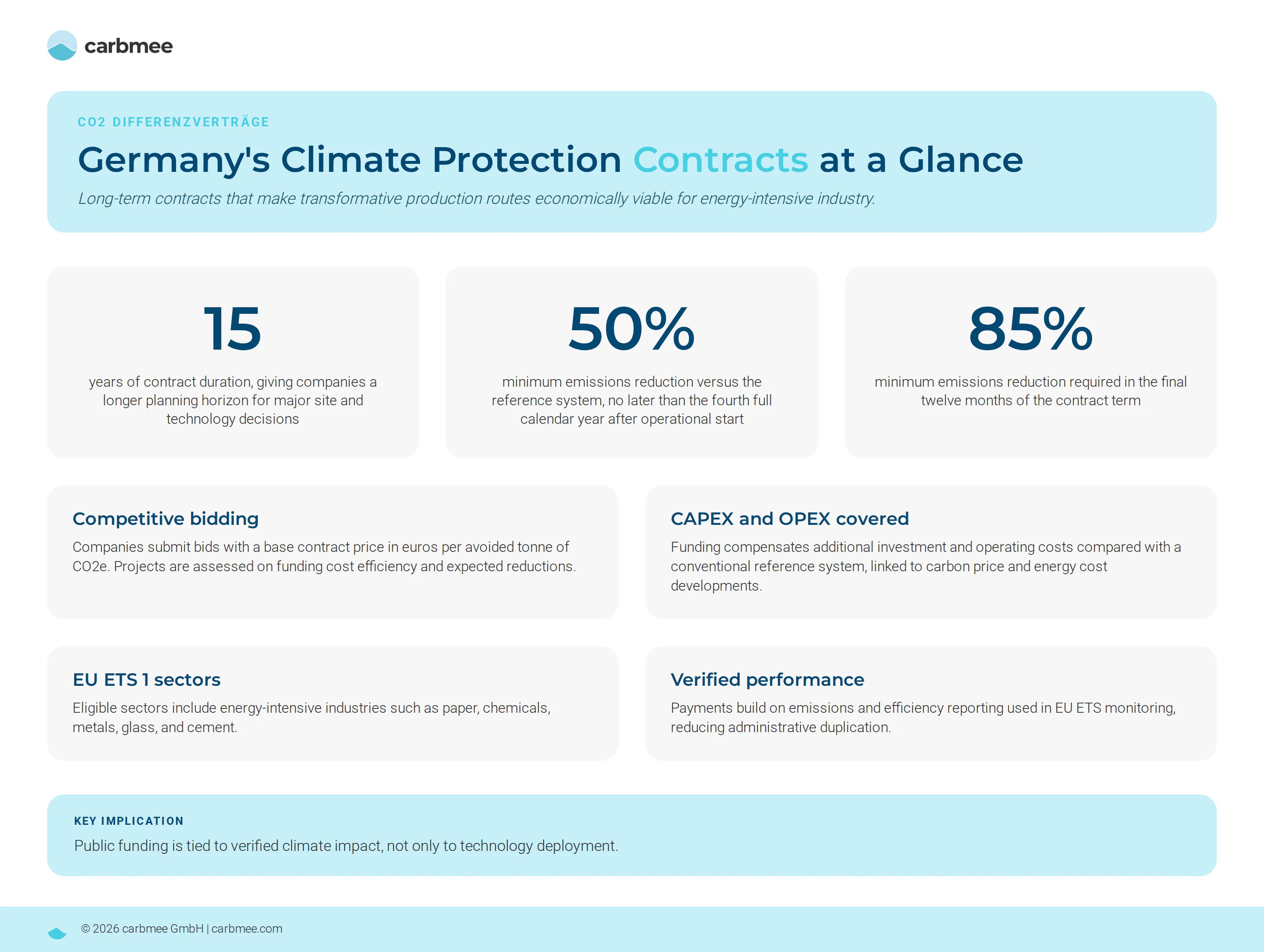
Germany is one of the most important examples of Carbon Contracts for Difference in practice. The German approach, known as CO2 Differenzverträge or climate protection contracts, is designed to support energy-intensive industrial companies that invest in climate-friendly production processes.
The German model focuses on companies whose production processes fall under the EU ETS 1. Eligible sectors can include industries such as paper, chemicals, metals, glass, cement, and other energy-intensive manufacturing activities. The goal is to make transformative production routes economically viable while supporting Germany’s industrial competitiveness and climate targets.
A central feature of the German program is the long contract duration. The contracts can run for 15 years, giving companies a longer planning horizon for major site and technology decisions. This is important because industrial transformation projects often involve investment cycles that are much longer than typical annual budget planning.
The funding is designed to compensate additional costs compared with a conventional reference system. These additional costs can include both CAPEX and OPEX, meaning investment costs and operating costs. The level of support is variable and linked to market conditions, including carbon price developments and certain energy carrier costs.
The allocation process is competitive. Companies submit bids, including a base contract price in euros per avoided tonne of CO2e. Projects are assessed based on factors such as funding cost efficiency and expected greenhouse gas emissions reduction. Funding is awarded according to the program rules until the available funding volume is reached.
Germany’s framework also includes emissions reduction requirements. According to the program information provided, supported projects must achieve at least 50% emissions reduction compared with the reference system no later than the fourth full calendar year after operational start. In the final twelve months of the contract term, the reduction must reach at least 85%.
This structure is designed to ensure that public funding is tied to actual climate impact rather than only to technology deployment. Payments are based on emissions and efficiency reporting, building on data used in EU ETS monitoring. This reduces administrative duplication and strengthens the link between funding and verified performance.
At the EU level, Carbon Contracts for Difference are part of a broader discussion about how to decarbonize industry while maintaining competitiveness. They interact with instruments such as the EU ETS, the Innovation Fund, state aid rules, green public procurement, the Carbon Border Adjustment Mechanism, and policies designed to create demand for low-carbon materials.
What Carbon Contracts for Difference Mean Globally
Although Carbon Contracts for Difference are especially prominent in Germany and Europe, the underlying problem is global. Industrial companies around the world face the same challenge: low-carbon technologies often require large investments before markets fully reward lower emissions.
Globally, CCfDs can be understood as one type of transition finance mechanism. They help bridge the gap between today’s market conditions and the future market needed for net-zero industry. The exact design can vary by country, but the strategic purpose is similar: reduce investment risk, accelerate technology deployment, and create early supply of low-carbon industrial products.
In regions with carbon pricing systems, CCfDs can be linked directly to the carbon price. In regions without a mature carbon market, governments may need other reference prices or benchmarks. Some countries may use CCfD-like instruments for clean hydrogen, green steel, low-carbon cement, sustainable aviation fuels, or carbon capture projects.
The global relevance also extends into supply chains. If European producers use CCfDs to scale low-carbon steel, chemicals, cement, or glass, downstream manufacturers may gain access to lower-carbon inputs. This can help companies reduce Scope 3 emissions and produce more credible product carbon footprints. For global buyers, CCfDs may therefore indirectly influence sourcing strategies, supplier engagement, and product-level climate claims.
However, CCfDs are not a universal solution. They require strong governance, clear baselines, credible emissions data, and careful design to avoid overcompensation or weak climate outcomes. They work best when combined with carbon pricing, infrastructure development, procurement signals, and transparent emissions accounting.
What Companies Should Know Before Relying on CCfDs
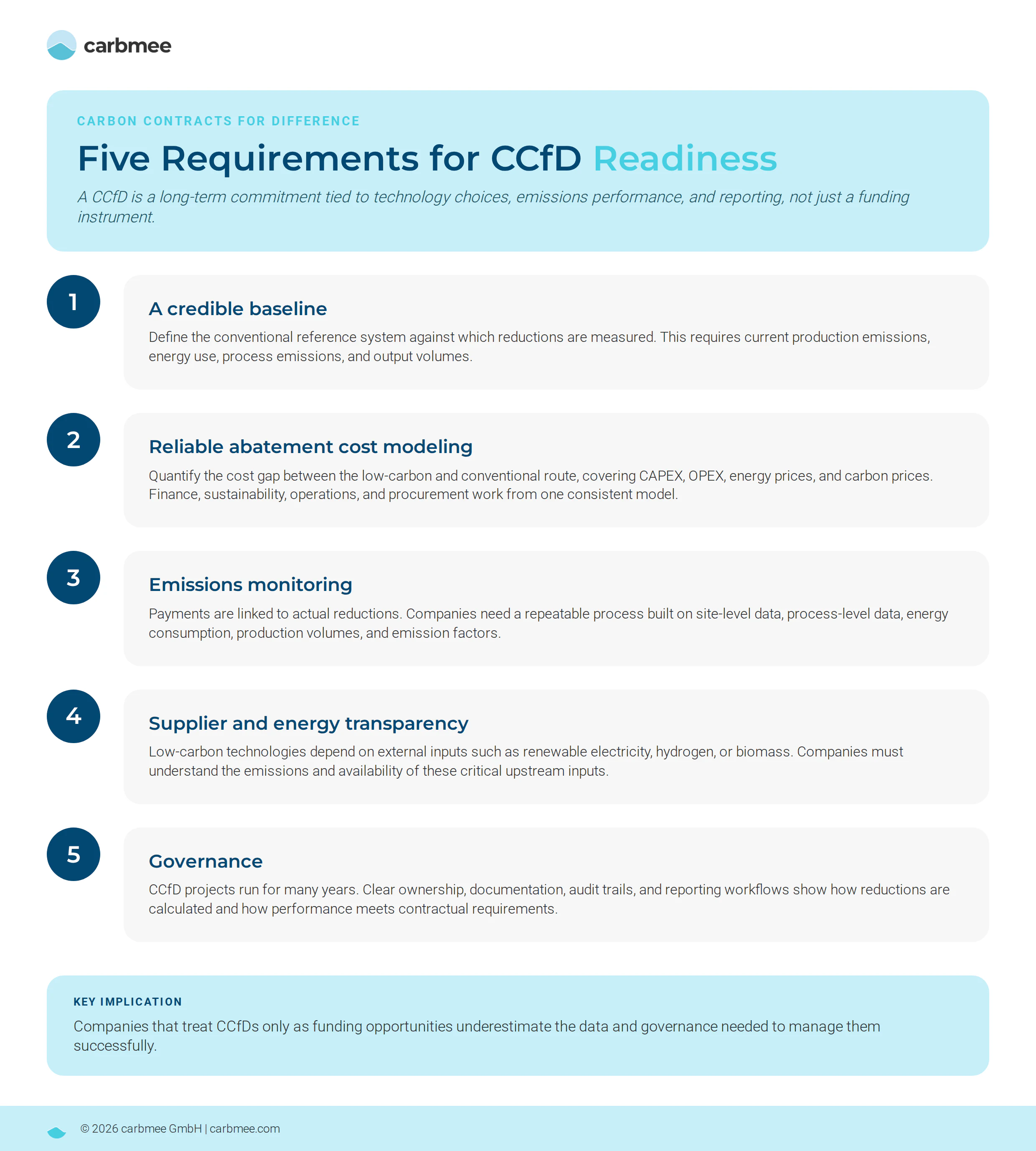
Carbon Contracts for Difference can create major opportunities, but companies need to understand the operational requirements behind them. A CCfD is not just a funding instrument. It is a long-term commitment tied to technology choices, emissions performance, reporting, and market assumptions.
The first requirement is a credible baseline. Companies need to define the conventional reference system against which emissions reductions are measured. This means understanding current production emissions, energy use, process emissions, output volumes, and relevant boundaries. A weak baseline can create problems later, especially if payments depend on avoided emissions.
The second requirement is reliable abatement cost modeling. Companies need to know the cost of the low-carbon production route compared with the conventional route. This includes capital expenditure, operating expenditure, energy prices, carbon prices, maintenance, yield impacts, and potential changes in material inputs. Finance, sustainability, operations, and procurement teams need to work from one consistent model.
The third requirement is emissions monitoring. Since CCfD payments are linked to actual reductions, companies need a repeatable process for tracking emissions performance over time. This includes site-level data, process-level data, energy consumption, production volumes, and emission factors.
The fourth requirement is supplier and energy transparency. Many low-carbon technologies depend on external inputs such as renewable electricity, hydrogen, biomass, captured carbon infrastructure, or lower-carbon materials. Companies need to understand not only their own site emissions, but also the emissions and availability of critical upstream inputs.
The fifth requirement is governance. CCfD projects can run for many years, so companies need clear ownership, documentation, audit trails, and reporting workflows. The organization must be able to explain how emissions reductions are calculated, how assumptions are updated, and how project performance compares with contractual requirements.
Turning Carbon Contracts for Difference Into Industrial Decarbonization
Carbon Contracts for Difference are becoming an important tool for accelerating industrial decarbonization, especially in Germany and the EU. They are designed to help companies invest in climate-friendly production processes by reducing the financial uncertainty created by volatile carbon prices, high technology costs, and immature green markets.
For energy-intensive industries, this can be transformative. CCfDs can support technologies such as hydrogen-based production, electrification, industrial heat pumps, carbon capture and storage, carbon capture and utilization, biomass-based processes, and other low-carbon production routes. They can also help create early supply of lower-carbon products, supporting green lead markets and helping downstream companies reduce product and Scope 3 emissions.
However, Carbon Contracts for Difference are not a shortcut around operational complexity. They require strong baselines, reliable emissions monitoring, clear reference systems, robust abatement cost calculations, and credible reporting. Companies that treat CCfDs only as funding opportunities may underestimate the data and governance needed to manage them successfully.
The companies best positioned to benefit will be those that already understand their emissions at an operational level. They will know which sites, products, processes, and inputs drive their footprint. They will be able to model abatement options, track realized reductions, and provide transparent data to customers, regulators, and funding bodies.
In that sense, Carbon Contracts for Difference are more than a policy mechanism. They are part of a broader shift from carbon reporting to carbon management. When combined with reliable emissions data, strong project governance, and clear industrial strategy, they can help turn ambitious decarbonization plans into investable, measurable, and scalable transformation.
How Carbmee Supports Companies Preparing for Carbon Contracts for Difference
For industrial companies, Carbon Contracts for Difference depend on reliable emissions data. Companies need to understand their baseline, abatement potential, product emissions, and operational drivers before they can confidently apply for, manage, or report against a CCfD.
Carbmee helps companies structure carbon data across sites, processes, suppliers, products, and reduction initiatives. This makes it easier to define credible baselines, identify suitable transformation projects, and estimate emissions reductions against a reference system.
For CCfD-supported projects, traceability is especially important. Companies need to show that reductions are real, measurable, and linked to the right operational data. Carbmee supports this by connecting carbon footprints, Scope 3 transparency, product carbon footprint data, and abatement tracking in one consistent carbon management process.
This helps companies move from one-time reporting to ongoing carbon management, giving teams a stronger foundation for funding readiness, stakeholder communication, and long-term decarbonization project tracking.