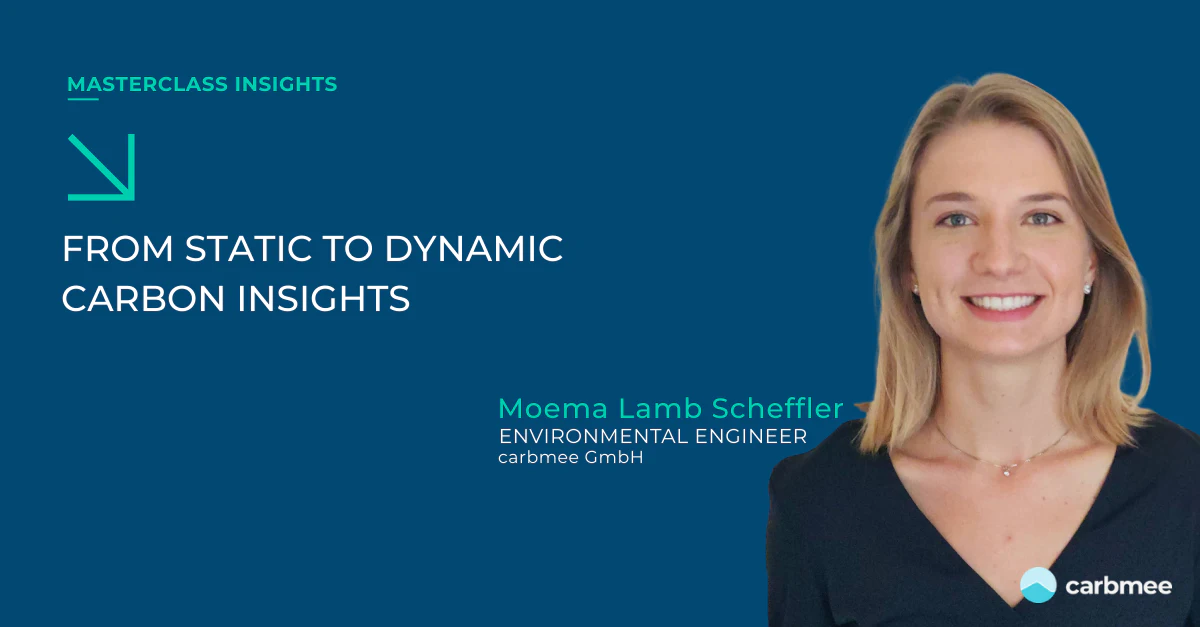
From Static to Dynamic Carbon Insights

The Limits of Static Carbon Calculations
What happens when carbon data stops being static and finally becomes dynamic?
Organizations gain the ability to shift from backward-looking estimates to real-time, strategic decision-making - grounded in accurate supplier data rather than assumptions.
Traditional carbon footprint assessments still rely heavily on spreadsheets, industry-average emission factors, and delayed supplier reporting. This approach creates major blind spots - especially in Scope 3, which represents up to 80% of total corporate emissions (LSEG, 2024). Static calculations provide a snapshot in time, but they cannot capture the continuous changes happening across supply chains.
As regulations such as CSRD, CBAM, and the EU ETS evolve, companies face rising expectations for transparency, auditability, and product-level accuracy. Still, data challenges remain widespread: in Sphera’s 2025 global survey, 62% of organizations reporting on Scope 3 identified internal data‑quality issues as a major barrier - and 79% cited supplier data availability as a top challenge (Sphera, 2025). This data gap makes it harder to meet compliance requirements and identify real reduction opportunities. Static or outdated data is no longer sufficient - or safe.
Connecting Supplier Data Directly to Decision-Making
Carbmee closes this gap by enabling companies to collect and validate primary supplier data directly within the platform. Through the integrated supplier engagement module, suppliers can upload verified PCFs or input primary activity data. Once approved, this information flows automatically into Scope 3.1 calculations and SKU-level PCFs.
This dynamic data infrastructure allows organizations to track emissions performance across suppliers, materials, and product lines with precision. Instead of generalized averages, teams work with real numbers that reflect real processes - enabling decisions grounded in fact, not estimation.
Dynamic Modeling and Scenario Analysis
Beyond real-time tracking, carbmee EIS™ provides advanced scenario modeling capabilities. Teams can simulate the impact of:
- switching to recycled or alternative materials
- supplier changes or production shifts
- renewable energy adoption
- efficiency improvements
These simulations quantify both carbon reduction potential and financial impact, helping teams prioritize the most effective actions.
Turning Insights Into Action
By shifting from static to dynamic carbon intelligence, companies unlock a scalable and fully transparent carbon management process. Real-time insights accelerate reduction initiatives, strengthen supplier collaboration, and reduce compliance risk - all while creating a clear view of emissions at SKU, supplier, and material level.
Peter Hagenow, Head of Strategic Group Procurement at KWS summarized the impact perfectly:
“For the first time, we were able to create complete transparency on our Scope 3 emissions for the data we integrated from our ERP system into carbmee and identified our highest emitting suppliers. This allowed us to prioritize collaboration with our suppliers in order to achieve greater precision and ultimately identify meaningful reduction potential together.”
Why Carbmee is the best solution
Carbmee provides the end-to-end infrastructure needed to manage emissions with financial-grade precision. By unifying supplier data, procurement transactions, and product structures in one system, carbmee EIS™ delivers real-time PCFs, automated compliance reporting, and actionable reduction pathways. Instead of estimating carbon footprints, companies can control them - transforming complex Scope 3 challenges into strategic advantages.