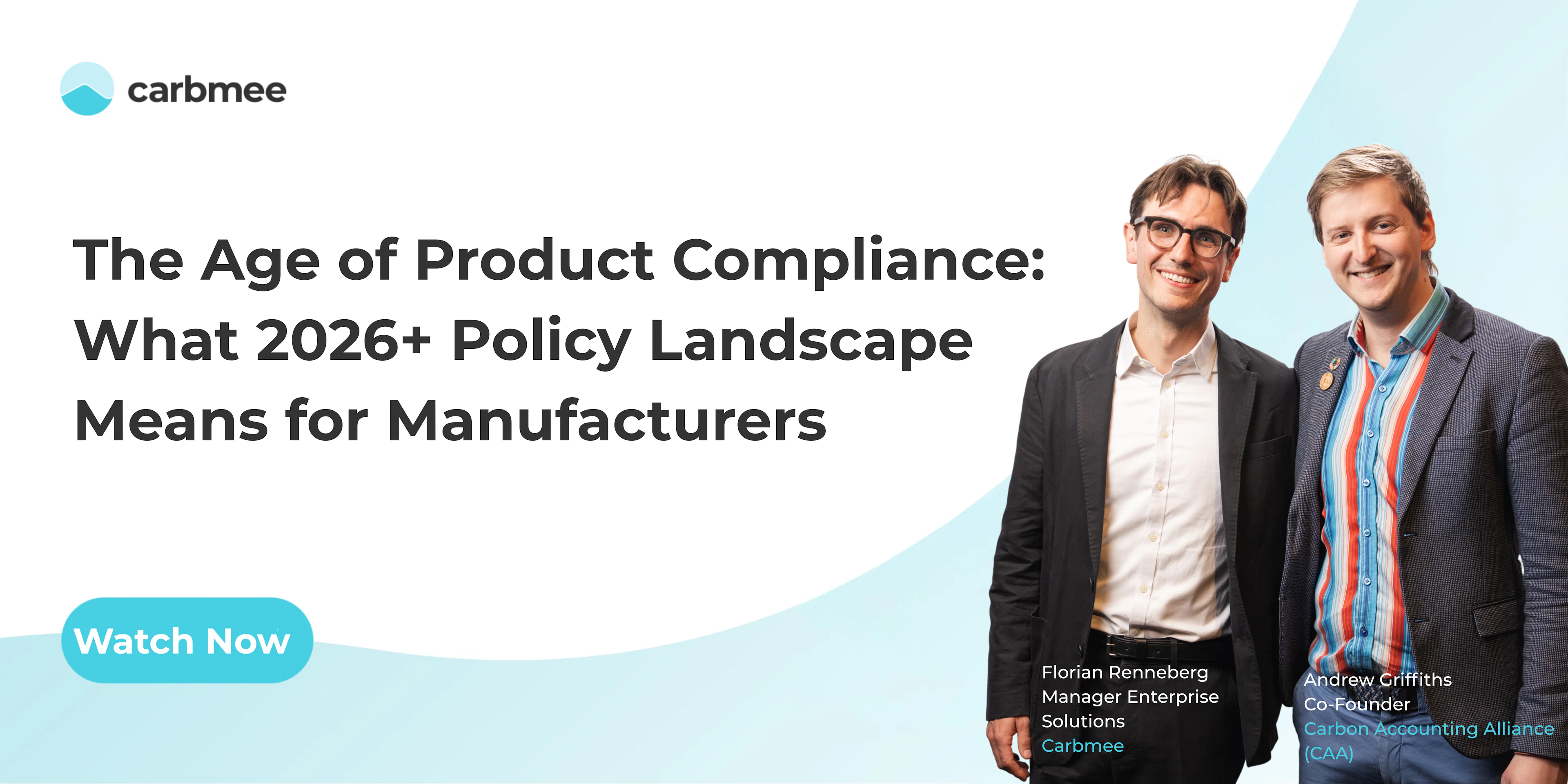
Fireside Chat: The Age of Product Compliance: What 2026+ Policy Landscape Means for Manufacturers
At the Global Decarbonization Forum 2026 in Berlin, Florian Renneberg, Manager Enterprise Solutions at carbmee and Andrew Griffiths, Co-Founder of the Carbon Accounting Alliance, sat down for a fireside chat that reframed the entire regulatory conversation. Not as a compliance burden to manage, but as a structural data problem to solve − once, at the right level, in the right foundation. Together they traced the full arc of the policy cascade, from international climate agreements all the way down to the SME supplier receiving a carbon data request from a customer for the first time, and made the case that the companies who build product-level data infrastructure now will not just stay compliant. They will stay ahead.


The Regulatory Cascade Is Real, and It Is Already Reaching Your Suppliers
Andrew opened with a framework that has become central to the Carbon Accounting Alliance's work: the policy cascade. It starts with international agreements like the Paris Climate Accord, flows down into national targets and regulations, lands on large corporates in the form of CSRD, ETS, and disclosure requirements, and then, unlike almost every other compliance wave before it, keeps going.
He drew a sharp contrast with modern slavery regulation. That cascade reached large corporates and largely stopped. Suppliers were asked for a policy statement. Nobody was asked for data. Scope 3 emissions are different. Because so much of a corporate's carbon footprint sits in its supply chain, companies have no choice but to turn to their suppliers and ask for real carbon data. The cascade does not stop at the large enterprise. It flows all the way through.
The numbers Andrew shared from a 2024 UK study of over 2,000 businesses made the point concrete. More than half of large businesses had been asked for carbon data by a customer in the previous 12 months. But so had 37 percent of medium-sized organizations and one in five small businesses, none of whom have any legal requirement to measure or disclose. And those numbers, Andrew was clear, are going up every single year.
The Geopolitical Noise Is Not the Signal
One of the most clarifying moments of the conversation came when Andrew addressed the narrative that businesses are stepping back from their sustainability commitments in response to geopolitical headwinds. His pushback was data-driven and direct. These claims are never based on data. They are based on individual examples, company by company, elevated into a trend. Meanwhile, the actual metrics − the number of companies disclosing through CDP, through EcoVadis, through any structured carbon measurement framework − are trending upward. Every single year. And the fundamental driver, Andrew argued, is not regulation. It is customers. Customers are asking for carbon data. That demand does not go away because of a political cycle. It accelerates because of physical climate reality that people are experiencing in their daily lives regardless of what any government is telling them.
The Problem With Corporate-Level Data Alone
Florian brought the conversation from the regulatory landscape into the operational reality that manufacturers face every day. And the core problem he identified is one that most companies have not yet fully confronted: corporate-level carbon data, however well measured, cannot solve product-level compliance requirements. You cannot un-bake a cake.
A CSRD report cannot tell you your CBAM exposure at the product and shipment level. A spend-based scope 3 calculation cannot tell you which of your suppliers to prioritize to reduce your Q1 2026 CBAM certificate cost, now confirmed at 75 euros per certificate. A GHG accounting total cannot tell you whether a specific product shipment to the US is exposed to a Section 232 tariff or what your EUDR reporting obligation looks like for a given SKU.
The regulatory landscape that is arriving is not corporate in nature. It is product in nature. Tariffs hit at the shipment level. CBAM hits at the product and supplier level. EUDR penalties, up to 3 percent of annual turnover for non-compliance, hit at the product reporting level. Digital product passports will require product-level traceability as standard. And none of that can be derived from the top-down corporate data model that most companies have spent the last five years building.
Bottom-Up Is Not More Work. It Is Less.
The reframe Florian offered was one of the most practically important of the day. The instinct for most companies is to see product-level data as an additional layer of complexity on top of what they already have. A new project. A new workstream. Another consultant, another report, another three to six months of effort.
The reality, he argued, is the opposite. If you build the data foundation at the product and SKU level first − connecting material specifications, supplier data, shipment-level information, and procurement transactions into a single dynamic model − you do not need to launch a new project every time a new regulation arrives. The data is already there. CBAM compliance becomes an output, not a project. EUDR reporting becomes an output. CSRD scope 3 data becomes an output. The pareto principle applies: identify the hotspots, connect the data that already exists across your ERP, your PLM, and your bill of materials, and then extend from there.
The Power of Asking the Question
For companies wondering where to start with supplier engagement, Andrew´s answer was disarmingly simple: just ask the question. You do not need ultimatums. You do not need a fully developed supplier carbon program. You just need to ask whether a supplier has carbon data they can share. Because when one customer asks, and another asks, and another asks, the supplier is going to get that data.
The question itself is the intervention. He illustrated the point with an example that has stayed with him across years of conversations with CEOs: graduate students asking questions about a company's sustainability strategy in job interviews had been meaningfully changing board-level strategy at large organizations. Someone who does not yet work at the company, influencing executive decisions, because they asked a question. The same dynamic is operating across supply chains, customer relationships, and talent pipelines simultaneously.
Aligning Incentives From Board to Buyer
The conversation closed with a question from the audience about organizational structure − which teams, which roles, which setups are most successful at making the transition from top-down to bottom-up data. Both speakers converged on the same answer: it is less about structure and more about incentive alignment.
Florian's recommendation was to give more operational power to the people who are closest to the data − procurement teams, supply chain managers, the people who sit on both the cost and the carbon content of every purchasing decision. Corporate strategy has a role: to inform, to signal upcoming regulation early enough for the operational teams to respond. But the action happens on the ground. And when the operational people take ownership, the bottom-up data foundation becomes possible. Without that, companies end up exactly where most find themselves today: CSRD report delivered, product-level compliance still a reactive scramble.
Andrew's framing was the one that brought it together. You manage what you measure. The moment you measure something, human behavior changes around it. Organizations that have gotten measurement, targets, and plans in place for carbon − and then aligned procurement incentives to reflect those targets − are the ones already pulling ahead. The ones waiting for someone to force them are going to find, as Andrew put it, that the tide goes out and there are no swimming shorts to be found.
carbmee EIS™: From Regulatory Cascade to Product-Level Control
The data foundation Florian described − dynamic, SKU-level, connected across procurement, supply chain, and compliance − is what carbmee EIS™ is built to deliver. Purpose-built for large industrial manufacturers navigating a regulatory environment that is product in nature, not just corporate, carbmee EIS™ helps organizations:
Collect and centralize environmental data across operations and supply chains.
Connect ERP, PLM, MES, and procurement systems in a single data model.
Identify emission hotspots and reduction opportunities with AI-powered analytics.
Streamline supplier collaboration and primary data collection at scale.
Ensure compliance with CBAM, ESRS, LCA, and EUDR from one platform.
Whether your priority is CBAM cost visibility, EUDR traceability, or building the product-level data foundation that makes every future regulation an output rather than a project, carbmee EIS™ provides the infrastructure to get there, without starting from scratch every time the regulatory landscape shifts.