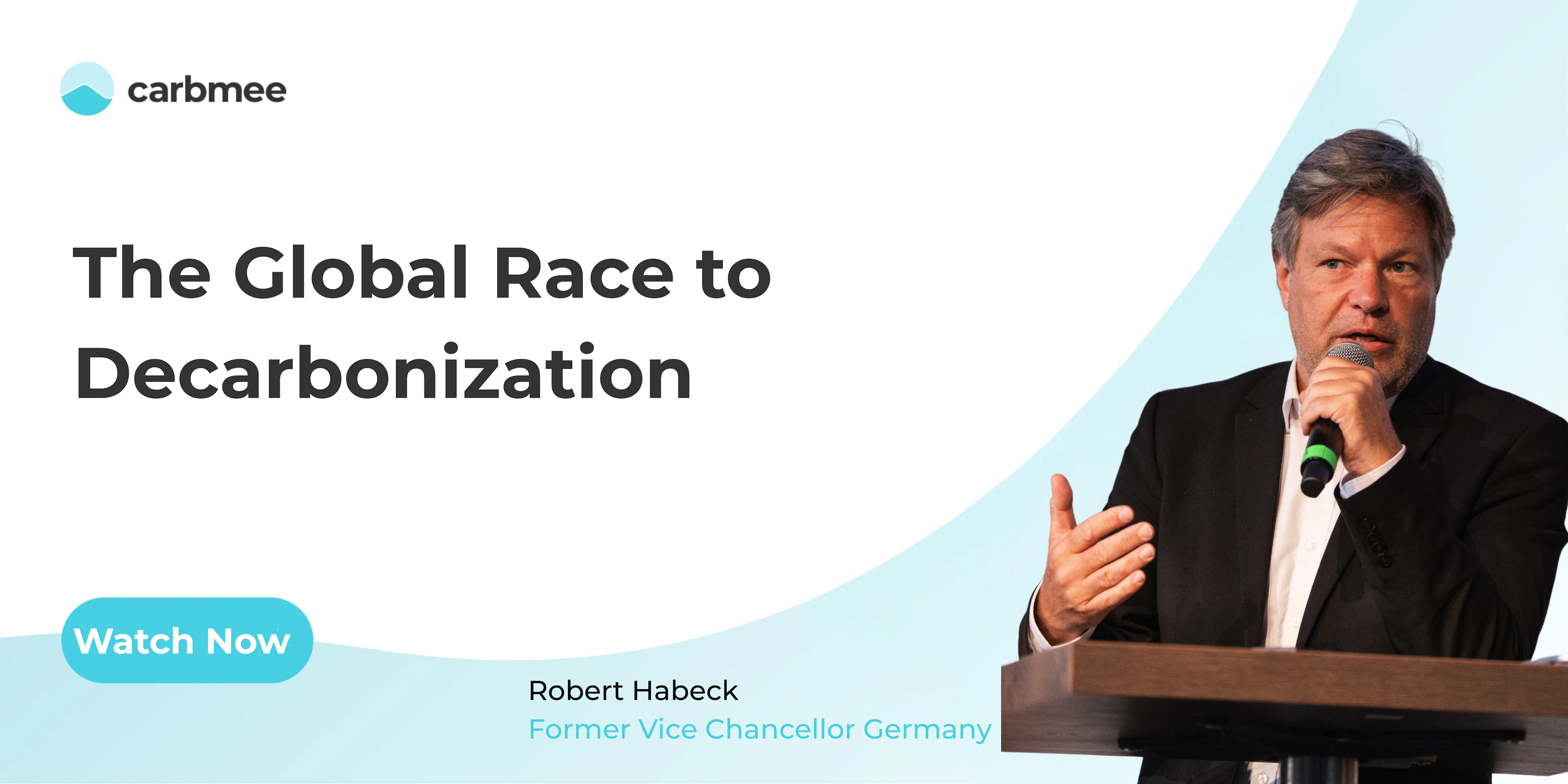
The Global Race to Decarbonization
At the Global Decarbonization Forum 2026 in Berlin, Dr. Robert Habeck, former Vice Chancellor of Germany, took the stage for a wide-ranging conversation on the forces reshaping the global energy landscape. His perspective was shaped not only by four years at the center of Europe's most consequential energy crisis in decades, but by the outside view that only distance from office can provide. What emerged was a clear-eyed assessment of where the transition stands, where the real risks lie, and why the conditions for decisive action are shifting faster than most businesses and politicians realize.


A World in Flux and Who Is Winning
Dr. Habeck opened with a frank assessment of the current geopolitical moment. The beneficiaries of today's instability, he argued, are clear: China, which has positioned itself as the dominant producer of the industrial goods the energy transition requires, batteries, solar panels, and the manufacturing capacity behind them, and to a lesser extent Russia, which benefits from elevated oil prices in the short term.
But the more important story is what is happening everywhere else. Roughly 150 countries are net energy importers. For all of them, the repeated shocks of recent years − the war in Ukraine, the current crisis in Iran, the exposure of global LNG markets as unreliable − are making the same argument with increasing force: dependency on fossil energy markets is not a strategy. Electrification and renewable energy are not just climate choices. They are security choices, economic choices, and increasingly the only choices that make sense.
The Crisis Cycle and Why This Time Is Different
Dr. Habeck addressed the uncomfortable pattern that runs through the history of the energy transition: societies tend to act decisively only when crisis forces them to, and then forget once the immediate pressure eases. He was candid about the limits of this dynamic and about why he believes the current moment may break the cycle. The growth of electric vehicles tells part of the story. Five years ago, global EV sales sat at around five percent. Last year they exceeded twenty-five percent of all new private vehicles sold. This year the estimate is above thirty and that was before the latest geopolitical escalation. The trajectory, Dr. Habeck argued, is now largely self-reinforcing. The more EVs are bought, the more the market shifts. The more the market shifts, the harder it becomes to reverse. This is not a trend that will unwind when the political weather changes.
India, CBAM, and the Proof of the Pudding
Perhaps the most striking data point in the conversation was Dr. Habeck's account of India's position on CBAM. For years, India was among the fiercest opponents of the carbon border adjustment mechanism, a position its trade minister pursued aggressively in international forums. The European Union's recent free trade agreement with India changed that entirely. CBAM is now accepted. No postponements, no carve-outs.
For Dr. Habeck, this is the proof of the pudding. When India, one of the world's largest and most vocal critics of European carbon regulation, accepts CBAM as a condition of deeper trade integration with Europe, it signals something important: the mechanism has enough economic gravity to override political resistance. And if it works with India, the logic will extend. The trickle-down effect to other developing economies, Dr. Habeck argued, is now a matter of when, not if.
The United States: What the Numbers Actually Show
In the United States, Dr. Habeck drew a sharp distinction between the Trump administration's political posture and what is actually happening in the American economy. Renewable energy is growing in the US − not despite the current political environment, but because the underlying economics are too compelling to ignore. California is building renewables because it wants to do the right thing. Texas is building them because it can do the math. And the explosion of data centre demand is accelerating the process further, as hyperscalers reach for the fastest and cheapest source of power available.
The political noise, Dr. Habeck suggested, should not be mistaken for the economic reality. Companies with operations in the US are not waiting for political permission. They are acting on the numbers. And the numbers are moving in one direction.
What Europe Must Do and What German Industry Faces
Dr. Habeck was direct about the challenge facing European and specifically German industry. Germany's economic model − built on exports, precision manufacturing, and the assumption of open global markets − is under pressure from multiple directions simultaneously. The industrial base for the energy transition, from batteries to solar, has largely been captured by China. Digitalization is being driven from the US. And the old model of integrating deeply into global supply chains without owning the underlying technology is no longer a reliable path to growth.
His argument was not defeatist. The data that exists inside European industrial companies, accumulated over decades of manufacturing, procurement, and supply chain management, represents a genuine competitive asset if it can be mobilized. The companies that figure out how to use that data, connect it, and act on it are the ones with the best chance of finding their place in the next industrial era.
The Political Pendulum and Why Climate Will Come Back
Dr. Habeck closed with a perspective that will resonate with anyone who has watched the political mood around climate and sustainability shift over the past two years. The pendulum, he argued, is already swinging back. Climate demonstrations are returning to the streets of European cities. In local and national elections across Europe, climate is re-emerging as a live political issue. The conclusion that voters have turned away from climate action permanently, he suggested, confuses a moment of political exhaustion with a structural shift in public values.
His prediction: within six months, climate will be back on the agenda in Germany and across Europe. The bridging argument, that energy security and decarbonization point in the same direction, has done its work. The task now is to make sure the business and policy infrastructure is ready for when that moment arrives.
carbmee EIS™ and the Infrastructure for What Comes Next
The imperatives Dr. Habeck described, data mobilization, supply chain transparency, and the ability to act on product-level carbon exposure, require infrastructure. carbmee EIS™ is the environmental intelligence platform purpose-built for large industrial companies navigating exactly this environment. From data ingestion to audit-ready reporting, carbmee EIS™ helps organizations:
Collect and centralize environmental data across operations and supply chains.
Connect ERP, PLM, MES, and procurement systems in a single data model.
Identify emission hotspots and reduction opportunities with AI-powered analytics.
Streamline supplier collaboration and primary data collection at scale.
Ensure compliance with CBAM, ESRS, LCA, and EUDR from one platform.
Whether your priority is CBAM cost visibility, Scope 3 accuracy, or audit-ready ESRS reporting, carbmee EIS™ provides the infrastructure to move from strategy to action, without a five-year implementation.