Sustainable Sourcing Under Pressure: Using Carbon Cost Forecasts to Drive Smarter Procurement
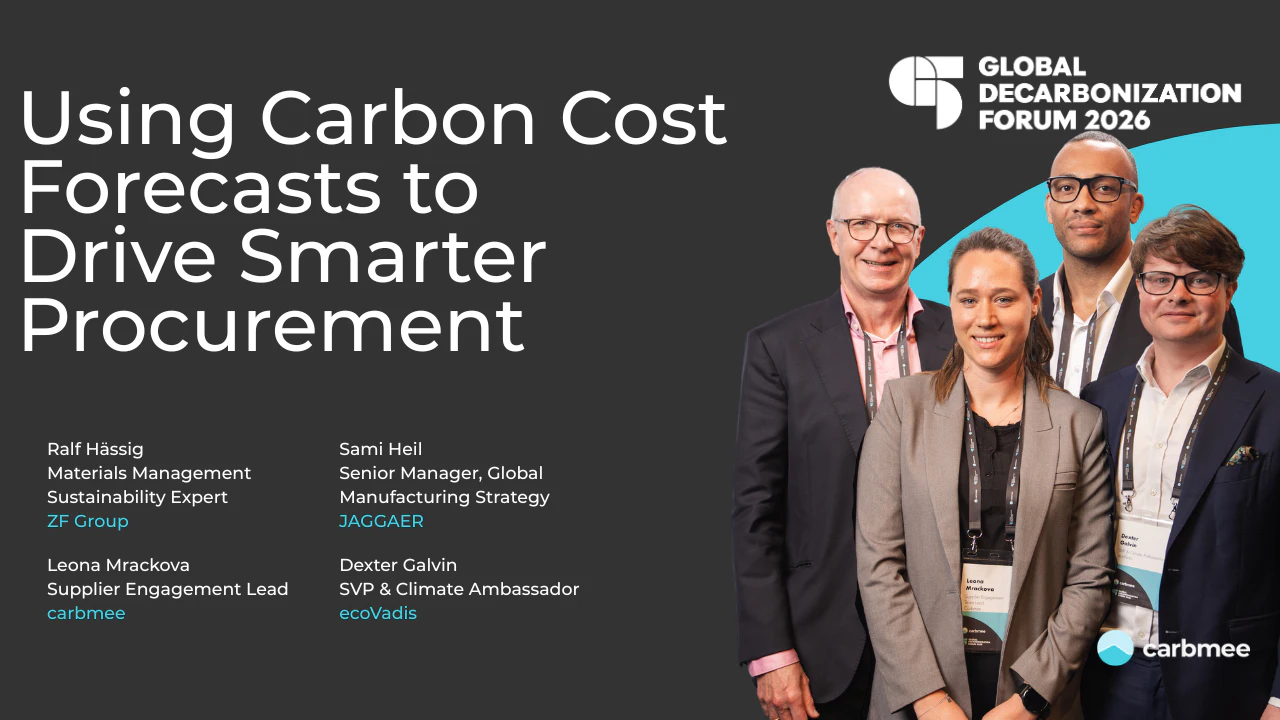
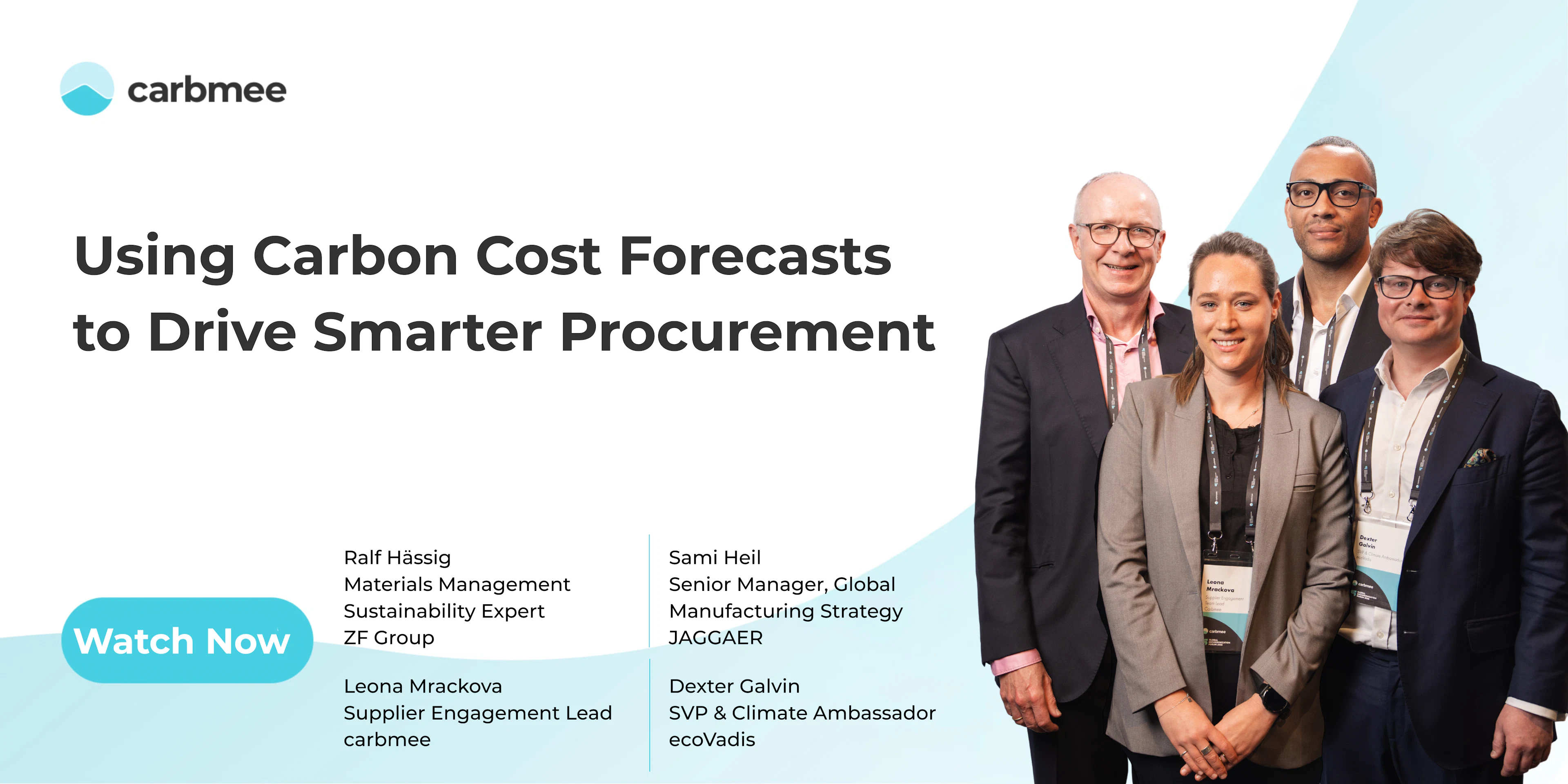
At the Global Decarbonization Forum 2026 in Berlin, Ralf Hässig (ZF Friedrichshafen), Leona Mrackova (carbmee), Dexter Galvin (EcoVadis), and Sami Heil (Jaggaer) took the stage for a panel conversation that cut through the complexity of sustainable sourcing and arrived at a single, uncomfortable truth: the carbon costs are not coming. They are already there. Most procurement organizations simply do not have the visibility to see them yet, and that invisibility is becoming a financial liability.
The Energy Crisis Made the Business Case Impossible to Ignore
Dexter opened with a number that reframed the entire conversation. In the first days of the most recent Iran conflict, retail gas prices in Europe rose by 60 percent. For one large chemicals company with roughly 80 percent of its emissions sitting in its supply chain, Dexter modeled the impact: $3.2 billion in increased supply chain costs from a single energy crisis. Had that company deployed renewables across 30 percent of its supplier base, it would have saved a billion dollars. At 60 percent, the saving approached $1.9 billion. This is not an ESG argument. It is a procurement argument. Energy spend is embedded in every supplier's cost structure. If suppliers are not managing it, the exposure travels upstream, quietly, invisibly, and at scale. The starting point is not perfection. It is measurement.
You Cannot Make a Decision You Cannot See
Sami drew a direct line from his own experience managing manufacturing sites during COVID to the procurement reality most organizations are still living in. At the time, the metrics were price, quality, and lead time. Carbon was invisible. Energy exposure was invisible. Supply chain resilience was invisible, until it wasn't. The shift carbmee represents, in his framing, is the move to procurement 2.0: transactional, activity-based carbon insights available at the material level, in a single day. Not a consulting project. Not a multi-year implementation. A live data foundation that gives buyers the visibility to make decisions that account for what is actually coming, not just what has already arrived.
Translating CO2 Into the Language Finance Actually Speaks
The most practically charged part of the conversation came from Ralf, who walked through how ZF Friedrichshafen approached the challenge of integrating carbon into sourcing decisions, not as a bonus model or a shadow price experiment, but as a genuine input to net present value calculations.
The insight was precise. Buyers cannot think in CO2. They think in cost. And the internal carbon pricing experiments most companies have tried − attaching a small bonus to lower PCF scores − have produced values far too low to change a single sourcing decision. The numbers simply do not move the needle. What does move the needle is translating carbon exposure into projected future cost. Taking a steel stamping part, modeling the production route, applying a carbon price forecast, and showing the finance VP not what carbon costs today but what it will cost over the lifecycle of a sourcing contract. At that point, the green steel option that looks slightly more expensive at start of production can flip, and the organization starts to see why paying more now is the cheaper decision over time. That is the moment, Ralf noted, when the finance community stops treating carbon as an ESG topic and starts treating it as a business input.
Bringing Suppliers On Board Without Letting Complexity Kill Momentum
Leona brought the supplier perspective into focus, and with it, one of the most important reframes of the session. Most supplier engagement conversations are framed around what the buying company needs. Data. Compliance. Verification. But the suppliers sitting across the table are companies too, and they have their own question: what is in it for us?
The answer is increasingly concrete. Suppliers with verified primary emissions data are becoming more competitive on the market. They can access global importers. They can demonstrate CBAM readiness. They are the partners that large industrials will prioritize as the regulatory environment tightens. Making that business case visible, not just asking for data, but showing suppliers why the investment in carbon transparency is a commercial advantage, is what separates supplier engagement programs that stall from ones that scale.
She also highlighted the internal work that has to come first. Suppliers can tell immediately whether a carbon initiative has genuine management buy-in or whether it is another corporate checkbox exercise. The preparation, the process, the cultural readiness to engage suppliers in their own language and at their own level of maturity − that work has to happen before the first supplier conversation, not during it.
How Much Data Is Enough to Start?
One of the sharpest exchanges of the panel came when the question of data quality was put on the table directly. Dexter was honest: company-level carbon data today is, in many cases, seriously unreliable. Scope three reduction targets set against estimates that are now 30 to 40 percent off are not targets, they are guesses. That needs to be acknowledged.
But Ralf pushed back on the conclusion that imperfect data is a reason to wait. His argument was precise and worth sitting with. For a stamping part made from flat steel, sourced from a European supplier, the variation between the European average emission factor and the mill-specific number is small. The variation in the carbon price forecast out to 2035 is enormous. The error in the estimate is not what will drive a wrong decision. Waiting for perfect data while carbon costs compound in the supply chain, that is the wrong decision.
The principle the panel landed on was clear: enough data to identify hotspots, make informed decisions, and start moving is available today. The pursuit of perfection should not be allowed to become the enemy of progress.
Carbon Belongs in Product Design, Not Just Procurement
Sami closed with a dimension the panel had not yet addressed, and one that changes the scale of the opportunity entirely. Analysts estimate that 70 to 80 percent of a product's costs are locked in during the design phase. If carbon data, regulatory exposure, and supplier emissions intelligence are not integrated at the point of new product introduction, the window to influence the largest share of long-term cost has already closed. The companies that bring carbon into design, not just sourcing, will build structurally different supplier relationships. Not transactional ones, but genuine partnerships built around shared investment in lower-carbon production. That is the lever that turns sustainable sourcing from a compliance function into a competitive advantage.
carbmee EIS™: The Data Foundation for Smarter Procurement
The capabilities the panel described − transactional carbon visibility, supplier collaboration at scale, carbon cost forecasting, and product-level emissions modeling − are core to carbmee EIS™, carbmee's environmental intelligence platform built for large industrial companies. From data ingestion to audit-ready reporting, carbmee EIS™ helps organizations:
Collect and centralize environmental data across operations and supply chains.
Connect ERP, PLM, MES, and procurement systems in a single data model.
Identify emission hotspots and reduction opportunities with AI-powered analytics.
Streamline supplier collaboration and primary data collection at scale.
Ensure compliance with CBAM, ESRS, LCA, and EUDR from one platform.
Whether your priority is CBAM cost visibility, scope 3 accuracy, or equipping your procurement team with the carbon intelligence to make better sourcing decisions today, carbmee EIS™ provides the infrastructure to make it happen, without a five-year implementation.